History, Art and Culture
Somnath Swabhiman Parv (1026-2026):
-
- Context: Recently, the Prime Minister marked 1000 years since the first attack on Somnath (1026 AD) as Somnath Swabhiman Parv.
- Somnath Swabhiman Parv commemorates a millennium since the first invasion of Somnath, celebrating India’s unbroken faith, cultural resilience, and civilisational pride.
- Cultural significance: Somnath symbolises the enduring spirit of Bharat, where repeated destruction failed to erase religious faith.
- It represents resistance, cultural continuity, and national self-respect rooted in shared heritage.
- About somnath temple:
- Somnath Temple is one of Hinduism’s most sacred shrines and a major pilgrimage site located at Prabhas Patan near Veraval, on Gujarat’s western coast.
- Diety: Lord Shiva.
- It houses the first of the 12 Jyotirlingas, regarded as self-manifested forms of Shiva.
- Sacred Geography: Triveni Sangam of Kapila, Hiran, and Saraswati rivers, enhancing its ancient spiritual significance.
- Origin: Somnath’s first temple is said to have existed 2000 years ago.
- Attacks and Destruction: Somnath faced repeated destruction from Mahmud Ghazni (1026 AD) to Delhi Sultanate invasions and Aurangzeb (1706) making it a symbol of resilience.
- Before that Arab governor of Sindh, Al-Junayd ibn Abd al-Rahman al-Murri, attacked and destroyed the second Somnath Temple in Gujarat around 725 CE.
- Reconstruction: In 649 AD, King Maitre of Vallabhini built a second temple in place of the temple and renovated it.
- In 815 AD, Pratishtha King Nag Bhatt II constructed the temple for the third time using a red stone (sandstone).
- During 1026-1042 AD, Solanki Raja Bhimdev built the fourth temple of Bhoj and Anhilwad Patan, Parmar King of Malwa.
- In 1782, Maratha queen Ahalyabai Holkar built a small temple at the site.
- After India’s independence, those ruins were demolished and the present Somnath temple was reconstructed in the Māru-Gurjara style of Hindu temple architecture in 1951.
- Māru-Gurjara style is marked by a curvilinear shikhara, ornate mandapas, high plinths, and intricate carvings.
(IE+HT)
Geography and Environment
Double-Humped Bactrian Camel:
-
- Context: Ladakh’s double-humped Bactrian camels are set to debut at the 77th Republic Day parade.
- Bactrian camel (Camelus bactrianus) is characterised by two humps (fat storage, not water).
- Native to cold desert regions of Central Asia; in India, found only in Ladakh (Nubra Valley).
- Highly adapted to extreme cold, low oxygen and scarce vegetation.
- Plays a key role in local livelihoods (transport, tourism) in Ladakh.
- Conservation status:
-
-
- Wild Bactrian camel – Critically Endangered (IUCN)
- Domestic Bactrian camel – population declining in India
- In India, it is listed under Schedule I of the Wildlife (Protection) Act, 1972.
-
-
- In 2024, the “Ladakh Double-Humped Camel” received a Geographical Indication (GI) tag.
- The GI tag aims to:
-
-
- Protect the unique genetic identity
- Support pastoral livelihoods
- Promote sustainable tourism and conservation
-

(IT)
Popocatépetl Volcano:
-
- Context: a team of scientists obtained the first 3D images from inside Mexico’s Popocatépetl volcano.
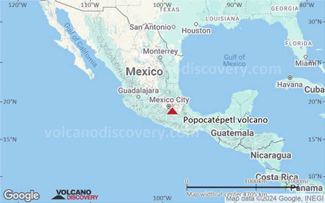
- Popocatépetl is an active stratovolcano located in central Mexico.
-
- Lies within the Trans-Mexican Volcanic Belt (a zone of intense tectono-volcanic activity).
- Situated close to major cities like Mexico City and Puebla, making eruptions highly hazardous.
- Height: ~5,426 m, second-highest peak in Mexico after Pico de Orizaba.
- Eruptive style: Explosive, producing ash plumes, lava domes, and pyroclastic flows.
- Tectonic setting: Formed due to subduction of the Cocos Plate beneath the North American Plate.
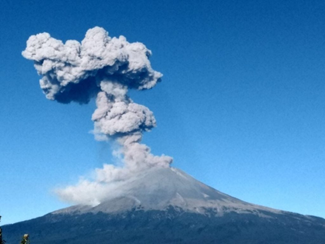
- Popocatépetl has shown frequent eruptive activity in recent years (2023–25) with:
-
-
- Ash emissions
- Aviation alerts
- Evacuations and closure of nearby areas
- Highlighted issues:
- Volcanic risk management
- Disaster preparedness in densely populated regions
- Often cited in geography questions related to:
- Ring of Fire vs non-Ring volcanoes
- Subduction-zone volcanism
-
(TH)
Socotra Island:
-
- Context: Hundreds of tourists are stuck on the Yemeni island of Socotra after flights were grounded over clashes on the mainland.
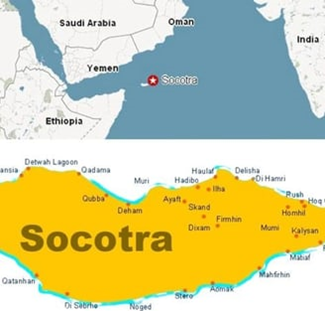
- Socotra Island lies in the Arabian Sea, near the Gulf of Aden.
- Politically part of Yemen, though geographically closer to the Horn of Africa.
- Known as the “Galápagos of the Indian Ocean” due to very high endemism.
- About one-third of plant species are endemic (e.g., Dragon’s Blood Tree).
- Inscribed as a UNESCO World Natural Heritage Site (2008).
- Climate: Arid–semi-arid, influenced by monsoon winds.
- Strategic location near major global shipping lanes connecting the Indian Ocean and Red Sea.
(IE)
Science and Technology
Spina Bifid:
-
- Context: In news because many countries across the world have initiated programmes to create awareness to prevent Spina Bifida through folic acid supplementation.
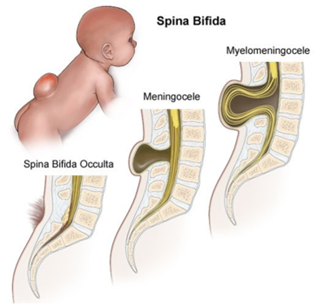
- Spina bifida is a congenital neural tube defect (NTD) in which the spinal cord and vertebral arches do not close completely during early embryonic development.
- Occurs within the first 28 days of pregnancy, often before a woman knows she is pregnant.
- Strongly associated with folic acid deficiency in the mother.
- Types include:
- Spina bifida occulta (mild, hidden)
- Meningocele
- Myelomeningocele (most severe)
- Can lead to paralysis of lower limbs, bladder and bowel dysfunction, hydrocephalus, and learning difficulties.
- Preventable to a large extent through adequate folic acid intake before and during early pregnancy.
- Public health relevance in India due to:
- Maternal malnutrition
- Low awareness of preconception care
- Linked to SDG-3 (Good Health and Well-being) and maternal–child health programmes.
(TH)
Notifiable Diseases:
-
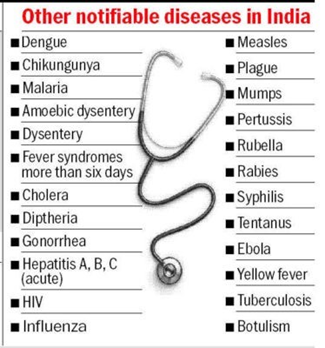
- Context: The Delhi government is set to declare rabies a notifiable disease to strengthen disease surveillance.
- Notifiable diseases are diseases that must be reported to government authorities by healthcare providers under law.
- Objective:
- Early detection
- Surveillance
- Prevention of outbreaks
- Reporting enables:
- Contact tracing
- Quarantine/isolation measures
- Evidence-based public health response
- In India, notification is governed mainly under:
- Epidemic Diseases Act, 1897
- Disaster Management Act, 2005 (during pandemics)
- Examples (India):
- Tuberculosis (TB) – mandatorily notifiable
- COVID-19
- Cholera, Plague, Dengue (state-specific lists)
- Lists of notifiable diseases vary from State to State (public health is a State subject under the Constitution).
- COVID-19 pandemic highlighted the importance of disease notification and real-time surveillance.
- TB notification (including from private healthcare providers) is a key pillar of India’s TB Elimination Programme (target: 2025).
- WHO and India increasingly emphasise Integrated Disease Surveillance Programme (IDSP) and the One Health approach for zoonotic and emerging diseases.
(TH)
Recirculatory Aquaculture System (RAS):
-
- Context: The Union Minister for Fisheries, Animal Husbandry and Dairying is set to inaugurate India’s first commercial-scale tropical Recirculatory Aquaculture System (RAS) based Rainbow Trout Aquaculture Farm & Research Institute in Hyderabad, Telangana.
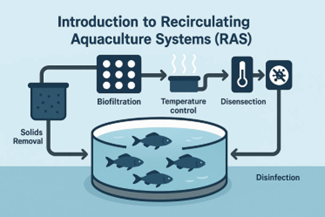
- A Recirculatory Aquaculture System (RAS) is a land-based, closed-loop aquaculture system in which water from culture tanks is continuously treated and reused, allowing intensive fish farming with minimal freshwater use and controlled environmental conditions.
- RAS is different from flow-through systems, where water is used once and discharged. In RAS, water is treated and reused multiple times.
- The system continuously recycles water after treatment, resulting in 90–99% water reuse and significantly reducing dependence on freshwater resources.
- Species cultured:
- Food fish: Tilapia, Catfish, Salmon, Trout, Barramundi
- Others: Shrimp, Prawns, Ornamental fish
(IE)
Defence and Security
Suryastra Rocket System:
-
- Context: Recently, the Indian Army has signed a ₹293 crore contract with private defence manufacturer NIBE Limited, in collaboration with Israel, for the supply of suryastra rocket launcher system.
- Suryastra is an indigenous precision-guided rocket system developed in India.
- It is a 122 mm guided rocket, compatible with BM-21 Grad–type multi-barrel rocket launchers (MBRLs).
- Designed to enhance the Indian Army’s artillery precision strike capability.
- Equipped with guidance and control kits, significantly improving accuracy (reduced Circular Error Probable – CEP) compared to unguided rockets.
- Can engage enemy targets at longer ranges with greater lethality and reduced collateral damage.
- Aligns with Atmanirbhar Bharat and indigenisation of artillery systems.
- Suryastra rockets were successfully tested by DRDO/Indian Army in recent trials (2024–25).
- The tests validated:
- Enhanced range
- High accuracy
- Compatibility with existing launcher systems
- Seen as a cost-effective upgrade over legacy rocket artillery and a step towards precision warfare, similar to global trends (GMLRS-type systems).

(TH)
Spread the Word