
Geography, Mapping, Ecology & Environment
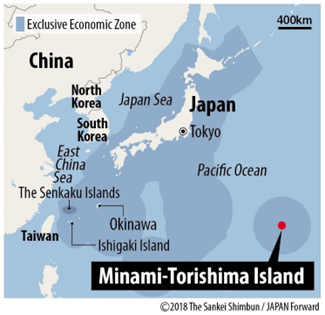
Minamitori Island:
-
- CONTEXT: Japan plans test mining of rare earths by 2026 to reduce dependence on China-dominated supply chains.
- Location: Japan’s easternmost island in the North-West Pacific Ocean, ~1,900 km southeast of Tokyo.
- Geographical nature: A coral atoll, uninhabited by civilians; only meteorological, coast guard and defence personnel stationed.
- Administrative status: Part of Tokyo Metropolis (Ogasawara Sub-prefecture).
- Strategic importance: Extends Japan’s Exclusive Economic Zone (EEZ) deep into the Pacific under UNCLOS.
- Resource significance: Seabed around the island contains rare earth-rich mud (neodymium, dysprosium, etc.).
- International dimension: Japan-US cooperation for critical mineral security in the Indo-Pacific.
- Security Aspect: Proposed missile testing / defence infrastructure, enhancing Japan’s maritime deterrence.
(TH)
Science & Technology
Frequency comb:
-
- A frequency comb is a special kind of laser light whose spectrum, or set of frequencies, resembles the teeth of a comb.
- Instead of containing just one colour (one frequency), it emits a large number of evenly spaced frequencies. The spacing is extremely regular.
- One way to make a frequency comb is using a mode-locked laser that emits very short pulses of light, repeating again and again at a steady rate.
- A frequency comb is useful because it lets scientists compare an unknown light frequency to a stable reference with extraordinary precision.
- Say you have some mystery light, e.g. light produced by a new laser that you have built, and you need to find out its exact frequency. You can shine the new laser light and light from a frequency comb on a common light sensor.
- Application: Frequency combs are an important modern tool to calibrate atomic clocks and measure shifts in light caused by gravity.

(TH)
Defence & Security
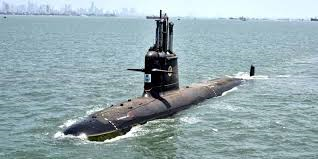
INS VAGHSHEER:
-
- CONTEXT: The President of India, Smt. Droupadi Murmu, undertook a submarine sortie aboard INS Vaghsheer on the Western Seaboard at Karwar Naval Harbour, Karnataka on 28 December 2025.
- Significance:
- This was a maiden submarine sortie by the President on an indigenous Kalvari-class submarine, reflecting continued engagement with the Armed Forces in operational settings.
- The President is the second head of state after Dr. A.P.J. Abdul Kalam to take such a submarine sortie.
- Class & Project:
- INS Vaghsheer (S26) is the sixth and final submarine of the Kalvari-class, built under Project 75 based on the French Scorpene® design. Naval Group
- Builder & Commissioning:
- Built by Mazagon Dock Shipbuilders Limited (MDL) with technology transfer from Naval Group, France.
- Launched on 20 April 2022 and commissioned on 15 January 2025 into the Indian Navy.
- Design & Capabilities: A diesel-electric attack submarine designed for multiple missions:
- Anti-surface warfare (ASuW)
- Anti-submarine warfare (ASW)
- Intelligence gathering
- Area surveillance
- Special operations
- Equipped with wire-guided torpedoes, anti-ship missiles and advanced sonar systems.
- Strategic Role:
- Enhances India’s undersea combat capabilities and contributes to maritime security in the Indian Ocean Region (IOR).
- Represents success of indigenous naval construction and Make-in-India (technology absorption and local systems integration).
(TH+PIB)
Personalities in news
Sri Guru Gobind Singh Ji:
-
- CONTEXT: On 27 December 2025, PM Modi, paid homage to Sri Guru Gobind Singh Ji on the occasion of his Parkash Utsav (sacred birth anniversary).
- PM described Sri Guru Gobind Singh Ji as an embodiment of courage, compassion, and sacrifice.
- Identity & early life:
- Tenth and last human Guru of Sikhism, born Gobind Rai on 22 December 1666 in Patna Sahib, Bihar, India.
- Succeeded as Guru at the age of nine after the martyrdom of his father, Guru Tegh Bahadur, who sacrificed his life defending religious freedom.
- Founding of the Khalsa:
- In 1699, at Vaisakhi, he founded the Khalsa Panth, an egalitarian Sikh martial community committed to truth, justice, self-defense and equality.
- Initiated the Panj Pyare (Five Beloved Ones) and introduced the title “Singh” for men and “Kaur” for women, symbolizing courage and dignity.
- Five Ks (Articles of Faith):
- Members of the Khalsa observe the Five Ks: Kesh (uncut hair), Kangha (comb), Kara (steel bracelet), Kirpan (sword), and Kachera (short breeches), representing identity, discipline, and readiness to uphold righteousness.
- Literary & religious contributions:
- Composed sacred texts and prayers such as Jaap Sahib, Tav-Prasad Savaiye, Zafarnama, and is associated with the Dasam Granth.
- Asserted the Guru Granth Sahib as the eternal Guru of the Sikhs in 1708, ending the line of human Gurus.
- Martial leadership & battles:
- Led the Sikhs against oppressive Mughal forces and local hill chiefs to protect religious freedom and justice.
- Emphasized a distinct Sikh identity that combined spiritual devotion with martial courage.
- Martyrdom of Sons (Chaar Sahibzaade): His four sons – Ajit Singh, Jujhar Singh, Zorawar Singh, and Fateh Singh, showed extraordinary bravery; the younger two were martyred at Sirhind refusing to renounce their faith.
- Death & legacy: Guru Gobind Singh Ji was assassinated on 7 October 1708 in Nanded, Maharashtra; before his death, he reaffirmed the Guru Granth Sahib as the spiritual authority of Sikhs.

(PIB)
Important data/facts
Economy
Venezuela’s resource curse:
-
- Venezuela has the largest proven reserves of crude oil in the world at 303 billion barrels (2023). Yet, it ranks much lower in the production and refining of oil. Most of its resources are extra-heavy crude oil, whose extraction and processing require specialised technology and refineries.
- Despite being a founding member of the Organisation of the Petroleum Exporting Countries (OPEC), Venezuela has the highest general government gross debt compared to other OPEC members.
- S. sanctions have played a major role in curbing the petroleum sector in Venezuela. The first Trump administration-imposed sanctions in August 2017, prohibiting Caracas from accessing U.S. financial markets. It then imposed more sanctions in 2019, on PDVSA, preventing it from being paid for exports to the U.S.
(TH)
Spread the Word