Geography, Mapping, Ecology & Environment
Bitra island:
-
- Context: Chinese interest in the Indian Ocean Region and threat of piracy increases the strategic significance of the islands.
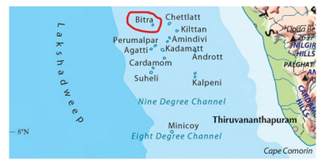
- Bitra is the smallest inhabited island of Lakshadweep, located in the Amini subgroup of islands.
- It is a coral atoll island formed by reef-building corals, part of the Lakshadweep archipelago in the Arabian Sea.
- The island has limited freshwater availability and is ecologically fragile.
- There is a small shrine of Malik Mulla, an old Arab Saint who is said to be have been burried here. The shrine is a place of pilgrimage for the people of other islands.
- Till 1835 BITRA was the breading ground for a number of sea birds,a favourite hunt of KILTAN and CHETLAT people.
- Surprisingly the first permanent settler at BITRA was a women from CHETLAT who with her son set up a permanent settler at house around 1945.
- Strategically important due to its location along India’s western maritime boundary.
- The climate of Bitra is similar to the climatic conditions of Kerala.
- Protected under the Island Protection Zone (IPZ) regulations for coastal management.
(TH)
Babanusa:
-
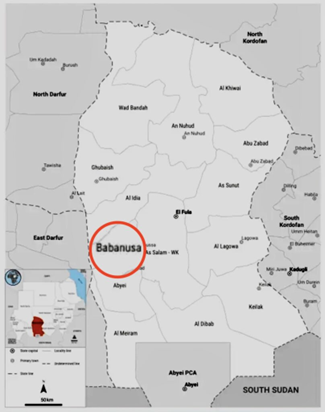
- Context: Sudan’s paramilitary Rapid Support Forces (RSF) seized full control of Babanusa, a transport junction in the country’s south, though its rival, the Sudanese army, disputed the claim.
- It lies on the historical rail route connecting Khartoum with the South Sudan region, making it strategically important for internal trade and military logistics.
- The region around Babanusa is part of the Sudan–Sahel transition zone, prone to desertification and climate stress.
- The economy largely depends on livestock trade, especially cattle, due to its location in pastoralist-dominated areas.
- The region has witnessed conflict and instability due to ethnic tensions and the broader Darfur–Kordofan conflict dynamics.
- Situated near important oil transport routes, especially those connecting to the Heglig oil fields (South Kordofan).
(TH)
Science & Technology
Glucagon-like peptide-1 (GLP-1) drugs:
-
- Context: WHO backs use of GLP-1 drugs for weight loss.
- GLP-1 drugs mimic the GLP-1 hormone, increasing insulin secretion and reducing blood glucose levels.
- Widely used for Type-2 Diabetes management and now globally discussed for obesity treatment (e.g., Semaglutide, Liraglutide).
- Act by slowing gastric emptying, reducing appetite, and improving satiety.
- Classified as incretin-based therapies, often administered as injections.
- Recent studies highlight possible benefits in cardiovascular risk reduction.
- Demand for GLP-1 drugs has surged worldwide, impacting global pharma supply chains.

(TH)
Defence & Security
Colombo Security Conclave (CSC):
-
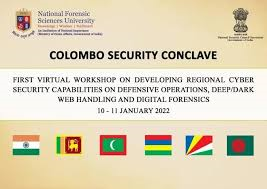
- CSC is a regional security grouping focused on the Indian Ocean Region (IOR), initiated by India, Sri Lanka, and the Maldives.
- It aims to enhance cooperation on maritime security, counter-terrorism, cyber security, and humanitarian assistance.
- Mauritius joined as a full member in 2022; Bangladesh and Seychelles often participate as observers.
- Originally began as a Trilateral Maritime Security Dialogue (2011) and later expanded into the CSC.
- Seen as an Indian initiative to strengthen regional security architecture in the Indian Ocean amidst increasing geopolitical competition (e.g., China’s presence).
- Focus areas include joint exercises, intelligence sharing, coastal surveillance, and capacity building.
(TH)
Government Schemes
Prime Minister Internship Scheme (PMIS):
-
- Context: Only 20% of candidates accepted PM Internship Scheme offers: data presented to parliament.
- PMIS was announced in the Union Budget 2024-25 and aims to provide up to one crore internships over the next five years across India.
- The scheme is implemented by the Ministry of Corporate Affairs (MCA), with internships offered through top ~500 companies chosen based on their CSR performance.
- Duration: internships under PMIS generally last 12 months.
- Financial support: Each intern gets a monthly stipend (₹5,000 total — ₹4,500 from government + ₹500 from company) plus a one-time grant of ₹6,000 at joining.
- Coverage: Interns are also provided insurance coverage under the Pradhan Mantri Jeevan Jyoti Bima Yojana (PMJJBY) and Pradhan Mantri Suraksha Bima Yojana (PMSBY).
- Eligibility constraints: Applicants must be Indian citizens, aged between 21–24 years, not engaged in full-time employment or full-time education.
- People with degrees from certain premier institutions (e.g. IITs, IIMs) or with certain professional/advanced qualifications are excluded; also there’s a family income cap (e.g. family income should not exceed ₹8 lakh per annum) and disqualification if a family member is a regular government employee.
(TH)
Important data/facts
Society & Social Justice
Jal Jeevan Mission projects:
-
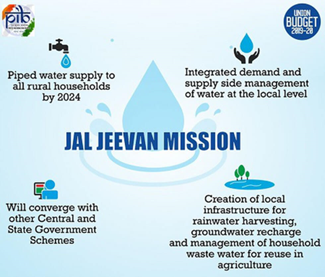
- Nearly 17,036 complaints have been received by States and Union Territories on “irregularities” and “poor work quality” in projects initiated under the Jal Jeevan Mission, with about 84% of the complaints coming from Uttar Pradesh.

(TH)
Geography & Environment
-
- Rivers draining in the west are influent, meaning that as the river flows through different States, the precipitation decreases.
- Whereas the east-flowing rivers are affluent, that is, the amount of precipitation increases in the course of time.
(TH)
Spread the Word