TOPIC-1: National Study Report on Low Participation in Gram Sabha
-
- GS Paper 2 (Functions and responsibilities of the Union and the States; Devolution of powers and finances up to local levels and challenges therein; Governance, Transparency & Accountability; Role of Civil Services and Local Self-Government).
Context: The Ministry of Panchayati Raj (MoPR) released a National Study Report on Low Participation in Gram Sabha highlights systemic, structural, and socio-economic bottlenecks that impair the functioning of the Gram Sabha.
Identified Causes of Low Participation in Gram Sabhas
1. Daily wage loss and occupational conflicts prevent rural citizens (especially landless laborers and migrant workers) from attending daytime meetings.
2. Undischarged domestic burdens, social hesitation, male-dominated discussions, and proxy governance inhibit meaningful participation by women.
3. Infrequent attendance by line department officials (e.g., revenue, agriculture, health, education), lack of feedback on previously passed resolutions, and weak grievance redressal mechanisms erode public trust in the Gram Sabha’s efficacy.
4. Inadequate advance notice of agendas and lack of transparency in Gram Panchayat Development Plan (GPDP) allocations.
Key Government Initiatives
1. Capacity Building & Training Frameworks
-
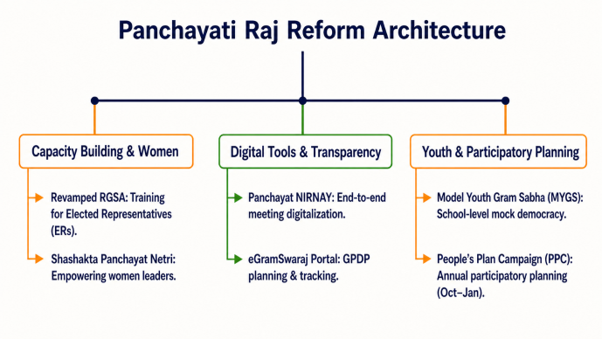
- Revamped Rashtriya Gram Swaraj Abhiyan (RGSA): Implemented since FY 2022–23, providing capacity building, orientation, and thematic training to Elected Representatives (ERs), functionaries, and disadvantaged groups (SCs, STs, Women, and Youth).
- Shashakta Panchayat Netri Abhiyan: A specialized capacity-building training module focused specifically on building leadership, administrative skills, and legal literacy among Women Elected Representatives (WERs) to foster genuine women-led governance.
2. Digital Public Infrastructure (e-Panchayat MMP)
-
- Panchayat NIRNAY (National Initiative for Rural India to Navigate, Action & Yield): A mobile and web application designed for the end-to-end digital lifecycle management of Gram Sabha meetings—including advance notification of meeting agendas, uploading photo-proof of quorums, recording meeting minutes, and publishing passed resolutions for public tracking.
- eGramSwaraj Portal: Provides a single platform for Gram Panchayats to prepare, track, and execute GPDPs transparently.
3. Grassroots Democratic Engagement Models
-
- Model Youth Gram Sabha (MYGS): An experiential educational simulation in schools where students participate in mock Gram Sabha sessions, agenda-setting, budgeting, and passing resolutions to build civic consciousness from a young age.
- People’s Plan Campaign (PPC) / “Sabki Yojana Sabka Vikas”: Conducted annually (typically 2nd October to 31st January) to mandate structured, participatory planning sessions across all Gram Sabhas to finalize GPDPs.
- Pre-Meeting Mechanisms: Advisories issued to States to mandate separate Ward Sabhas and Mahila Sabhas prior to the main Gram Sabha meeting to aggregate micro-level and gender-specific priorities.
UPSC Quick Reference Table
| Aspect | Detailed Specification |
| Nodal Body | Ministry of Panchayati Raj (MoPR) |
| Study Conducting Agency | National Institute of Rural Development and Panchayati Raj (NIRDPR) |
| Constitutional Basis | Article 243(b) (Gram Sabha definition) & Article 243A (Powers/Functions) |
| Primary Capacity Scheme | Revamped Rashtriya Gram Swaraj Abhiyan (RGSA) (FY 2022–23 onwards) |
| Women Leadership Program | Shashakta Panchayat Netri Abhiyan |
| Meeting Management App | Panchayat NIRNAY (Digital meeting scheduling, minutes, & outcome tracking) |
| School Democracy Module | Model Youth Gram Sabha (MYGS) |
Conclusion:
Digitizing meeting records through Panchayat NIRNAY, holding pre-meeting Mahila Sabhas, ensuring the presence of line-department officials, and training women leaders under the Shashakta Panchayat Netri Abhiyan help transform Gram Sabhas into responsive and accountable institutions of local self-governance.
TOPIC-2: Space Vision 2047
-
- GS Paper 3 (Science & Technology – Developments and their applications in daily life; Indigenization of technology; Private sector participation; IT & Space technology applications in agriculture, disaster management, and infrastructure).
Key Operational Space Applications Across Sectors (2026)
1. Agriculture
-
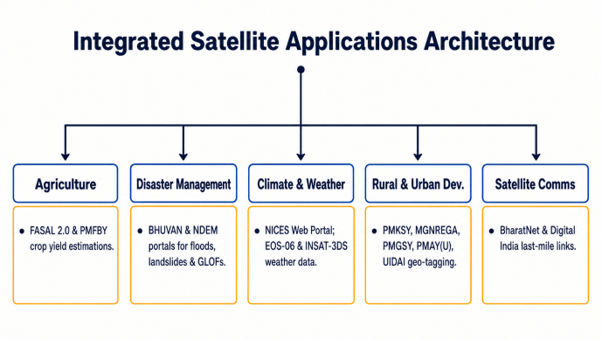
- FASAL 2.0 & GeoCrest: Deployed via the VEDAS (Visualisation of Earth Observation Data and Archival System) portal for national/state-level crop acreage, yield forecasting, and Jute surveillance in Assam, Bihar, Odisha, and West Bengal.
- PMFBY Support: Provides insurance unit-level crop yield estimation across 10 States to support the Pradhan Mantri Fasal Bima Yojana.
2. Disaster Management
-
- Real-Time Monitoring: Continuous assessment of floods, cyclones, landslides, Glacial Lake Outburst Floods (GLOFs), forest fires, and droughts via the BHUVAN and National Database for Emergency Management (NDEM) portals.
- Naval Rescue Tools: Installed at the Naval Operations Data Processing and Analysis Centre (NODPAC), Kochi, for Indian Navy maritime search and rescue operations.
3. Climate Monitoring
-
- EOS-06 & INSAT-3DS: Satellite data processing via the NICES (National Information System for Climate and Environment Studies) portal for sea-surface winds, ocean chlorophyll, and cloud coverage.
- Nowcasting Tools: Satellite-derived Extreme Weather Nowcasting tools deployed in collaboration with the India Meteorological Department (IMD) / MoES.
4. Flagship Governance Programmes
-
- Satellite-based geo-tagging and spatial planning for MGNREGA, WDC-PMKSY, PMAY-HFA(U), PMGSY rural roads, RKVY assets, NHAI green cover, and UIDAI facilities.
- BharatNet Connectivity: Utilizes Satellite Communication (SatCom) via VSATs to extend broadband to remote Gram Panchayats, enabling tele-education, tele-medicine, and secure emergency governance.
Strategic Roadmap:
The MoHUA/ISRO Outcome Report of National Meet – 2025: Leveraging Space Technology & Applications for Viksit Bharat 2047 establishes four technological targets:
1. Next-Generation Satellite Communication (SatCom)
-
- Advanced Payloads: Development of Flexible Payloads, Direct-to-Device (D2D) technology, and Non-Terrestrial Networks (NTN) aligned with 5G/6G standards.
- Optical & Quantum Comms: Establishment of optical/laser ground station infrastructure and operational Quantum Key Distribution (QKD) systems for secure strategic communications.
- Sovereignty: Planning indigenous N-GSO (Non-Geostationary Satellite Orbit) constellations for global broadband.
2. NavIC Expansion & Positioning, Navigation, and Timing (PNT)
-
- High-Precision Augmentation: Development of NavIC receiver technologies for Precise Point Positioning (PPP) and Real-Time Kinematics (RTK) for sub-meter accuracy in aviation, railways, smart cities, and defense.
- Indigenization: Native manufacturing of NavIC-enabled GNSS Baseband ASICs (chipsets) for integration into commercial smartphones and automotive IoT devices.
- Deep Space Navigation: Extending NavIC positioning services for future Lunar PNT missions.
UPSC Quick Reference Table
| Component | Detailed Specification |
| Nodal Department | Department of Space (DoS) / ISRO |
| Agricultural Portal | VEDAS (FASAL 2.0 / GeoCrest) |
| Disaster Portals | BHUVAN & NDEM (National Database for Emergency Management) |
| Climate Data Portal | NICES (MOSDAC & EOS-06 datasets) |
| Free Data Threshold | Ground Sampling Distance (GSD) coarser than 5 meters |
| NavIC Vision 2047 | PPP/RTK precision, 5G/6G integration, domestic ASIC chipsets, & Lunar PNT |
Conclusion:
Integrating space-based Earth Observation, SatCom, and NavIC capabilities across agricultural, disaster, and infrastructure sectors supports evidence-based governance in India. Modernizing digital public infrastructure, opening up EO data under the Indian Space Policy 2023, and advancing toward indigenous QKD, 6G-NTN, and NavIC chipsets under Space Vision 2047 help position India as a global space power.
TOPIC-3: India and Southern African Customs Union (SACU) Terms of Reference (ToR) for Preferential Trade Agreement (PTA)
-
- GS Paper 2 (Bilateral, regional, and global groupings and agreements involving India and/or affecting India’s interests; Effect of policies and politics of developed/developing countries on India’s interests – South-South Cooperation);
- GS Paper 3 (Indian Economy – International Trade, Foreign Trade Policy, Trade Agreements, and Global Value Chains).
Overview: India and the Southern African Customs Union (SACU) signed the Terms of Reference (ToR) at Vanijya Bhawan, New Delhi, to formally initiate negotiations for a Preferential Trade Agreement (PTA). This marks India’s first ToR signing with an African regional economic bloc, establishing a structured, predictable, and transparent roadmap for trade talks.
Understanding the SACU Bloc
-
- Established: 1910 (Recognized as the world’s oldest existing customs union).
- Headquarters: Windhoek, Namibia.
- Economic Composition: High degree of economic heterogeneity, spanning industrial hubs (South Africa) to LDCs and Small and Vulnerable Economies (Eswatini, Lesotho).
Key Strategic
1. Core Negotiating Architecture (8 Chapters)
As outlined by Commerce Secretary Shri Rajesh Agrawal, the proposed India–SACU PTA will negotiate eight specific trade chapters:
1. Trade in Goods & Market Access: Tariff preference schedules.
2. Rules of Origin (RoO) & Origin Procedures: Ensuring product authenticity and preventing trade deflection.
3. Customs Procedures & Trade Facilitation: Simplifying port and customs workflows.
4. Trade Remedies & Bilateral Safeguard Mechanisms: Protecting domestic industries against sudden import surges.
5. Sanitary and Phytosanitary (SPS) Measures: Food safety and agricultural trade standards.
6. Technical Barriers to Trade (TBT): Harmonizing technical quality standards.
7. Dispute Settlement Framework: Mechanisms for resolving state-to-state trade disputes.
8. Legal and Horizontal Provisions: General rules, exceptions, and institutional clauses.
2. India’s Sectoral Strengths & Export Integration
-
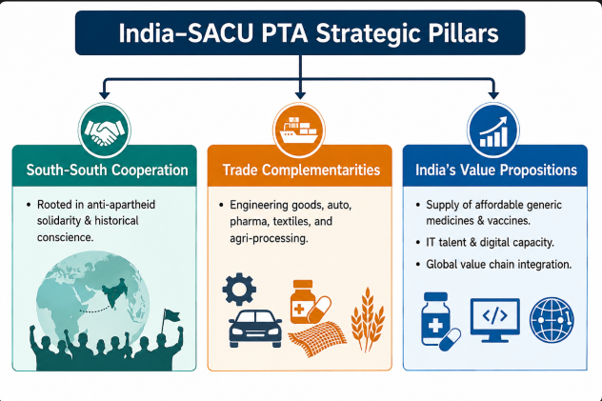
- Pharmaceuticals: Supplying high-quality, affordable generic medicines and healthcare formulations to Southern Africa.
- IT Talent & Capacity Building: Supporting digital infrastructure and technology skill-building in the SACU region.
- Global Supply Chains: Integrating SACU businesses into global manufacturing networks in competitive sectors like automotive parts, machinery, textiles, and agro-processing.
3. Development-Oriented Approach
Recognizing the diverse developmental levels within SACU, the negotiations emphasize Special and Differential Treatment (SDT) to protect the economic interests of SACU’s Least Developed Countries (LDCs) and Small and Vulnerable Economies (SVEs).
UPSC Quick Reference Table
| Metric / Parameter | Detailed Specification |
| Nodal Ministry | Ministry of Commerce & Industry (Department of Commerce) |
| Partner Bloc | Southern African Customs Union (SACU) |
| Agreement Type | Preferential Trade Agreement (PTA) |
| SACU Members (5) | Botswana, Eswatini, Lesotho, Namibia, South Africa |
| Significance | India’s 1st ToR for a trade agreement in the African region |
| Negotiation Scope | 8 Chapters (Goods, RoO, Customs, Trade Remedies, SPS, TBT, Dispute Settlement, Legal) |
Conclusion:
By combining market access in engineering, pharmaceuticals, and automobiles with capacity building in IT and supply chain integration, the PTA supports South-South cooperation and strengthens India–Africa economic ties.
TOPIC-4: Launch of Central Bank Digital Currency (CBDC)-Based Direct Benefit Transfer (DBT)
-
- GS Paper 3 (Indian Economy – Monetary Policy, Central Bank Digital Currency (CBDC), Digital Public Infrastructure, Direct Benefit Transfer (DBT), Public Distribution System (PDS) & Food Security).
Context: The Government of India is launching CBDC-based Direct Benefit Transfer (DBT) under the flagship Pradhan Mantri Garib Kalyan Anna Yojana (PMGKAY) in the Union Territories of Chandigarh and Dadra & Nagar Haveli. Building upon earlier pilot projects in Puducherry and Gujarat, Chandigarh and Dadra & Nagar Haveli will become the first Union Territories to achieve full operational coverage and saturation by delivering food subsidy directly in the form of programmable Digital Rupee () tokens into beneficiaries’ CBDC wallets.
Strategic Benefits
1. Programmability & Elimination of Diversion: Unlike traditional cash/bank DBT, programmable CBDC tokens can be coded to ensure the transferred subsidy is spent exclusively on foodgrains at designated empanelled merchants, eliminating non-essential diversion.
2. End-to-End Traceability: Provides real-time visibility into subsidy utilization across the supply chain, reducing leakages and cash-handling costs.
3. Digital Public Infrastructure (DPI) Scalability: Serves as a national proof-of-concept and scalable template for integrating central bank digital currencies into other central sector welfare schemes.
UPSC Quick Reference Table
| Feature | Detailed Specification |
| Nodal Ministries | Ministry of Consumer Affairs, Food and Public Distribution; Ministry of Finance |
| Pilot Phase UTs/States | Puducherry & Gujarat |
| First Full-Saturation UTs | Chandigarh and Dadra & Nagar Haveli |
| Target Scheme | Pradhan Mantri Garib Kalyan Anna Yojana (PMGKAY) |
| Currency Form | Digital Rupee () — Central Bank Digital Currency (CBDC) |
| Primary Innovation | Programmable tokens credited to mobile digital wallets |
Conclusion:
Applying programmable Digital Rupee tokens to Direct Benefit Transfers helps ensure end-to-end traceability, prevents non-food diversion, and provides a scalable model for modernizing welfare delivery across India.
Spread the Word