
Essay Strategy for 2026

The landscape of the UPSC Civil Services Essay paper has underwent a massive paradigm shift. Gone are the days when you could rely on a formulaic, structured template—such as blindly applying the PESTEL (Political, Economic, Social, Technological, Environmental, Legal) framework across every topic. With UPSC leaning heavily into abstract, philosophical, and psychological themes, the “De-Coaching” strategy is about unlearning rote mechanics and injecting raw originality, fluid transition, and critical thinking into your writing.

Here is a highly nuanced blueprint of the De-Coaching Strategy for the 2026 Essay, explicitly integrating the DEEPHIR technique and the Pendulum Approach.

The Core Philosophy of “De-Coaching”

Coaching centers often manufacture “assembly-line” essay writers who produce predictable, rigid content. De-coaching forces you to treat the essay as an organic conversation with the examiner rather than a GS answer on steroids.

    • Move away from PESTEL: Using a strict PESTEL framework on a philosophical topic like “The ship is safest at the harbour, but that is not what it is built for” makes the essay look fragmented and mechanical.
    • Focus on Thesis Elasticity: Give your essay breathing room. A de-coached essay doesn’t explicitly announce its sections; it allows one thought to naturalistically trigger the next.
    • Ditch Canned Openings: Avoid starting every essay with the same generic story of Gautama Buddha or Abraham Lincoln. Use contemporary contextual anomalies, thought experiments, or nuanced personal reflections.

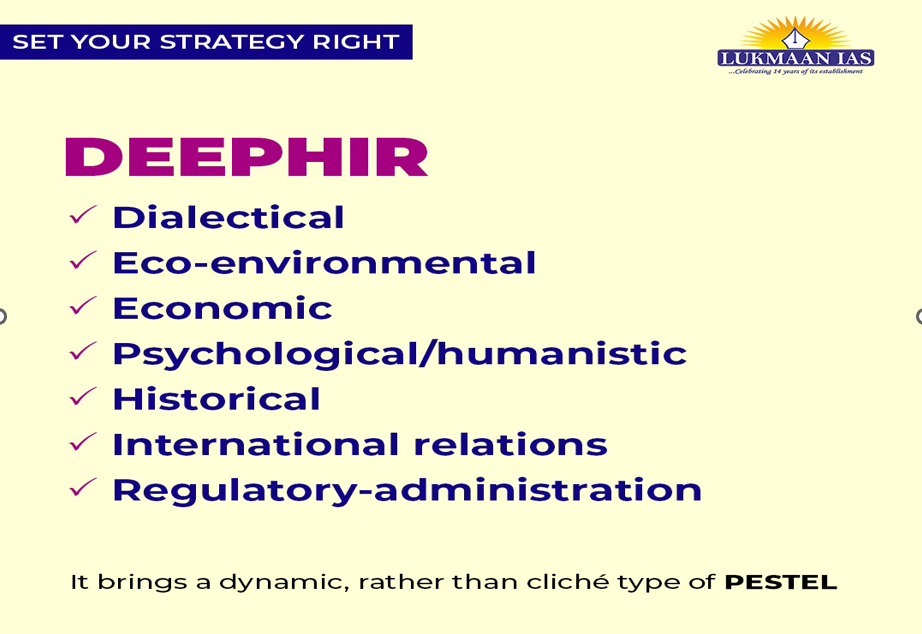
The DEEPHIR Technique

As a modern replacement for rigid traditional frameworks, the DEEPHIR model provides an analytical architecture suited specifically for abstract and philosophical essays. It forces you to explore a concept down to its core roots rather than skimming its surfaces.
1_

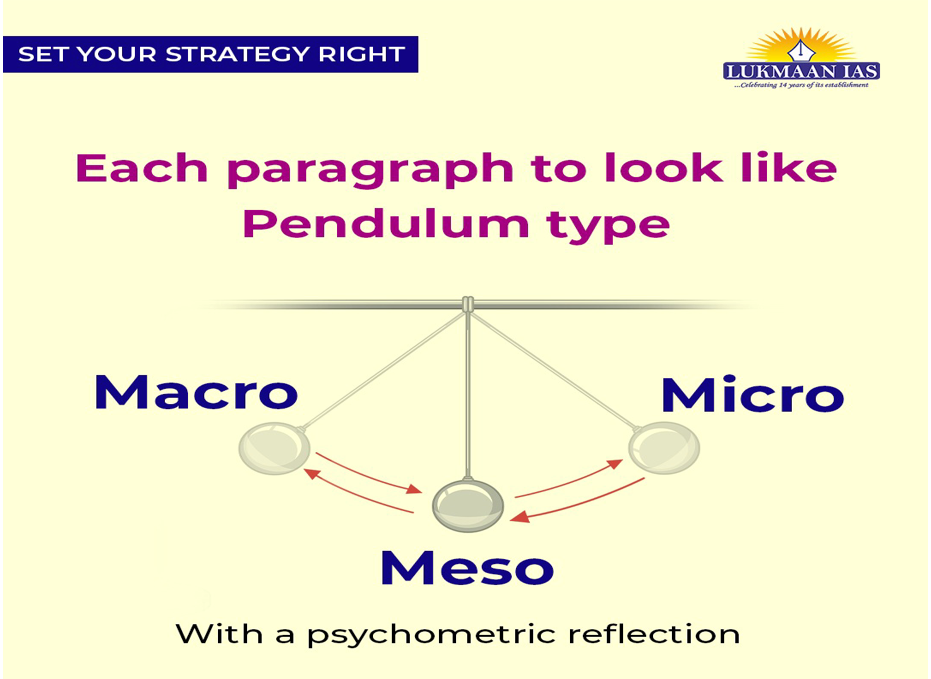
The Pendulum Approach (Dynamic Balancing)

When dealing with complex, philosophical prompts, mediocre essays take a binary view (“I agree with this quote and here are 10 pages proving why”). A high-scoring, nuanced essay uses the Pendulum Approach to simulate an internal intellectual debate.
2__

Step 1: The Left Swing (Validation)

Start by leaning into the face-value truth of the prompt. Build a compelling, robust defense of the quote using strong philosophical underpinnings and historical case studies. Make the examiner believe that this viewpoint is absolute.

Step 2: The Right Swing (The Nuanced Counter/Limitation)

Use smooth transitions (e.g., “However, absolute compliance with this thought risks creating an intellectual blind spot…”). Pivot sharply to analyze the antithesis. Explore the limits of the prompt.

    • Example: If the essay is about the virtues of patience, swing the pendulum to explore where patience turns into structural inertia or cowardice.

Step 3: Finding Equilibrium (The Synthesis)

A pendulum eventually comes to rest at the center (equilibrium). Your final sections should synthesize these competing forces. Do not simply pick a side; redefine the boundary where the pro-argument ends and the counter-argument begins. This shows the examiner an exceptional level of cognitive maturity.

Nuanced Execution Tips for 2026

    • Micro-Transitions over Macro-Headings: Avoid putting stark headings like “Economic Aspects.” Use subtle rhetorical bridges at the end of paragraphs to pull the reader into the next thought. (e.g., “While institutions can safeguard liberty, the true battleground of freedom lies within the human psyche…” → pivots from political to psychological).
    • The 80-20 Rule of Examples: 20% of your examples can be standard textbook cases (e.g., Ashoka, French Revolution) to ground your essay. But 80% should be fresh, dynamic, or deeply intellectual—drawn from peer-reviewed essays, obscure socio-economic trends, complex literary allegories, or systemic global shifts.
    • Avoid the “GS Answer” Trap: If your paragraph sounds like a 15-mark GS paper response with bullet points and underlined data metrics, pause and rewrite it. The tone of an essay must remain contemplative, analytical, and literary.

Implementing a highly advanced strategy like De-Coaching requires more than just theoretical understanding—it demands precision-guided execution, expert evaluation, and regular Course Corrections. This is exactly where Lukmaan IAS, under the guidance of S. Ansari, becomes an invaluable catalyst for your 2026 preparation.

Lukmaan IAS has been a pioneer in actively dismantling the rigid, “assembly-line” templates of old-school preparation, aligning their curriculum precisely with this modern ethos.

How Lukmaan IAS Facilitates Your De-Coaching Strategy

Institutional Pioneers of the DEEPHIR Technique

The DEEPHIR technique isn’t a random internet framework; it is a proprietary, flagship methodology championed explicitly by S. Ansari at Lukmaan IAS to replace the outdated PESTEL framework.

    • Beyond Surface-Level Arguments: In his classes, Ansari sir trains you to structurally map out an abstract quote through all seven lenses (Definitional, Existential, Evolutionary, Political, Humanistic, Ideological, and Reformative).
    • The Transition from Theory to Paper: Lukmaan IAS provides dedicated Philosophical Essay Study Material and theme-wise topic lists designed specifically around DEEPHIR, showing you how to break open complex topics under exam pressure.

Standardizing the “Pendulum Approach” via Expert Brainstorming

To write a balanced essay that dynamically swings between a robust thesis and a sharp anti-thesis, you need an extensive, multi-dimensional thought process.

    • Dedicated Brainstorming Sessions: Lukmaan’s specialized Essay Programs include focused brainstorming classes. They teach you how to look at a prompt, instantly identify its core limitations (the counter-arguments), and successfully merge them into a brilliant synthesis.
    • Cultivating “View-Based” Preparation: Instead of giving you rote facts to memorize, Lukmaan IAS focuses on developing an analytical worldview. This ensures your essays sound intellectually mature and authentic, completely eliminating the “GS-answer trap.”

Rigorous Evaluation Against “Coached” Tropes

You cannot de-coach yourself in isolation; you need an examiner to point out when you are accidentally falling back into old, mechanical habits.

    • UPSC-Standard Evaluation: The evaluation ecosystem at Lukmaan IAS is highly supervised by S. Ansari. Evaluators are explicitly trained to catch and penalize formulaic, boilerplate introductions, generic examples, and rigid structures.
    • Direct Feedback Sessions with S. Ansari: The institute integrates personalized, individual feedback sessions. Having a seasoned mentor dissect your copy ensures you can pinpoint exactly where your structural transitions are jarring and where your arguments lose their organic flow.

Resource Ecosystem for Fresh, Nuanced Content

To hit the “80-20 rule” of unique examples, you need to look past basic compilation books.

    • The Ethical Perspective & Applied Handouts: Lukmaan’s ancillary materials, current development updates, and dedicated essay modules supply you with an elite bank of contemporary anomalies, philosophical insights, and institutional case studies. This allows you to smoothly execute original, high-impact narratives that stand out to the UPSC evaluator.

Ultimately, Lukmaan IAS acts as the perfect testing ground. It provides the structured guidance required to confidently throw away the safety net of old coaching methodologies, allowing you to master a fluid, deeply philosophical, and scoring style of essay writing for 2026.

Spread the Word

The landscape of the UPSC Civil Services Essay paper has underwent a massive paradigm shift. Gone are the days when you could rely on a formulaic, structured template—such as blindly applying the PESTEL (Political, Economic, Social, Technological, Environmental, Legal) framework across every topic. With UPSC leaning heavily into abstract, philosophical, and psychological themes, the “De-Coaching” strategy is about unlearning rote mechanics and injecting raw originality, fluid transition, and critical thinking into your writing.

Here is a highly nuanced blueprint of the De-Coaching Strategy for the 2026 Essay, explicitly integrating the DEEPHIR technique and the Pendulum Approach.

The Core Philosophy of “De-Coaching”

Coaching centers often manufacture “assembly-line” essay writers who produce predictable, rigid content. De-coaching forces you to treat the essay as an organic conversation with the examiner rather than a GS answer on steroids.

    • Move away from PESTEL: Using a strict PESTEL framework on a philosophical topic like “The ship is safest at the harbour, but that is not what it is built for” makes the essay look fragmented and mechanical.
    • Focus on Thesis Elasticity: Give your essay breathing room. A de-coached essay doesn’t explicitly announce its sections; it allows one thought to naturalistically trigger the next.
    • Ditch Canned Openings: Avoid starting every essay with the same generic story of Gautama Buddha or Abraham Lincoln. Use contemporary contextual anomalies, thought experiments, or nuanced personal reflections.

The DEEPHIR Technique

As a modern replacement for rigid traditional frameworks, the DEEPHIR model provides an analytical architecture suited specifically for abstract and philosophical essays. It forces you to explore a concept down to its core roots rather than skimming its surfaces.

1_

The Pendulum Approach (Dynamic Balancing)

When dealing with complex, philosophical prompts, mediocre essays take a binary view (“I agree with this quote and here are 10 pages proving why”). A high-scoring, nuanced essay uses the Pendulum Approach to simulate an internal intellectual debate.

2__

Step 1: The Left Swing (Validation)

Start by leaning into the face-value truth of the prompt. Build a compelling, robust defense of the quote using strong philosophical underpinnings and historical case studies. Make the examiner believe that this viewpoint is absolute.

Step 2: The Right Swing (The Nuanced Counter/Limitation)

Use smooth transitions (e.g., “However, absolute compliance with this thought risks creating an intellectual blind spot…”). Pivot sharply to analyze the antithesis. Explore the limits of the prompt.

    • Example: If the essay is about the virtues of patience, swing the pendulum to explore where patience turns into structural inertia or cowardice.

Step 3: Finding Equilibrium (The Synthesis)

A pendulum eventually comes to rest at the center (equilibrium). Your final sections should synthesize these competing forces. Do not simply pick a side; redefine the boundary where the pro-argument ends and the counter-argument begins. This shows the examiner an exceptional level of cognitive maturity.

Nuanced Execution Tips for 2026

    • Micro-Transitions over Macro-Headings: Avoid putting stark headings like “Economic Aspects.” Use subtle rhetorical bridges at the end of paragraphs to pull the reader into the next thought. (e.g., “While institutions can safeguard liberty, the true battleground of freedom lies within the human psyche…” → pivots from political to psychological).
    • The 80-20 Rule of Examples: 20% of your examples can be standard textbook cases (e.g., Ashoka, French Revolution) to ground your essay. But 80% should be fresh, dynamic, or deeply intellectual—drawn from peer-reviewed essays, obscure socio-economic trends, complex literary allegories, or systemic global shifts.
    • Avoid the “GS Answer” Trap: If your paragraph sounds like a 15-mark GS paper response with bullet points and underlined data metrics, pause and rewrite it. The tone of an essay must remain contemplative, analytical, and literary.

Implementing a highly advanced strategy like De-Coaching requires more than just theoretical understanding—it demands precision-guided execution, expert evaluation, and regular Course Corrections. This is exactly where Lukmaan IAS, under the guidance of S. Ansari, becomes an invaluable catalyst for your 2026 preparation.

Lukmaan IAS has been a pioneer in actively dismantling the rigid, “assembly-line” templates of old-school preparation, aligning their curriculum precisely with this modern ethos.

How Lukmaan IAS Facilitates Your De-Coaching Strategy

Institutional Pioneers of the DEEPHIR Technique

The DEEPHIR technique isn’t a random internet framework; it is a proprietary, flagship methodology championed explicitly by S. Ansari at Lukmaan IAS to replace the outdated PESTEL framework.

    • Beyond Surface-Level Arguments: In his classes, Ansari sir trains you to structurally map out an abstract quote through all seven lenses (Definitional, Existential, Evolutionary, Political, Humanistic, Ideological, and Reformative).
    • The Transition from Theory to Paper: Lukmaan IAS provides dedicated Philosophical Essay Study Material and theme-wise topic lists designed specifically around DEEPHIR, showing you how to break open complex topics under exam pressure.

Standardizing the “Pendulum Approach” via Expert Brainstorming

To write a balanced essay that dynamically swings between a robust thesis and a sharp anti-thesis, you need an extensive, multi-dimensional thought process.

    • Dedicated Brainstorming Sessions: Lukmaan’s specialized Essay Programs include focused brainstorming classes. They teach you how to look at a prompt, instantly identify its core limitations (the counter-arguments), and successfully merge them into a brilliant synthesis.
    • Cultivating “View-Based” Preparation: Instead of giving you rote facts to memorize, Lukmaan IAS focuses on developing an analytical worldview. This ensures your essays sound intellectually mature and authentic, completely eliminating the “GS-answer trap.”

Rigorous Evaluation Against “Coached” Tropes

You cannot de-coach yourself in isolation; you need an examiner to point out when you are accidentally falling back into old, mechanical habits.

    • UPSC-Standard Evaluation: The evaluation ecosystem at Lukmaan IAS is highly supervised by S. Ansari. Evaluators are explicitly trained to catch and penalize formulaic, boilerplate introductions, generic examples, and rigid structures.
    • Direct Feedback Sessions with S. Ansari: The institute integrates personalized, individual feedback sessions. Having a seasoned mentor dissect your copy ensures you can pinpoint exactly where your structural transitions are jarring and where your arguments lose their organic flow.

Resource Ecosystem for Fresh, Nuanced Content

To hit the “80-20 rule” of unique examples, you need to look past basic compilation books.

    • The Ethical Perspective & Applied Handouts: Lukmaan’s ancillary materials, current development updates, and dedicated essay modules supply you with an elite bank of contemporary anomalies, philosophical insights, and institutional case studies. This allows you to smoothly execute original, high-impact narratives that stand out to the UPSC evaluator.

Ultimately, Lukmaan IAS acts as the perfect testing ground. It provides the structured guidance required to confidently throw away the safety net of old coaching methodologies, allowing you to master a fluid, deeply philosophical, and scoring style of essay writing for 2026.

Spread the Word
Index