SECTION A
Q1.(a) Owing to paucity of time, a university professor generates a Ph.D. evaluation report using Artificial Intelligence and submits it with some modifications. Discuss this from the perspective of accountability and integrity. (150 words, 10 marks)
ANS.
STRUCTURE
1. Explain the context in brief
2. Then relate and explain accountability and integrity with adequate examples and philosophical links
3. Also write in which scenario-there is not breach of accountability and integrity
4. Give a way forward type conclusion with a philosophy or quote
THE CONTEXT (INTRODUCTION)
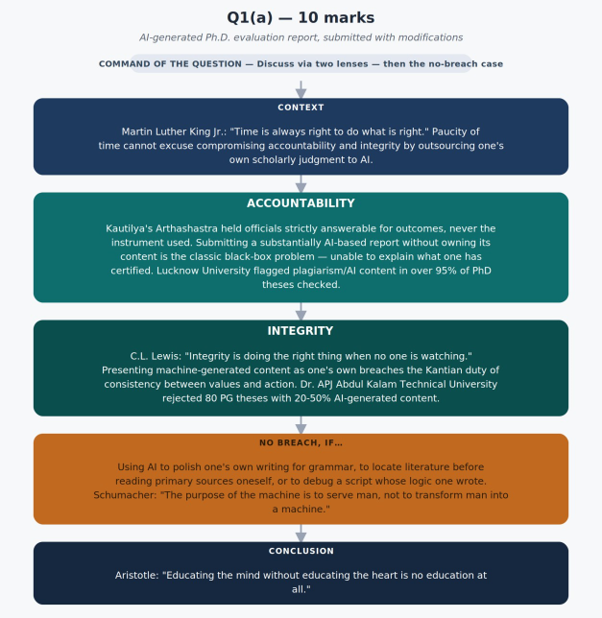
“Time is always right to do what is right” -Martin Luther King Jr view seems to play here a reminder role that paucity of time can’t become an excuse for compromising accountability and integrity by generating a report without application of one’s own wisdom.
BODY
It is true that Artificial Intelligence has transformative effects on society beyond human imagination but it has become a double edge sword.
In the context of the university professor, the AI has been used to produce a sort of plagiarised report which compromises both accountability and integrity.
Compromise of Accountability:
-
- By submitting substantially based on AI, the report lacks a sense of ownership on content which one cannot explain-the problem of EXPLAINABILITY and BLACKBOX.
- Accountability requires the professor to personally own every conclusion in the report; Kautilya’s Arthashastra held officials strictly answerable for outcomes, never the instrument they used.
- Example: Lucknow University flagged plagiarism and AI-generated content in over 95% of PhD theses submitted across various disciplines.
Compromise of Integrity:
“Integrity is doing the right thing when no one is watching”-CL Lewis
-
- Erosion of Intellectual Integrity: Presenting machine generated content as human thought is breach of intellectual Integrity demands consistency between professional values and actions (Kantian Duty/Categorical Imperative).
- Example: Dr. A.P.J. Abdul Kalam Technical University rejected 80 postgraduate (MTech, MPharm, MArch) theses when it was 20% and 50% AI-generated content and plagiarism.
“The purpose of the machine is to serve man, not to transform man into a machine.”— E. F. Schumacher.
Although there can be scenarios in which accountability and integrity will not be considered compromised like:
-
- Writing: Polishing self-written text for flow and
- Literature: Using AI to find papers, then reading primary
- Data Analysis: Writing script logic and using AI to debug syntax.
“Technology is a useful servant but a dangerous master.”— Christian Lous Lange
How to preserve of integrity and accountability?
-
- Codifying the “Human-in-the-Loop” Standard
- Mandatory Disclosure and Transparency Declarations
- Shift from “Output Auditing” to “Process-Based Integrity”
CONCLUSION
AI should serve as an intellectual multiplier that supports human reasoning, rather than a replacement for critical thought. “Educating the mind without educating the heart is no education at all.”— Aristotle
Q1. (b) A business house is working on a project that could displace a forest community from their habitat. As the administrative officer of that district, what ethical challenges are you likely to face? (150 words, 10 marks)
ANS.
STRUCTURE
1. Explain the context in brief
2. Then relate and explain administrative officer ethical challenges
3. How to overcome
4. Conclusion with a philosophy or quote
THE CONTEXT (INTRODUCTION)
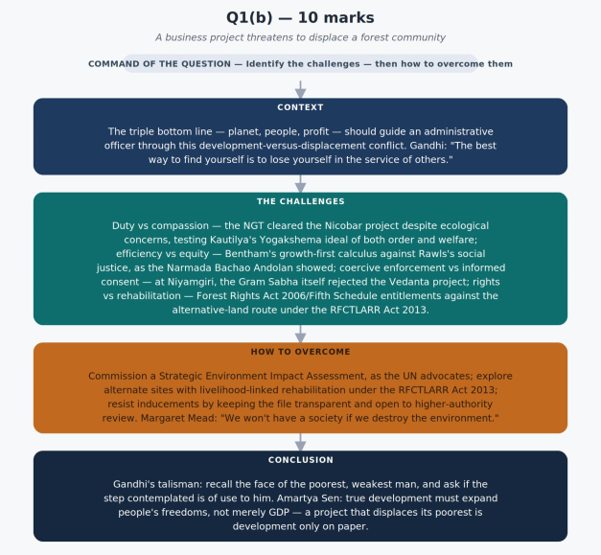
The triple bottom line -planet, people and profit should work as the guiding principle being an administrative officer to play the role of environmental stewardship and get through the challenges.
“The best way to find yourself is to lose in service of others”-Gandhi.
BODY
Development-environment conflict in the given situation poses following ethical challenges:
-
- Duty vs. Compassion: One is bound to enforce law as administrative officer but at the same time the state is supposed to be compassionate-Yogakshema of Kautilya-the go ahead of Nicobar Project by NGT.
- Efficiency vs. equity: Ease of doing business and its profit motive is to be protected for the sake of growth-Bentham’s GGGN but then state also has welfare commitment-John Rawls’ social justice-the issue highlighted by Narmada Bachau Andolan.
- Good governance vs. ethical governance: Adopting outcome driven approach on the one hand and rightness of action on the other-the recent stay by SC on Aravalli case.
- Coercive enforcement of law vs. informed consent: The case related to Niyamgiri Hills, in which thee Gram Sabha rejected approval of Vedant project.
- Rights alternative: The forest community has right under the Forest Rights Act 2006 and the Fifth Schedule and the alternative land for rehabilitation or dislocation-as will happen in case of Nicobar Project.
- De-growth/deep ecology vs. growth/anthropocentricism: Whether to adopt life as per the nature or follow growth with the least destruction and dislocation.
Since it is a case of conflict between development and environment, there exists past judicial precedents and administrative interventions in resolutions of the ethical challenges:
1. Strategic Environment Impact Assessment advocated by UNs
2. Exploring alternate sites to ensure livelihood-linked rehabilitation under the RFCTLARR Act 2013
3. Resist inducements by keeping the file transparent and open to higher-authority
“We won’t has society if we destroy the environment”-Margaret Mead
CONCLUSION:
Gandhi’s talisman remains the surest test, ‘recall the face of the poorest, weakest man, and ask if the step contemplated will be of use to him’. As Amartya Sen reminds us, true development must expand people’s freedoms, not merely GDP-a project that displaces its poorest is development only on paper.
*Read More*Spread the Word