
TOPIC-1: AI-Based Real-Time Monitoring System for Mithun (“Cattle of the Hills”)
-
- UPSC Relevance: GS Paper 3 (Science & Technology — Applications of AI & Computer Vision; Agriculture & Precision Livestock Farming; Socio-Economic Development of North East India).
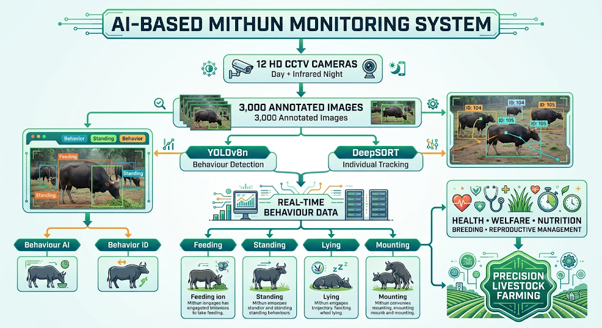
Introduction: Researchers at the ICAR-National Research Centre on Mithun (ICAR-NRC on Mithun) in Nagaland in collaboration with NIT Nagaland, Nagaland University and CHRIST University have developed an AI-based non-contact framework for real-time detection and tracking of Mithun (Bos frontalis) behavior. The system automates continuous day-and-night monitoring to support livestock health, reproductive management and precision farming.
About Mithun: Known as the “Cattle of the Hills,” Mithun holds significant socio-cultural and economic importance for indigenous communities across North East India (Nagaland, Arunachal Pradesh, Manipur, and Mizoram).
-
- Conventional livestock monitoring relies on manual observation, which is labor-intensive, subjective, and difficult to sustain continuouslyespecially during night hours.
- Early behavioral changes in feeding, standing, lying, and mounting provide vital indicators of animal health, nutrition, oestrus/breeding readiness, and physiological stress.
Key Highlights:
-
- Computer Vision Model Integration: Combines YOLOv8n (You Only Look Once v8 nano) for instant multi-behavior detection with DeepSORT (Deep Simple Online and Realtime Tracking) to assign persistent individual tracking IDs to animals.
- 4-Behavior Tracking Matrix: Tracks feeding, standing, lying, and mounting in real time across complex farm conditions (shadows, background clutter, wet ground, and motion blur).
- Night Vision & Oestrus Detection: Leverages infrared CCTV camera feeds to capture mounting behavior during night hours, significantly aiding artificial insemination, oestrus management, and controlled breeding.
- Future Research Roadmap: Plans to expand detection to additional behaviors (aggression, grooming, disease-related inactivity), integrate temporal AI models, and deploy the system directly onto edge-AI devices for local farm use.
UPSC Quick Reference Table
| Feature | Detailed Specification |
| Nodal Institute | ICAR-NRC on Mithun, Medziphema, Nagaland |
| Collaborating Partners | NIT Nagaland, Nagaland University, CHRIST (Deemed to be University) |
| Species Monitored | Mithun (Bos frontalis) — “Cattle of the Hills” |
| AI Architecture | YOLOv8n (Detection) + DeepSORT (Individual Tracking) |
| Key Metrics | 99.5% mAP@0.5, 99.6% Recall, ~3 Frames Per Second (FPS) |
| Journal Publication | Engineering Research Express (Vol. 8, Article 7523, 2026) |
Conclusion:
Applying computer vision and artificial intelligence to Mithun farming modernizes precision livestock management in North East India. Continuous, non-invasive automated monitoring reduces labor demands, enables early disease detection, and supports sustainable breeding practices for tribal livelihoods.
TOPIC-2: Inaugural India–Morocco Joint Defence Committee Meeting
-
- UPSC Relevance: GS Paper 2 (Bilateral Groupings & Agreements involving India; India–Africa Strategic & Defence Partnerships) & GS Paper 3 (Defence Production, Indigenous Military Manufacturing, Exports under Aatmanirbhar Bharat, and Cyber Defence).
Introduction: The inaugural India–Morocco Joint Defence Committee (JDC) meeting was held in New Delhi on September 8, 2026. The institutional mechanism establishes a structured framework to deepen defense ties covering joint military training, defense industrial co-production, maintenance, and cyber defense as both nations prepare to mark the 70th anniversary of diplomatic relations in 2027.
About the India–Morocco JDC:
The Joint Defence Committee is the official execution body established under the Bilateral Memorandum of Understanding (MoU) on Defence Cooperation, signed in Rabat during Raksha Mantri Shri Rajnath Singh’s official visit to Morocco in September 2025.
Key Highlights:
-
- Defense Manufacturing & Industrial Co-Production: The Moroccan delegation visited DPSU Bhawan, New Delhi, to explore defense co-production, joint ventures, and maintenance/sustainment partnerships. This builds on Indian defense presence in North Africa, such as the Tata Advanced Systems Maroc (TASM) plant for Wheeled Armoured Platforms.
- Multilateral & Operational Cooperation: Agreed to expand engagement in UN Peacekeeping Operations (UNPKOs), joint military exercises, and tri-service officer training exchanges.
- Cyber Defense & Military Medicine: Focused on cyber defense capability building and conducted field visits to the Army Hospital (Research & Referral) to examine India’s military medicine and trauma care capabilities.
- Roadmap to 2027 Milestone: Serves as a primary strategic anchor leading up to the 70th anniversary of diplomatic relations between India and Morocco in 2027.
UPSC Quick Reference Table
| Feature | Detailed Specification |
| Nodal Agencies | Ministry of Defence (India) & Moroccan Royal Armed Forces (Morocco) |
| Event Name | Inaugural India–Morocco Joint Defence Committee (JDC) Meeting |
| Delegation Co-Chairs | Shri Amitabh Prasad (JS, MoD) & Brig. Gen. Abdellah Athmani |
| Parent Institutional Pact | Bilateral MoU on Defence Cooperation (Signed September 2025 in Rabat) |
| Key Focus Areas | Co-production, Cyber Defence, Military Medicine, & Peacekeeping |
| Diplomatic Milestone | Broadening defense ties ahead of the 70th Anniversary in 2027 |
Conclusion:
The inaugural Joint Defence Committee meeting cements the defense agreement signed between India and Morocco in 2025. Expanding defense manufacturing co-production, military training, and technology collaboration strengthens India’s defense diplomacy footprint across North Africa and the broader Mediterranean region.
TOPIC-3: IAF Dronathon 2026 — Advancing Indigenous Drone & Counter-Drone Capabilities
-
- UPSC Relevance: GS Paper 3 — Science & Technology (Unmanned Aerial Systems, Autonomous & Swarm Technologies, Electronic Warfare); Defence Technology & Indigenisation; Atmanirbhar Bharat; Internal & External Security.
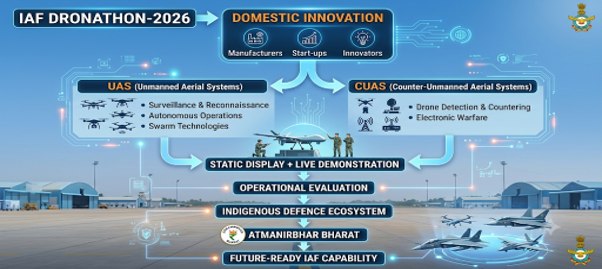
Introduction: The Indian Air Force (IAF) is organising Dronathon-2026 from 4–6 September 2026 at the Pokhran Range, Jaisalmer, to provide a platform for domestic manufacturers, start-ups and innovators to demonstrate advancements in Unmanned Aerial Systems (UAS) and Counter-Unmanned Aerial Systems (CUAS). The event seeks to facilitate technology evaluation, operational demonstrations and mutual learning among defence stakeholders.
UAS & CUAS: Unmanned Aerial Systems (UAS) comprise remotely operated or autonomous aerial platforms along with their control, communication and support systems. Their growing role in surveillance, reconnaissance and autonomous operations is changing modern warfare.
At the same time, the proliferation of drones has created the need for Counter-UAS (CUAS) capabilities that can detect, track and neutralise hostile or unauthorised drones.
-
- UAS: Used for surveillance, reconnaissance, intelligence gathering, autonomous operations and increasingly complex battlefield missions.
- CUAS: Provides protection against hostile drones through technologies such as detection, tracking, electronic disruption and other countermeasures.
- The emergence of swarm technologies and autonomous systems is further increasing the complexity of future battlefields.
Key Highlights
-
- Dronathon-2026 is being organised by the Indian Air Force to showcase the capabilities and technological advancements of domestic manufacturers in UAS and CUAS.
- The event will be held at the Pokhran Range, Jaisalmer, from 4–6 September 2026, combining static displays with live operational demonstrations.
- The demonstrations will enable defence stakeholders to witness emerging drone and counter-drone technologies in operation and facilitate mutual learning between users, manufacturers and innovators.
- A key objective is to identify contemporary technological solutions and evaluate their combat effectiveness under operationally relevant conditions.
- Major areas of focus include surveillance and reconnaissance, autonomous operations, swarm technologies and electronic warfare, reflecting emerging trends in modern warfare.
- Dronathon-2026 seeks to strengthen the domestic defence-industrial ecosystem by bringing together industry experts, start-ups and innovators with the armed forces.
- The initiative supports the vision of Atmanirbhar Bharat by encouraging indigenous development of critical defence technologies and reducing dependence on external sources.
By providing an interface between the armed forces and domestic technology developers, such initiatives can help align innovation with actual operational requirements. The initiative reflects the IAF’s objective of building a technologically advanced, indigenous and future-ready force capable of responding to rapidly changing security challenges.
UPSC Quick Reference Table
| Parameter | Key Details |
| Event | IAF Dronathon-2026 |
| Organiser | Indian Air Force (IAF) |
| Venue & Dates | Pokhran Range, Jaisalmer; 4–6 September 2026 |
| Core Technologies | UAS & CUAS; autonomous and swarm technologies; electronic warfare |
| Event Format | Static display + live demonstrations; operational evaluation |
| Strategic Objective | Indigenous defence innovation, combat effectiveness assessment and Atmanirbhar Bharat |
Conclusion:
Dronathon-2026 highlights the growing strategic importance of drones, counter-drone systems, autonomy and electronic warfare in modern conflicts. By connecting the IAF with domestic manufacturers, start-ups and innovators, it can accelerate indigenous defence innovation and the development of a future-ready military capability.
TOPIC-4: 9th ASEAN–India Ministerial Meeting on Agriculture & Forestry, 2026
-
- UPSC Relevance: GS Paper 2 — India & ASEAN; Regional Cooperation; International Organisations and Groupings. GS Paper 3 — Agriculture; Food Security; Climate-Resilient Agriculture; Digital Agriculture; Agricultural Technology; Sustainable Development.
Introduction: The 9th ASEAN–India Ministerial Meeting on Agriculture and Forestry was held in New Delhi on 9 September 2026, co-chaired by India and the Philippines. The meeting reaffirmed the commitment of India and ASEAN towards a food-secure, sustainable and climate-resilient agricultural future with emphasis on farmer-centric cooperation, technology, research, market connectivity and resilient agricultural value chains.
Why ASEAN–India Cooperation in Agriculture Matters?
Agriculture is central to the economies and livelihoods of both India and ASEAN countries, while the region faces common challenges such as climate change, extreme weather events, input-price volatility, trade disruptions and transboundary pests and diseases. Greater cooperation can therefore help build resilient food systems and agricultural value chains through:
-
- Technology & innovation: Sharing digital, AI-enabled and climate-smart agricultural technologies.
- Research cooperation: Connecting agricultural research institutions, scientists and technology developers.
- Market connectivity: Improving agricultural trade, logistics, value addition and supply-chain resilience.
- Farmer-centric cooperation: Promoting capacity building, farmer exchanges and wider adoption of innovations.
Key Highlights
-
- The meeting welcomed ASEAN 2045: Our Shared Future and the ASEAN Food, Agriculture and Forestry Sectoral Plan 2026–2030 as strategic frameworks for sustainable and resilient agricultural development.
- India and ASEAN looked forward to adopting and implementing the ASEAN–India Medium-Term Plan of Action for Cooperation in Agriculture and Forestry 2026–2030.
- Key areas identified for practical cooperation include climate-resilient agriculture, low-emission rice, water productivity, AI-enabled digital agriculture and soil health.
- India and ASEAN recognised common emerging challenges including climate change, extreme weather events, geopolitical and economic uncertainties, input-market volatility, trade disruptions and transboundary pests and diseases.
- The ‘India–ASEAN Friendship Spike for Agriculture and Forestry’ was unveiled as a symbol of the enduring partnership and shared commitment to agricultural and forestry cooperation.
- Kisan Sarathi, an ICAR-supported digital advisory platform, was highlighted for supporting 3.03 crore registered farmers across more than 3.5 lakh villages in 3 Indian languages through KVK and ICAR experts.
- Other technologies showcased included an indigenous African Swine Fever vaccine, disease-forewarning systems, a 40–50-tonne/20-day shrimp farming model, diversified horticultural technologies and virus-free potato seed production through aeroponics.
- The next ASEAN–India Ministerial Meeting on Agriculture and Forestry is scheduled to be convened in 2028.
UPSC Quick Reference Table
| Parameter | Key Details |
| Ministerial Meeting | 9th ASEAN–India Ministerial Meeting on Agriculture & Forestry, New Delhi, 9 Sept 2026 |
| Working Group | 0th ASEAN–India Agriculture Working Group Meeting, New Delhi, 8 Sept 2026; 45 delegates from ASEAN Member States |
| Strategic Frameworks | ASEAN 2045: Our Shared Future; ASEAN Food, Agriculture & Forestry Sectoral Plan 2026–30; proposed ASEAN–India Medium-Term Plan of Action 2026–30 |
| Key Cooperation Areas | Climate-resilient agriculture, low-emission rice, AI-enabled digital agriculture, soil health, water productivity, agroforestry, circular bioeconomy |
| Indian Technology Showcase | Kisan Sarathi; African Swine Fever vaccine; disease-forewarning systems; shrimp farming model; aeroponic virus-free potato seed |
| Next Meeting | 0th ASEAN–India Ministerial Meeting on Agriculture & Forestry to be convened in 2028 |
Conclusion:
The ASEAN–India agricultural partnership can help transform common regional challenges into opportunities for technology-led, climate-resilient and farmer-centric agricultural development. Strengthening research, digital innovation, market connectivity and resilient value chains can deepen the ASEAN–India Comprehensive Strategic Partnership while advancing regional food security.
TOPIC-5: India’s Expanded Participation in WorldSkills Shanghai 2026
-
- UPSC Relevance: GS Paper 2 — Government Policies & Interventions; Human Resource Development; Skill Development. GS Paper 3 — Emerging Technologies, Future of Work, Industry 4.0 and Employment; Atmanirbhar Bharat and global competitiveness.
Introduction: India will participate in the 48th WorldSkills Competition, to be held in Shanghai, China, from 22–27 September 2026, with its largest and most diverse representations to date. The participation is being led by the Ministry of Skill Development and Entrepreneurship (MSDE), while the National Skill Development Corporation (NSDC) is coordinating preparation with industry partners, training institutions and domain experts.
WorldSkills: WorldSkills Competition provides an international platform where skilled youth compete and benchmark their capabilities against global standards across diverse occupational domains. India’s expanding participation reflects the transition of its skilling ecosystem from conventional trades towards advanced technology, specialised services and future-oriented industrial skills.
Significance for India:
-
- India will compete across areas including healthcare technologies, digital design, intelligent systems, drone technology, advanced manufacturing, mobility and customer-centric services.
- The competition provides an opportunity to benchmark Indian skills against international standards and expose young talent to global practices.
- It also strengthens the linkage between skill development, industry requirements and employability.
India’s Progress in WorldSkills
India’s performance in global skills competitions has improved significantly:
-
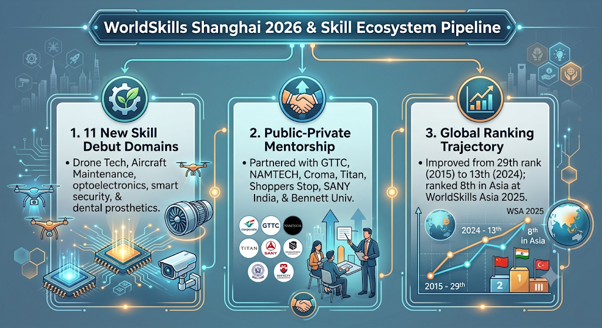
- 29th (2015) → 13th (2024) → 8th in Asia (WorldSkills Asia 2025). India also won five medals at the Taipei Capital Cup 2026, indicating growing international competitiveness in skills.
Key Highlights:
The 11 new skills are Dental Prosthetics, Digital Interactive Media Design, Intelligent Security Technology, Landscape Gardening, Optoelectronic Technology, Retail Sales, Unmanned Aerial Systems, Industrial Mechanics, Software Testing and Heavy Vehicle Technology, and Aircraft Maintenance.
-
- Team Skill India will compete in 63 out of 64 skills with a contingent of nearly 70 competitors, making it one of India’s largest and most diverse WorldSkills representations.
- Unmanned Aerial Systems reflects the growing importance of drone technologies in areas such as agriculture, infrastructure, public services, monitoring and autonomous applications.
- Intelligent Security Technology focuses on AI-enabled surveillance, intelligent sensors and automated response systems for protecting people, infrastructure and assets.
- Optoelectronic Technology combines light and electricity and has applications in advanced manufacturing, healthcare, communications and intelligent technologies.
- Digital Interactive Media Design represents the convergence of design, content and emerging technologies to create immersive and interactive digital experiences.
- Aircraft Maintenance and Heavy Vehicle Technology reflect the increasing need for specialised technical capabilities in sophisticated mobility and transportation systems.
- Software Testing and Industrial Mechanics highlight the importance of quality assurance, precision maintenance, troubleshooting and optimisation in modern industrial systems.
- Dental Prosthetics, Landscape Gardening and Retail Sales demonstrate that future-oriented skilling extends beyond high technology to include healthcare, sustainable services and customer-centric occupations.
UPSC Quick Reference Table
| Parameter | Key Details |
| Event | 48th WorldSkills Competition, Shanghai 2026 |
| Dates & Venue | 22–27 September 2026; Shanghai, China |
| India’s Participation | 63 of 64 skills; nearly 70 competitors |
| New Skills | 11 first-time categories including UAS, Software Testing, Aircraft Maintenance, Optoelectronics and Dental Prosthetics |
| Institutional Framework | MSDE leads; NSDC coordinates preparation with industry, training institutions and experts |
| Performance & Mission | India: 29th (2015) → 13th (2024); 8th in Asia at WorldSkills Asia 2025; aligned with Skill India Mission |
Conclusion:
India’s expanded participation in WorldSkills Shanghai 2026 reflects the evolution of its skilling ecosystem towards globally benchmarked, technology-enabled and industry-relevant capabilities.
Spread the Word