TOPIC-1: DGFT Introduces Open API Facility for Certificate of Origin on Trade Connect e-Platform
-
- GS Paper 2 (Government Policies & Interventions for Governance; Ease of Doing Business)
- GS Paper 3 (Indian Economy — Foreign Trade Policy, Trade Facilitation, Digital Public Infrastructure, and Export Promotion).
Introduction: The Directorate General of Foreign Trade (DGFT), Ministry of Commerce and Industry, launched an Open Application Programming Interface (API) facility on Trade Connect e-Platform on September 7, 2026. The system enables Indian exporters to integrate their internal ERP and accounting software directly with the DGFT portal to apply for, receive and verify Certificates of Origin (CoO).
About Certificate of Origin (CoO):
A Certificate of Origin (CoO) is a critical trade document declaring national origin of exported goods. Preferential CoOs allow importers to claim reduced or zero customs tariffs under Free Trade Agreements (FTAs), whereas Non-Preferential CoOs validate origin for general customs clearance and trade remedies. DGFT replaces manual web data entry with direct system-to-system data transfer from exporters’ Enterprise Resource Planning (ERP) systems, reducing errors and processing latency.
Key Highlights
-
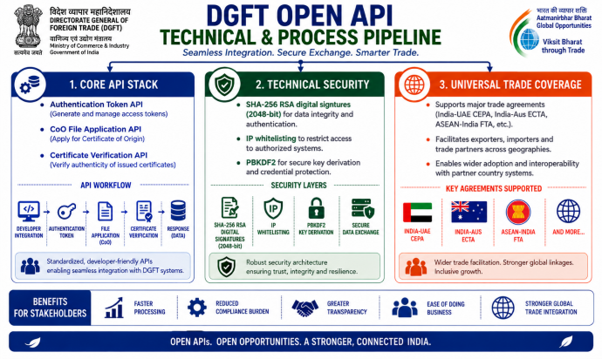
- Direct ERP Integration: Allows exporters to push shipment data directly from accounting software (e.g., SAP, Tally, Oracle) to DGFT, eliminating redundant manual data entries.
- Three-Tier API Architecture: Deploys a dedicated Authentication Token API for secure sessions, a CoO File API for application handling/certificate issuance, and a Certificate Verification API for real-time authenticity checks.
- Enterprise Security & Encryption: Features SHA-256 RSA digital signatures with 2048-bit X.509 certificates, dynamic salt PBKDF2 password hashing, and IP-whitelisted endpoint access.
- Real-time Transaction Ledger: Tracks application lifecycles (Draft, In Process, Approved, Issued, Rejected) via automated file numbers and unique acknowledgement IDs.
- Broad Trade Agreement Coverage: Automates origin rules for key bilateral and regional pacts—including India–UAE CEPA, India–Australia ECTA, SAFTA, ASEAN–India FTA, India–Japan CEPA, and non-preferential schemes.
UPSC Quick Reference Table
| Feature | Detailed Specification |
| Nodal Agency | Directorate General of Foreign Trade (DGFT), Ministry of Commerce & Industry |
| Portal / Platform | Trade Connect e-Platform (trade.gov.in) |
| Regulatory Instrument | Trade Notice No. 25/2026-27 (Dated 07 September 2026) |
| Primary Core Innovation | Open API Integration for Preferential & Non-Preferential CoO |
| Security Standards | SHA-256 RSA (2048-bit digital signatures) & IP Whitelisting |
| Trade Policy Goal | Digital Trade Facilitation, Reducing Compliance Costs, & Ease of Doing Business |
Conclusion:
The introduction of the Open API facility on the Trade Connect e-Platform modernizes India’s digital trade infrastructure. Automating Certificate of Origin workflows lowers transaction costs, prevents data errors, and enhances export competitiveness under India’s expanding Free Trade Agreements.
TOPIC-2: IndiaAI Mission & Sweden Strategic Dialogue under SITAC
-
- GS Paper 2 (Bilateral Groupings & Agreements involving India; International Technology Governance)
- GS Paper 3 (Science & Technology — Artificial Intelligence, IndiaAI Mission, Digital Public Infrastructure, and Industrial AI).
Introduction: The IndiaAI Mission under the Ministry of Electronics and Information Technology (MeitY) held a high-level bilateral dialogue with a Swedish delegation in New Delhi under Sweden-India Technology and AI Corridor (SITAC) on September 07, 2026. The meeting aimed to leverage synergies between Sweden’s advanced manufacturing/industrial AI expertise and India’s scale, AI talent, and Digital Public Infrastructure (DPI).
About SITAC:
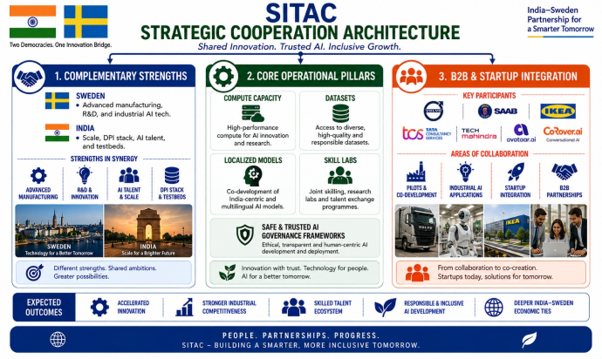
The Sweden-India Technology and AI Corridor (SITAC) serves as a structured bridge between Swedish industrial leaders and India’s growing artificial intelligence ecosystem. The dialogue aligns with the IndiaAI Mission’s core pillars i.e. compute infrastructure, datasets and models, indigenous AI development, application engineering, future skills, startup financing and Safe & Trusted AI.
Key Highlights:
-
- Industrial AI & R&D Synergy: Merges Sweden’s capabilities in precision manufacturing, robotics, and industrial AI with India’s enterprise AI solutions and large-scale deployment testbeds.
- Responsible AI & Governance Dialogue: Deliberated on enterprise AI adoption, data localization, trusted data flows, and market access parameters to foster ethical and secure AI deployment.
- Corporate & Startup Collaboration: Facilitated direct discussions between major Swedish firms (Volvo Group, Saab, Sandvik, SKF, IKEA, Autoliv) and Indian technology players (TCS, Tech Mahindra, CoRover.ai, Avataar AI, Innefu, Gnani) to explore pilot programs and co-development.
- Promoting Trade & Tech Innovation: Reaffirmed shared goals under SITAC to streamline cross-border trade, regulatory alignment, and startup incubation across electronics and artificial intelligence value chains.
UPSC Quick Reference Table
| Feature | Detailed Specification |
| Nodal Agency | IndiaAI Mission, Ministry of Electronics & IT (MeitY) |
| Partner Country / Entity | Sweden / Business Sweden & Embassy of Sweden in India |
| Institutional Corridor | Sweden-India Technology and AI Corridor (SITAC) |
| Key Leadership | Shri Saurabh Vijay IAS (CEO, IndiaAI) & H.E. Agnes Julin (Minister Counsellor, Sweden) |
| IndiaAI Pillars Covered | Compute, Datasets & Models, Domain AI, Future Skills, & Safe/Trusted AI |
| Primary Industry Focus | Industrial AI, Digital Public Infrastructure (DPI), Advanced Manufacturing |
Conclusion:
The SITAC dialogue between IndiaAI Mission and Sweden strengthens bilateral cooperation in artificial intelligence and digitalisation. Combining Sweden’s industrial R&D with India’s digital infrastructure and tech talent supports responsible, trusted, and commercial AI adoption across global markets.
TOPIC-3: NITI Aayog Launches PACT & ZET Marketplace under e-FAST India
-
- GS Paper 2 (Government Policies & Interventions in Infrastructure)
- GS Paper 3 (Indian Economy — Transport & Logistics Sector, Decarbonization, Electric Mobility, and Climate Change Commitments).
Introduction: NITI Aayog launched Platform for Aggregating Clean Transport (PACT) and Zero-Emission Truck (ZET) Marketplace during the 5th e-FAST India Summit 2026. The dual initiatives aim to accelerate the commercial deployment of electric medium- and heavy-duty vehicles (e-MHDVs) by aggregating freight demand across logistics corridors.
About e-FAST India, PACT, and ZET Marketplace:
-
- e-FAST India (Electric Freight Accelerator for Sustainable Transport – India) is NITI Aayog’s apex multi-stakeholder platform connecting OEMs, shippers, logistics service providers (LSPs), financiers, and charge point operators (CPOs).
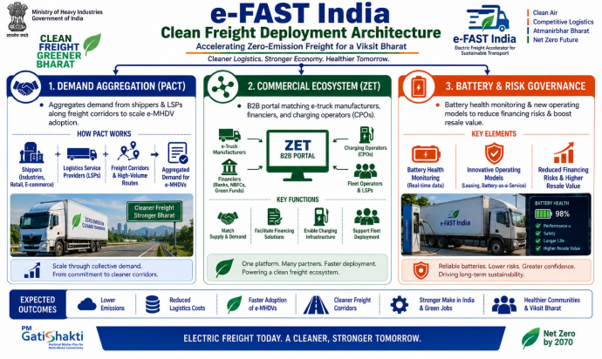
- The newly launched PACT aggregates freight demand to improve demand visibility along designated freight corridors.
- ZET Marketplace serves as a B2B interactive hub connecting OEMs, technology firms, and financiers to convert zero-emission freight commitments into deployed fleets.
Key Highlights:
-
- Demand Aggregation via PACT: Solves market fragmentation by pooling demand across shippers and logistics operators, strengthening the financial viability of electric trucks.
- Accelerated Market Growth: Electric freight deployments surged more than fourfold from 201 vehicles in FY25 to 826 in FY26, bringing the total operational e-MHD trucks in India to over 3,000 units.
- ZET Marketplace B2B Hub: Facilitates commercial partnerships, financing models, charging infrastructure planning, and de-risking mechanisms for fleet operators.
- Focus on Battery Governance: Promotes battery health monitoring systems and asset-light operating models to lower financing risks, enhance secondary market resale values, and attract private capital.
UPSC Quick Reference Table
| Feature | Detailed Specification |
| Nodal Think Tank | NITI Aayog (in partnership with MoRTH, MHI, and WRI India) |
| Parent Platform | e-FAST India (Electric Freight Accelerator for Sustainable Transport) |
| Key Launches | PACT (Platform for Aggregating Clean Transport) & ZET Marketplace |
| Target Vehicle Segment | Electric Medium- and Heavy-Duty Vehicles (e-MHDVs) |
| E-Freight Growth | Deployments expanded from 201 (FY25) to 826 (FY26); 3,000+ active e-trucks |
| Strategic Focus | Corridor-based charging, battery health monitoring, and demand aggregation |
Conclusion:
Launching PACT and the ZET Marketplace shifts India’s zero-emission freight strategy from isolated pilot programs to a scalable, commercially viable model. Aggregating demand, improving battery governance, and expanding corridor charging infrastructure strengthens logistics competitiveness while advancing national net-zero targets.
Spread the Word