TOPIC-1: Award of President’s Colours to Puducherry Police
-
- GS Paper 2 (Functions and responsibilities of the Union and the States, Governance in Union Territories; Statutory, regulatory, and quasi-judicial bodies)
- GS Paper 3 (Internal security challenges, police reforms, technology in criminal justice).
Context: The President’s Colours is the highest military and police honour bestowed upon a disciplined force in India, acknowledging exemplary service, valour, and operational dedication over an extended period.
-
- Establishment of DGP Post: The formal administrative post of Director General of Police (DGP) in Puducherry was instituted on 1 October 1963, forming the core of internal security management in the Union Territory.
- Geographic Jurisdiction: The force manages internal security across four geographically separated enclaves spread across three coastal states: Puducherry and Karaikal (Tamil Nadu), Yanam (Andhra Pradesh), and Mahe (Kerala).
Key Highlights
1. Transition to New Criminal Laws:
The address underscored the operational implementation of India’s three reformed criminal laws (Bharatiya Nyaya Sanhita, Bharatiya Nagarik Suraksha Sanhita, and Bharatiya Sakshya Adhiniyam), which replaced colonial-era penal codes.
2. Financial & Infrastructural Development in Puducherry
-
- Financial Allocations: Central assistance to Puducherry rose significantly from ₹3,500 crore (1950–2014) to ₹13,762 crore (2014–2026).
- Industrial Capital: Facilitated industrial investments worth ₹39,000 crore over the past nine years.
- Connectivity Upgrades:
- NH 332-A Four-Laning: Executed at a cost of ₹2,200 crore.
- Aviation Infrastructure: Construction of an extended runway (~3,400 meters long by 45 meters wide).
UPSC Quick Reference Table
| Component | Detailed Specification |
| Nodal Ministry | Ministry of Home Affairs (MHA) |
| Highest Police Honour | President’s Colours |
| DGP Post Institution Date | 1 October 1963 |
| Reformed Legal Pillars | Technology, Timeline, and Trust |
| Major Highway Project | Four-laning of NH 332-A (₹2,200 Crore) |
| Industrial Investment | ₹39,000 Crore (2017–2026 period) |
Conclusion:
Aligning modern policing with technology-driven criminal justice laws and expanded UT infrastructure supports regional security and development goals.
TOPIC-2: India Achieves Landmark 300 GW Non-Fossil Fuel Power Capacity
-
- GS Paper 3 (Infrastructure: Energy; Conservation, environmental pollution, and degradation; Science & Technology – Indigenization of technology & development of new technology).
Overview: India crossed 300 GW of installed non-fossil fuel-based electricity generation capacity as of 31 July 2026. This milestone represents over 60% of the country’s target to achieve 500 GW of non-fossil power capacity by 2030. Non-fossil fuel sources now account for over 54% of India’s total installed electricity generation capacity, which stands at approximately 552 GW.
Capacity Breakdown
| Source Category | Installed Capacity (as on 31.07.2026) | Historical Benchmark (2014) | Key Growth Highlights |
|---|---|---|---|
| Solar Power | 164.59 GW | ~2.8 GW | Primary growth driver; expanded nearly 59-fold since 2014. |
| Wind Power | 58.14 GW | ~21.0 GW | Strong onshore and offshore momentum; nearly tripled since 2014. |
| Hydro Power | 57.24 GW | — | Encompasses both Large and Small Hydroelectric projects. |
| Bio-Power | 11.75 GW | — | Includes biomass, bagasse cogeneration, and waste-to-energy. |
| Nuclear Power | 8.78 GW | — | Managed by NPCIL; clean baseload power source. |
| Total Non-Fossil | 300.50 GW | — | Account for >54% of total installed power capacity (552 GW). |
Developments:
1. FY 2025–26 Addition Record: During the financial year 2025–26, India installed a record 29 GW of non-fossil fuel electricity capacity in a single year. Key contributions included:
-
- Solar Capacity Addition:60 GW
- Wind Capacity Addition:00 GW
2. Clean Energy Generation Growth: Renewable energy generation in India expanded from 96 Billion Units (BU) in 2014–15 to 477.79 BU in 2025–26, providing clean energy across industrial, commercial, and domestic grids.
Schemes:
1. Approved List of Models and Manufacturers (ALMM): Non-tariff barriers and quality benchmarks under ALMM have boosted domestic solar PV manufacturing capacity beyond 200 GW, up from just 2.3 GW in 2014.
2. Production Linked Incentive (PLI) Scheme: Supports end-to-end integration of high-efficiency solar PV modules, wafers, and ingots.
3. National Green Hydrogen Mission: Implemented by the Ministry of New and Renewable Energy (MNRE) to drive deep industrial decarbonization in hard-to-abate sectors (steel, fertilizers, shipping) and establish India as a green hydrogen export hub.
UPSC Quick Reference Table
| Indicator / Metric | Detailed Specification |
| Nodal Ministry | Ministry of New and Renewable Energy (MNRE) |
| Current Non-Fossil Capacity | 300.50 GW (as on 31 July 2026) |
| 2030 National Target | 500 GW Non-Fossil Capacity (Panchamrit Goal) |
| Non-Fossil Share in Grid | >54% of Total Installed Generation Capacity (~552 GW) |
| Single-Year Record (FY 26) | 55.29 GW Non-Fossil capacity added in FY 2025–26 |
| ALMM Module Capacity | Crossed 200 GW enlisted domestic capacity |
| RE Generation Surge | Increased to 477.79 Billion Units (BU) in FY 2025–26 |
Conclusion:
By combining rapid solar and wind deployment with domestic manufacturing support under ALMM and the PLI scheme, India is advancing toward its target of 500 GW non-fossil capacity by 2030 and its long-term goal of Net-Zero emissions by 2070.
TOPIC-3: India’s First Accreditation Scheme for Mobile Food Testing Laboratories
-
- GS Paper 2 (Government policies and interventions; Statutory, regulatory, and quasi-judicial bodies — Quality Council of India/NABL);
- GS Paper 3 (Food security, food safety infrastructure, regulatory compliance, and Ease of Doing Business).
Overview: The National Accreditation Board for Testing and Calibration Laboratories (NABL), a constituent board of the Quality Council of India (QCI) under the Ministry of Commerce & Industry, launched India’s first-of-its-kind Accreditation Scheme for Mobile Food Testing Laboratories. The initiative was unveiled alongside a Multilateral MoU Exchange at the ‘Gunvatta Samanvaya’ ceremony in New Delhi.
Core Objectives
-
- Last-Mile Food Safety Surveillance: Brings internationally benchmarked, quality-assured testing directly to local mandis, rural markets, and food business operators (FBOs), speeding up regulatory interventions and detecting adulteration at the source.
- Integrated Assessment Framework (IAF): Unifies multiple testing certifications through a single, coordinated assessment framework, eliminating duplicate audits and improving the Ease of Doing Business (EoDB) for laboratory networks.
- Consumer Confidence & Traceability: Enhances public trust by providing verifiable, accredited test results for fresh produce, milk, spices, and processed food products in non-laboratory settings.
Institutional Framework
-
- NABL & QCI: Serves as the primary accreditation body, aligning mobile laboratory standards with international benchmarks (e.g., ISO/IEC 17025).
- DPIIT (Department for Promotion of Industry and Internal Trade): Oversees national quality infrastructure policies aimed at achieving the Viksit Bharat @2047 quality targets.
- Regulatory & Commodity Boards: Facilitates mutual recognition among state food safety authorities, FSSAI, and commodity boards (e.g., Spices Board, Tea Board) under the multilateral MoU.
UPSC Quick Reference Table
| Aspect | Detailed Specification |
| Nodal Body | NABL (National Accreditation Board for Testing and Calibration Laboratories) |
| Parent Organization | Quality Council of India (QCI), DPIIT, Ministry of Commerce & Industry |
| Key Event | Gunvatta Samanvaya — Multilateral MoU Exchange Ceremony |
| Primary Initiative | Accreditation Scheme for Mobile Food Testing Laboratories |
| Operational Program | Integrated Assessment Programme (IAP) |
| Core Value Drivers | Quality-at-source, last-mile food safety, regulatory harmonizations, EoDB |
Conclusion:
Launching the Accreditation Scheme for Mobile Food Testing Laboratories under the Integrated Assessment Framework helps strengthen India’s quality control infrastructure. Decentralizing food testing to mobile units while harmonizing regulatory assessments supports food safety surveillance, reduces compliance burdens, and protects consumer health across rural and urban markets.
TOPIC-4: National Framework for Cultural Diplomacy
-
- GS Paper 2 (India and its neighborhood-relations; Bilateral, regional and global groupings and agreements involving India and/or affecting India’s interests; Effect of policies and politics of developed and developing countries on India’s interests);
- GS Paper 1 (Indian Culture – salient aspects of Art Forms, Literature, and Architecture from ancient to modern times).
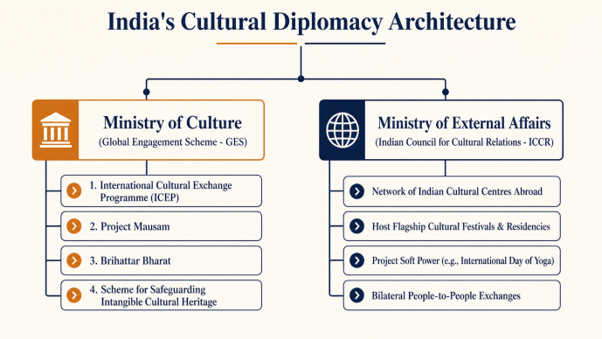
Context: India’s international cultural relations are primarily promoted through Global Engagement Scheme (GES) an umbrella scheme administered by the Ministry of Culture in close synergy with the Indian Council for Cultural Relations (ICCR) under the Ministry of External Affairs (MEA).
The Four Pillars of the Global Engagement Scheme (GES)
The Ministry of Culture operates the GES across four specific components to project India’s civilizational heritage, support capacity building, and strengthen soft-power engagement:
| GES Component | Core Operational Mandate & Key Features |
|---|---|
| 1. International Cultural Exchange Programme (ICEP) | • Executes Festivals of India overseas, exchanges of artistic troupes, and manages bilateral agreements. • Operates valid Cultural Exchange Programmes (CEPs) with 98 countries. • Facilitates multilateral cultural tracks under BRICS, G20, SCO, and BIMSTEC. |
| 2. Project Mausam | • Focuses on maritime cultural routes and historical linkages across the Indian Ocean World. • Promotes heritage conservation, cross-border maritime documentation, and joint UNESCO nominations. |
| 3. Brihattar Bharat | • Documenting and preserving historical civilizational, artistic, architectural, and literary linkages across South, South-East, and Central Asia. |
| 4. Scheme for Safeguarding Intangible Cultural Heritage (ICH) | • Focuses on inventorying, protecting, and promoting India’s diverse cultural traditions and UNESCO-recognized intangible heritage. |
Role of the Indian Council for Cultural Relations (ICCR)
As an autonomous body under the Ministry of External Affairs (MEA), ICCR complements the Ministry of Culture’s efforts through direct international execution:
-
- Global Footprint: Manages a widespread network of Indian Cultural Centres (ICCs) across the world.
- Flagship Festivals & Residencies: Hosts international cultural festivals and visual art residencies in India, providing a platform for foreign artists to collaborate with domestic practitioners.
- Global Soft Power Initiatives: Leads international commemorations, including the annual execution and coordination of the International Day of Yoga (21 June) globally.
UPSC Quick Reference Table
| Aspect | Detailed Specification |
| Nodal Ministries | Ministry of Culture (GES) & Ministry of External Affairs (ICCR) |
| Key Umbrella Scheme | Global Engagement Scheme (GES) |
| Active CEP Countries | 98 Countries (Bilateral Cultural Exchange Programmes) |
| Multilateral Forums | BRICS, G20, Shanghai Cooperation Organisation (SCO), BIMSTEC |
| Key Maritime Project | Project Mausam (Indian Ocean World cultural connectivity) |
Conclusion:
Integrating the Ministry of Culture’s Global Engagement Scheme (GES) with the ICCR’s global outreach network provides a structured framework for India’s soft-power projection.
TOPIC-5: GIS-Based Urban Planning & Modernisation of Master Plans
-
- GS Paper 2 (Governance, Constitutional 12th Schedule, Devolution of powers to ULBs);
- GS Paper 3 (Urbanization, Infrastructure – PM Gati Shakti, Disaster Management & Geospatial Technology Applications).
Constitutional Architecture: Under the Twelfth Schedule (Article 243W) of the Constitution of India, urban planning—including the preparation and enforcement of municipal master plans—is the statutory function of State Governments, Urban Local Bodies (ULBs), and Urban Development Authorities. The Ministry of Housing and Urban Affairs (MoHUA) supplements state efforts through Central Sector/Centrally Sponsored schemes, technical advisories, and standardized planning frameworks like the URDPFI (Urban and Regional Development Plans Formulation and Implementation) Guidelines.
Implementation Footprint (As of August 2026)
| Metric / Stage | AMRUT GIS Sub-Scheme (Class-I Cities) | AMRUT 2.0 GIS Sub-Scheme (Class-II Towns) |
|---|---|---|
| Scope / Target | 461 Cities across 35 States/UTs | 875 Towns (Population 50k–99,999) |
| Mapping Resolution | VHRS Satellite Imagery (1:4000 scale) | VHRS (1:4000) + Drone/UAV (1:1000 scale) |
| Draft Geo-Databases | 437 Cities completed | 399 Towns prepared (100 finalized) |
| Draft Master Plans | 404 Cities prepared | 136 Towns prepared |
| Final Master Plans | 292 Cities finalized | 93 Towns finalized |
| Capacity Building | 2,968 officials trained (79 workshops) | 2,648 officials trained (34 workshops) |
Integration with PM Gati Shakti
-
- PM Gati Shakti Convergence: To eliminate inter-departmental silos, GIS base layers created under AMRUT and AMRUT 2.0 are directly integrated into the PM Gati Shakti National Master Plan (NMP) Portal, with spatial datasets for 343 towns already uploaded to enable synchronized infrastructure layout (water, gas, transit, electricity).
-
- Multi-Layered Spatial Analytics: The digital master plans integrate datasets covering land use, transport corridors, drainage networks, water supply grids, public utilities, and environmentally sensitive zones.
- Enforcement & Building Bye-Laws: While MoHUA provides the digital base map, the actual enforcement against unauthorized construction relies on State/ULB integration with Online Building Permission Systems (OBPAS).
UPSC Quick Reference Table
| Component | Detailed Specification |
| Nodal Ministry | Ministry of Housing and Urban Affairs (MoHUA) |
| Constitutional Mandate | 12th Schedule (Urban Local Bodies / State Subject) |
| Core Guidance | URDPFI Guidelines (2014) & MoHUA Geospatial Standards (2016/2020) |
| Target Scale | Class-I (1:4000 VHRS); Class-II (1:1000 Drone mapping) |
| Central Integration | PM Gati Shakti National Master Plan Portal (343 towns uploaded) |
| Total Coverage | 461 AMRUT Cities + 875 Class-II Towns |
Conclusion:
Integrating municipal geodatabases with PM Gati Shakti National Master Plan supports data-driven decision-making, faster building approvals, and coordinated urban infrastructure development.
Spread the Word