
TOPIC-1: Glaw Lake Designated as India’s 101st Ramsar Site
-
- GS Paper 3 (Conservation, environmental pollution and degradation, environmental impact assessment; Biodiversity hotspots, wetlands preservation, and international conventions – Ramsar Convention).
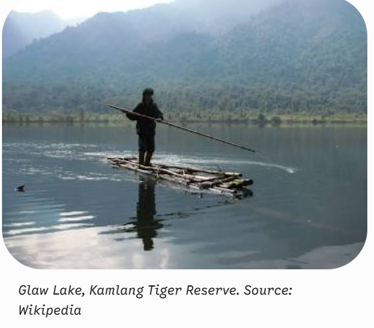
Overview: Union Minister for Environment, Forest and Climate Change, Shri Bhupender Yadav, announced the designation of Glaw Lake in Arunachal Pradesh as India’s 101st Ramsar Site. This declaration marks a notable milestone, as Glaw Lake becomes the first-ever designated Ramsar Site in Arunachal Pradesh. With this addition, India’s national tallies under the Ramsar Convention on Wetlands have expanded from 26 sites in 2014 to over 100 sites today.
Ecological of Glaw Lake
-
- Location: Embedded inside the Kamlang Tiger Reserve and Wildlife Sanctuary in the Eastern Himalayas (Lohit District, Arunachal Pradesh).
- Hydrology: A high-altitude, pristine freshwater lake nourished continuously by perennial mountain streams.
- Botanical Diversity: Serves as a key ecological refugium containing over 150 tree species and 49 orchid species within the wetland basin and surrounding catchment area.
Strategic & Ecological Importance
1. Biodiversity Hotspot Conservation: Protects critical micro-habitats within the Eastern Himalayan biodiversity hotspot, supporting endemic flora, avian corridors, and mammalian fauna inside Kamlang Tiger Reserve.
2. Climate & Water Security: Acts as a vital natural freshwater reservoir and hydrological regulator for downstream river ecosystems in North-East India.
3. Sustainable Community Livelihoods: Enhances community-led eco-tourism, sustainable resource management, and conservation partnerships with local indigenous tribes (such as the Mishmi community).
UPSC Quick Reference Table
| Component | Detailed Specification |
| Nodal Ministry | Ministry of Environment, Forest and Climate Change (MoEFCC) |
| Wetland Name | Glaw Lake (Glao Lake) |
| State Status | Arunachal Pradesh’s 1st Ramsar Site |
| National Milestone | India’s 101st Ramsar Site |
| Associated Protected Area | Kamlang Tiger Reserve and Wildlife Sanctuary |
| International Convention | Ramsar Convention on Wetlands (1971) |
Conclusion:
Designating Glaw Lake as Arunachal Pradesh’s first Ramsar Site strengthens the protection of high-altitude freshwater ecosystems in the Eastern Himalayas. Bringing the lake under the Ramsar framework supports biodiversity conservation, preserves water resources, and promotes sustainable livelihoods for local communities.
TOPIC-2: Climate Resilient Cities & Urban Heatwaves
-
- GS Paper 1 (Urbanization, their problems and remedies; Effects of climate change on human habitat);
- GS Paper 2 (Functions and responsibilities of the Union and the States; Constitutional 12th Schedule; Governance and disaster management);
- GS Paper 3 (Disaster Management – Urban Heat Islands & Heat Action Plans; Environmental Conservation and Sustainable Cooling).
Constitutional Architecture
Under the Twelfth Schedule (Article 243W) of the Constitution of India, urban planning and municipal management fall under the executive domain of State Governments and Urban Local Bodies (ULBs). The Central Government (MoHUA, NDMA, MoEFCC) provides technical advisories, model guidelines, disaster action frameworks, and financial assistance to strengthen urban climate resilience.
Key Initiatives Across Ministries
1. NDMA Guidelines & Informal Worker Protections
-
- Heat Action Plans (HAPs): NDMA’s National Guidelines for Preparation of Action Plan – Prevention and Management of Heat Wave (2019) mandate local vulnerability assessments to address the Urban Heat Island (UHI) effect. HAPs have been adopted across 23 States, 195 districts, and 64 cities.
- Protections for Informal/Outdoor Workers: Advisory measures for street vendors and construction workers include:
- Provision of shaded vending zones and hydration facilities.
- Operation of dedicated cooling centers.
- Staggered/flexible working hours and real-time heat alerts.
2. MoHUA Climate-Responsive Planning & PMAY-U
-
- URDPFI & Urban Green Guidelines (2014): Encourages micro-climate management via compact development, urban forestry, water body restoration, shaded public spaces, cool roofs, and energy-efficient building design.
- Technology & Innovation Sub-Mission (TISM): Established under Pradhan Mantri Awas Yojana – Urban (PMAY-U) to promote resource-efficient, climate-responsive, and eco-friendly construction materials that enhance indoor thermal comfort and lower energy demand.
3. MoEFCC: India Cooling Action Plan (ICAP)
-
- Public Infrastructure Adoption: Enforces Energy Conservation Building Code (ECBC) norms across transport hubs (railway stations, airports, ports).
- MAC & Refrigerant Transition: Encourages research into low Global Warming Potential (GWP) refrigerants and energy-efficient Mobile Air-Conditioning (MAC) systems.
- Skill Development & Circular Economy: Upskills service technicians and enforces the environmentally sound recovery of refrigerants from end-of-life vehicles.
UPSC Quick Reference Table
| Feature / Strategy | Detailed Specification |
| Constitutional Basis | 12th Schedule (State & ULB Subject) |
| HAP Reach | 64 Cities, 195 Districts, 23 States (NDMA 2019 Framework) |
| Key Planning Code | URDPFI Guidelines 2014 (MoHUA) |
| Housing Tech Sub-Mission | TISM under PMAY-U (Focus on cool roofs & green design) |
| Cooling Roadmap | India Cooling Action Plan (ICAP) (MoEFCC) |
| Target Sector Support | Outdoor/Informal Workers (Hydration, shade, flexible hours) |
Conclusion:
Managing urban heatwaves requires coordinated action across urban planning, disaster management, and green housing. Combining local Heat Action Plans with sustainable construction under PMAY-U and cooling protocols under ICAP helps cities adapt to rising temperatures and protect vulnerable populations.
TOPIC-3: India’s First Indigenous African Swine Fever (ASF) Vaccine
-
- GS Paper 3 (Science & Technology – Indigenization of technology, biotechnology in animal health; Economics of animal-rearing; Food and biosecurity; Issues related to livestock and disease management).
Overview of the Innovation: On ICAR’s Foundation Day, Union Agriculture Minister Shri Shivraj Singh Chouhan dedicated India’s first indigenous African Swine Fever (ASF) vaccine to the nation. Developed by scientists at the ICAR–National Institute of High Security Animal Diseases (ICAR-NIHSAD), Bhopal, the vaccine represents a milestone in veterinary biotechnology under the Atmanirbhar Bharat vision, positioning India to strengthen its livestock biosecurity and potentially serve as a global supplier of affordable ASF vaccines.
Disease Context

-
- Nature of Disease: African Swine Fever is a severe viral disease affecting domestic and wild pigs, characterized by high fever, hemorrhages, and mortality rates approaching 100%. It poses no threat to human health (non-zoonotic), but causes severe economic disruption to livestock farming.
- Impact in India: Since its first detection in India in 2020, ASF has disproportionately affected smallholder pig farmers, particularly across the North-Eastern region, disrupting rural livelihoods and protein food chains.
Key Features of the Vaccine Innovation
-
- Platform: A MA-104_Cell_Line-Based Live Attenuated ASF Vaccine derived from a novel attenuated ASFV Genotype II virus with targeted gene deletions.
- Manufacturing Advantage: Existing commercial ASF vaccines (such as those licensed in Vietnam) rely on patented, proprietary cell lines. In contrast, ICAR-NIHSAD’s vaccine utilizes the widely accessible MA-104 cell line, eliminating proprietary dependence, enabling scalable mass production, and significantly lowering per-dose costs.
- Administration & Dosage: Recommended for healthy pigs above 8 weeks of age. Delivered as a 1 mL intramuscular injection, followed by a booster dose 14 days after the primary dose.
- Validation: Field-validated in collaboration with the Department of Animal Husbandry & Dairying (DAHD), satisfying safety, genetic stability, purity, immunogenicity, and non-reversion parameters.
UPSC Quick Reference Table
| Feature | Detailed Specification |
| Developing Body | ICAR–NIHSAD, Bhopal (National Institute of High Security Animal Diseases) |
| Disease Targeted | African Swine Fever (ASFV Genotype II) |
| Vaccine Type | Live Attenuated (MA-104 Cell Line-Based) |
| Dosage Schedule | Primary 1 mL dose at >8 weeks + Booster dose after 14 days |
| Key Distinctions | Non-proprietary cell line platform; scalable for low-cost global supply |
| Primary Beneficiaries | Smallholder pig farmers (especially in North-East India) |
Conclusion:
The development of an indigenous live-attenuated ASF vaccine using the non-proprietary MA-104 cell line addresses a major biosecurity threat to India’s pig farming sector. Lowering production costs and establishing local manufacturing capabilities supports smallholder livestock livelihoods in North-East India and strengthens national veterinary science.
TOPIC-4: Clouded Leopard Conservation Action Plan (CAP)
-
- GS Paper 3 (Conservation, environmental pollution and degradation, biodiversity hotspots; Wildlife protection, species recovery programmes, and international conservation frameworks).
Overview of the Action Plan: On the occasion of International Clouded Leopard Day, the Ministry of Environment, Forest and Climate Change (MoEFCC) highlighted the launch of the Clouded Leopard Conservation Action Plan (CAP). Prepared under a joint Government of India–GEF–UNDP initiative, the plan was released during the 91st meeting of the Standing Committee of the National Board for Wildlife (SCNBWL) in Coimbatore. It creates a structured landscape-level blueprint for securing habitats, restoring ecological corridors, and applying advanced technology to conserve the species across Northeast India.

Key Pillars of the Action Plan (CAP)
1. Priority Landscapes & Corridor Restoration
-
- 14 Priority Landscapes: Identifies 14 key conservation landscapes across North-Eastern states for targeted habitat management.
- Corridor Connectivity: Focuses on restoring fragmented forest corridors to ensure genetic exchange and free movement across contiguous forest tracts.
- Scheme Integration: Formally included under the Species Recovery Programme of the Integrated Development of Wildlife Habitats (IDWH) scheme.
2. Scientific Monitoring & Digital Surveillance
-
- Advanced Monitoring Methods: Uses non-invasive techniques including camera trap surveys, occupancy modeling, genetics, and environmental DNA (eDNA) testing.
- Smart Patrols: Upgrades frontline staff capabilities using the M-STrIPES (Monitoring System for Tigers – Intensive Protection and Ecological Status) application for tracking and anti-poaching operations.
3. Community Participation & Transboundary Cooperation
-
- Community Livelihoods: Partners with indigenous local communities for joint forest protection, eco-tourism, and sustainable livelihood support.
- Transboundary Linkages: Promotes cross-border collaboration with neighboring range countries (e.g., Bhutan, Myanmar, Bangladesh) to manage contiguous wildlife corridors.
UPSC Quick Reference Table
| Component | Detailed Specification |
| Nodal Ministry | Ministry of Environment, Forest and Climate Change (MoEFCC) |
| Collaborative Partners | Government of India – GEF – UNDP |
| Release Event | 91st SCNBWL Meeting (Coimbatore) |
| Target Region | Northeast India (14 Priority Conservation Landscapes) |
| Central Scheme Inclusion | Species Recovery Programme under IDWH |
| Key Patrol Tool | M-STrIPES Smart Application |
Conclusion:
The Clouded Leopard Conservation Action Plan moves protection efforts from isolated wildlife sanctuaries toward landscape-scale management. Combining eDNA monitoring, M-STrIPES patrols, community partnerships, and transboundary cooperation strengthens biodiversity conservation across the ecosystems of Northeast India.
TOPIC-5: Panchayat Advancement Index (PAI) & Localization of SDGs
-
- GS Paper 2 (Devolution of powers and finances up to local levels; Mechanisms, laws, institutions and Bodies constituted for the protection and betterment of vulnerable sections; Governance and Local Self-Government).
Overview: The Ministry of Panchayati Raj (MoPR) has developed the Panchayat Advancement Index (PAI), formerly known as the Panchayat Development Index (PDI), as a composite assessment framework. The framework tracks the incremental performance of Gram Panchayats (GPs) across the nine themes of Localization of Sustainable Development Goals (LSDGs), enabling local authorities to pinpoint performance gaps and prioritize developmental interventions.
Key Components
1. PAI 2.0 Grading Distribution (FY 2023–24)
The PAI 2.0 evaluation evaluated 259,867 Gram Panchayats across the country:
-
- Grade A+ (Top Performers): 0 GPs
- Grade A: 3,635 GPs (Led by Tripura with 943 GPs, Andhra Pradesh with 591, and Odisha with 555)
- Grade B: 118,824 GPs
- Grade C: 123,719 GPs
- Grade D: 13,689 GPs
2. Thematic Planning & “Sankalp” in GPDPs
Before formulating their Gram Panchayat Development Plans (GPDPs), GPs commit to a focus area referred to as a “Sankalp”. For the FY 2026–27 plan year:
-
- 1,56,019 Gram Panchayats have registered their Sankalp.
- 31,789 GPs selected Theme 4: Water Sufficient Panchayat (focusing on drip/sprinkler irrigation, watershed development, and water conservation).
- 32,806 GPs selected Theme 5: Clean and Green Panchayat (focusing on climate-resilient agriculture, agroforestry, and sustainable waste management).
3. Training & Institutional Support
Under the Revamped Rashtriya Gram Swaraj Abhiyan (RGSA), a total of 36,81,750 elected representatives and local stakeholders received thematic training on LSDGs between FY 2022–23 and FY 2026–27 (as of July 10, 2026).
UPSC Quick Reference Table
| Component | Detailed Specification |
| Nodal Ministry | Ministry of Panchayati Raj (MoPR) |
| Framework Name | Panchayat Advancement Index (PAI) — formerly PDI |
| Coverage (PAI 2.0) | 2,59,867 Gram Panchayats across 33 States/UTs |
| Top PAI Grade Achieved | Grade A (3,635 GPs) — Zero GPs qualified for Grade A+ |
| Capacity Building Scheme | Revamped Rashtriya Gram Swaraj Abhiyan (RGSA) |
| Key Climate Themes | Theme 4 (Water Sufficient) & Theme 5 (Clean and Green) |
Conclusion:
The Panchayat Advancement Index (PAI) provides a data-driven approach to local governance by tracking how Gram Panchayats progress on sustainable development goals. Integrating thematic planning into Gram Panchayat Development Plans helps rural local bodies address climate resilience, water conservation, and essential service delivery at the grassroots level.
Spread the Word