
Introduction:
With the transport sector accounting for a significant share of greenhouse gas emissions, decarbonising mobility has become a key priority for achieving India’s Net Zero by 2070 target. In this direction, Indian Railways has launched India’s first indigenous Hydrogen Fuel Cell-powered train, marking a major step towards clean rail transportation, energy security, and the objectives of the National Green Hydrogen Mission.
Key Highlights
-
- India inaugurated its first indigenous Hydrogen Fuel Cell-powered train on 17 July 2026.
- The train will operate on the Jind–Sonipat section of the Northern Railway.
- Developed entirely in India under the technical guidance of Research Design & Standards Organisation (RDSO).
- Powered by a 1200 kW Hydrogen Fuel Cell propulsion system.
- Supported by India’s largest railway hydrogen storage and refuelling facility at Jind, Haryana.
- The initiative complements the National Green Hydrogen Mission and Indian Railways’ goal of becoming a Net Zero Carbon Emitter by 2030.
Hydrogen as a Clean Energy Carrier
Hydrogen is not a primary source of energy, but an energy carrier that stores and delivers energy similar to electricity. It is increasingly regarded as a fuel of the future because it can provide clean energy for sectors where direct electrification is difficult.
Why is Hydrogen Considered a Clean Fuel?
-
- Hydrogen has a high energy density, enabling it to generate more energy per unit mass than conventional fossil fuels, making it suitable for heavy transportation and industrial applications.
- When used in a fuel cell, hydrogen combines with oxygen through an electrochemical process to produce electricity, emitting only water vapour and heat as by-products without releasing carbon dioxide.
- Unlike fossil fuels, hydrogen can contribute to reducing air pollution, improving energy security and supporting the transition towards a low-carbon economy.
- It is particularly valuable for hard-to-abate sectors such as railways, shipping, aviation, steel and fertiliser industries where battery-based technologies have practical limitations.
Types of Hydrogen
Hydrogen is classified according to the method of production and the associated carbon emissions. India’s policy focus is on Green Hydrogen, which forms the foundation of the National Green Hydrogen Mission.
| Type | Production Method | Carbon Emissions |
|---|---|---|
| Grey Hydrogen | Produced from natural gas through steam methane reforming | High carbon emissions |
| Blue Hydrogen | Produced from fossil fuels with Carbon Capture, Utilisation and Storage (CCUS) | Lower emissions than grey hydrogen |
| Green Hydrogen | Produced by electrolysis of water using renewable energy sources such as solar or wind | Near-zero carbon emissions |
Applications of Hydrogen
Hydrogen has emerged as a versatile clean fuel with applications across multiple sectors of the economy.
1. Transport Sector
-
- Hydrogen fuel cells are increasingly being deployed in trains, buses, trucks, ships and future aviation technologies, particularly for long-distance transport where batteries may be less efficient.
- Hydrogen-powered mobility offers an alternative to diesel in sectors requiring high power output and longer operational range.
2. Industrial Sector
-
- Green hydrogen can replace fossil fuels in steel manufacturing, oil refineries, fertiliser production and other energy-intensive industries, reducing industrial carbon emissions.
3. Power & Energy Sector
-
- Hydrogen can be used for long-duration energy storage, balancing renewable energy generation and improving grid stability.
- It also enables the conversion of surplus renewable electricity into a storable form of clean energy.
4. Strategic Importance
-
- Reduces dependence on imported fossil fuels, thereby enhancing energy security.
- Supports India’s ambition of becoming a global hub for green hydrogen production and exports under the National Green Hydrogen Mission.
Hydrogen Fuel Cell Technology
The Hydrogen Fuel Cell is the core technology powering India’s first hydrogen train, converting chemical energy directly into electricity without combustion.
Working Mechanism
-
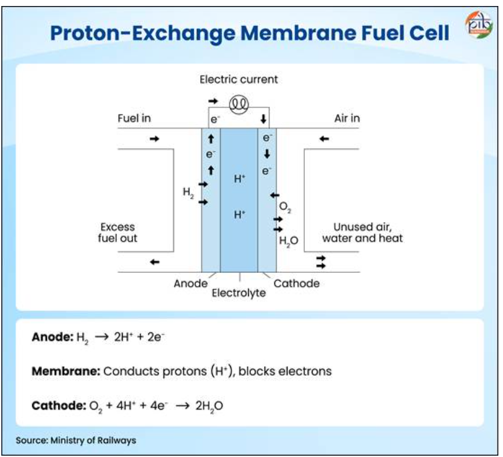
- The train uses a Proton Exchange Membrane Fuel Cell (PEMFC), in which hydrogen reacts electrochemically with oxygen across a proton-conducting membrane to generate electricity.
- The electricity generated powers the train’s electric motors, while the only by-products are water vapour and heat, making the system a zero tailpipe emission technology.
- Unlike conventional diesel locomotives, fuel cells convert energy directly into electricity without combustion, resulting in higher efficiency, lower noise levels and reduced maintenance requirements.
- The technology is particularly suitable for non-electrified railway routes, where full electrification may not be technically or economically feasible.
Advantages over Diesel Traction
-
- Hydrogen possesses an energy density of approximately 120 MJ/kg, compared to 43 MJ/kg for diesel, making it a highly energy-efficient fuel for heavy transportation.
- Fuel cell trains significantly reduce greenhouse gas emissions and local air pollutants while maintaining operational reliability.
- The technology supports sustainable mobility without compromising passenger capacity or long-distance operational capability.
National Green Hydrogen Mission
-
- Launched in 2023, the National Green Hydrogen Mission aims to position India as a global hub for the production, utilisation and export of Green Hydrogen.
- The Mission seeks to decarbonise hard-to-abate sectors, reduce dependence on imported fossil fuels and promote indigenous manufacturing of hydrogen technologies.
- Initiatives such as the Hydrogen Fuel Cell Train serve as pilot projects for demonstrating the commercial viability of green hydrogen in the transport sector.
- The Mission contributes towards India’s commitments under the Panchamrit goals and the target of achieving Net Zero emissions by 2070.
India’s First Hydrogen-Powered Train: Salient Features
-
- The train will operate on the Jind–Sonipat section of Northern Railway, demonstrating hydrogen-based propulsion on a non-electrified railway route.
- It has been designed and developed indigenously under the technical guidance of the Research Design & Standards Organisation (RDSO), reflecting the objectives of Atmanirbhar Bharat in advanced railway technologies.
- The train is powered by a 1200 kW Hydrogen Fuel Cell propulsion system, making it one of the most powerful hydrogen-powered passenger trains currently under development.
- Besides introducing a new trainset, the project establishes the institutional and technical ecosystem necessary for scaling hydrogen mobility in Indian Railways.
Hydrogen Infrastructure
-
- Indian Railways has established the country’s largest railway hydrogen storage and refuelling facility at Jind, Haryana, enabling regular operation of hydrogen-powered trains.
- The facility can store nearly 3,000 kg of hydrogen and includes hydrogen compression, dispensing and standby refuelling systems to ensure uninterrupted train operations.
- The infrastructure has been licensed by the Petroleum and Explosives Safety Organisation (PESO) and developed in accordance with internationally recognised NFPA-2 and ISO 19880 Series standards.
- An independent safety assessment by TÜV SÜD (Germany) validates the safety and reliability of the hydrogen ecosystem.
Operational Preparedness
-
- Indian Railways has established Standard Operating Procedures (SOPs), specialised maintenance facilities, trained personnel and continuous operational monitoring to ensure safe deployment of hydrogen technology.
- Multiple safety systems, including hydrogen leak detectors, flame detectors, automatic hydrogen shut-off mechanisms and continuous ventilation, minimise operational risks associated with hydrogen storage and utilisation.
Significance
-
- Hydrogen fuel cell technology provides a zero tailpipe emission alternative to diesel locomotives, supporting India’s transition towards a low-carbon transport system and reducing greenhouse gas emissions from the railway sector.
-
- The project serves as a pilot for large-scale deployment of green hydrogen in transportation, creating demand for indigenous hydrogen production and accelerating the implementation of the National Green Hydrogen Mission.
-
- Hydrogen offers an alternative to imported petroleum fuels, reducing dependence on fossil fuel imports while diversifying India’s clean energy portfolio.
-
- Indigenous development of hydrogen propulsion technology, storage infrastructure and safety systems enhances domestic technological capability and creates opportunities for innovation and manufacturing.
- The project establishes operational protocols, technical standards and institutional capacity that can facilitate the gradual expansion of hydrogen-powered mobility across suitable railway routes.
Challenges
-
- According to NITI Aayog and the International Energy Agency (IEA), green hydrogen remains significantly more expensive than fossil-fuel alternatives due to high renewable electricity and electrolyser costs, limiting its commercial competitiveness.
- Reports by IEA and Ministry of New & Renewable Energy (MNRE) highlight that India currently lacks an extensive network of hydrogen production, storage, transport and refuelling infrastructure required for large-scale deployment.
- NITI Aayog and Parliamentary Standing Committee on Energy have emphasised the need to strengthen domestic manufacturing of electrolysers, fuel cells and hydrogen storage systems to reduce import dependence.
- Hydrogen is highly flammable and requires stringent standards for storage, transportation and refuelling. Continuous refinement of safety protocols and skilled manpower will be essential as deployment expands. (IEA; Ministry of Railways)
- The long-term financial sustainability of hydrogen-powered trains will depend on reductions in hydrogen production costs, economies of scale and supportive policy incentives. (IEA; ORF)
Way Forward
-
- Accelerate implementation of the National Green Hydrogen Mission through greater investment in renewable energy, electrolyser manufacturing and dedicated hydrogen hubs. (MNRE; NITI Aayog)
- Expand hydrogen production, storage, transportation and refuelling facilities along major railway corridors to support commercial deployment. (IEA; Ministry of Railways)
- Promote domestic production of fuel cells, electrolysers, storage cylinders and related components through targeted incentives and public-private partnerships. (NITI Aayog; Make in India)
- Continue demonstration projects across different climatic and operational conditions to improve efficiency, reduce costs and establish standard operating practices. (IEA; Ministry of Railways)
- Develop comprehensive standards for hydrogen safety, certification, transportation and emergency response in line with international best practices to facilitate large-scale adoption. (IEA; PESO; Ministry of Railways)
Conclusion:
It represents the creation of an ecosystem for clean, indigenous and future-ready rail mobility by integrating green hydrogen into the transport sector. India is laying the foundation for a resilient, low-carbon railway network while advancing the objectives of the National Green Hydrogen Mission, Atmanirbhar Bharat and the country’s Net Zero 2070 commitment.
Spread the Word