
TOPIC-1 : India’s Nationally Determined Contribution (NDC) Targets & Climate Architecture
-
- GS Paper 3 (Conservation, environmental pollution and degradation, environmental impact assessment; Climate Change Mitigation & Adaptation; India’s International Commitments – Paris Agreement).
What are Nationally Determined Contributions (NDCs)?
Nationally Determined Contributions (NDCs) represent the national climate action plans submitted by signatory countries under the Paris Agreement (Article 4). They outline quantitative targets for reducing greenhouse gas emissions, adapting to climate impacts, and transitioning to clean energy models to limit global warming.
India’s Quantitative NDC Targets
1. Quantitative Performance Matrix
-
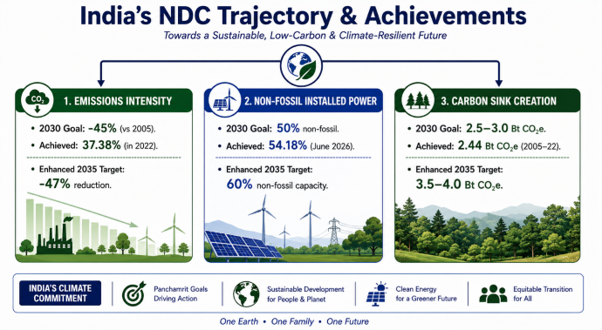
- Emissions Intensity of GDP: Achieved a 37.38% reduction in 2022 from the 2005 baseline, progressing toward the 2030 commitment of 45%.
- Non-Fossil Electric Power Capacity: Non-fossil fuel sources crossed 50% in June 2025 (5 years ahead of the 2030 target) and reached 54.18% as of 30th June 2026.
- Additional Carbon Sink: Created an additional carbon sink of 2.44 billion tonnes of equivalent through forest and tree cover (2005–2022), against the 2030 target of 2.5 to 3.0 billion tonnes.
2. Enhanced Targets for 2035
Aligned with the Viksit Bharat @ 2047 vision, India has scaled up its quantitative goals for 2035:
-
- Emissions Intensity: Reduce emissions intensity of GDP by 47% from 2005 levels.
- Non-Fossil Energy: Achieve 60% cumulative installed electricity capacity from non-fossil sources.
- Carbon Sink Expansion: Expand additional carbon sink capacity to 3.5–4.0 billion tonnes of equivalent.
Flagship Climate Mitigation & Adaptation Programs
-
- Clean Energy Initiatives: National Green Hydrogen Mission, PM Surya Ghar: Muft Bijli Yojana, PM-KUSUM, and Production Linked Incentive (PLI) schemes for high-efficiency solar PV modules and Advanced Chemistry Cell (ACC) batteries.
- Mobility & Industrial Transitions: Deployment of hydrogen-powered trains, Nuclear Energy Mission, and Carbon Capture, Utilisation, and Storage (CCUS) frameworks.
- Coastal Ecosystem Resilience: Implementation of the MISHTI (Mangrove Initiative for Shoreline Habitats & Tangible Incomes) scheme and National Coastal Mission under Coastal Regulation Zone (CRZ) rules.
UPSC Quick Reference Table
| Feature / Indicator | Detailed Specification |
| Nodal Ministry | Ministry of Environment, Forest and Climate Change (MoEFCC) |
| Non-Fossil Share (Current) | 54.18% (as of 30th June 2026; surpassed 2030 target of 50% in 2025) |
| Emissions Intensity Achieved | 37.38% reduction (2022 level vs 2005 baseline) |
| Carbon Sink Created | 2.44 Billion Tonnes e (2005–2022) |
| 2035 Enhanced Targets | -47% Emission Intensity; 60% Non-Fossil Power; 3.5–4.0 Bt e Sink |
| International Governance | AIPA (Apex Committee for Implementation of Paris Agreement) & ETF (Enhanced Transparency Framework) |
Conclusion:
Updating the 2035 targets and deploying programs like MISHTI, the National Green Hydrogen Mission, and PM-KUSUM support India’s broader climate goals and its long-term commitment to net-zero emissions by 2070.
TOPIC-2: Gyan Bharatam Mission (GBM)
-
- GS Paper 1 (Indian Culture – Salient aspects of Art Forms, Literature, and Architecture from ancient to modern times; Preservation and promotion of Indian literary heritage)
- GS Paper 2 (Government policies and interventions for development in various sectors).
What is the Gyan Bharatam Mission (GBM)?
The Gyan Bharatam Mission (GBM) is a nationwide initiative launched by the Ministry of Culture aimed at the systematic identification, cataloguing, physical conservation, digitization, research, publication, and dissemination of India’s vast manuscript heritage. The mission covers manuscripts across all scripts, languages, dialects, traditions, communities, and geographical regions.
Key Progress Metrics & Findings
1. National Manuscript Survey (Launched March 2026)
-
- Manuscripts Documented: Over 1.19 crore manuscripts identified and reported across all States and Union Territories during the survey.
- Digitization Status: Over 8 lakh manuscripts have been digitized nationwide.
- Public Access Portal: More than 3.90 lakh digitized manuscripts are hosted on the Gyan Bharatam portal for public viewing.
2. Financial Allocations (2024–2027)
| Financial Year | Sanctioned Budget (₹ in Crore) | Actual Expenditure (₹ in Crore) |
| 2024–25 | 3.50 | 2.63 |
| 2025–26 | 15.00 | 14.25 |
| 2026–27 | 60.00 | 4.48 (till July 2026) |
Prominent Onboarded Institutions (Select Examples)
-
- Cluster Centres:
- The Asiatic Society, Kolkata (West Bengal)
- Bhandarkar Oriental Research Institute (BORI), Pune (Maharashtra)
- Oriental Research Institute (ORI), Mysuru (Karnataka)
- Oriental Institute, MSU, Vadodara (Gujarat)
- Central Institute of Buddhist Studies, Leh (Ladakh)
- Independent Centres:
- Khuda Bakhsh Oriental Public Library, Patna (Bihar)
- Nagari Pracharini Sabha, Varanasi (Uttar Pradesh)
- Hindi Sahitya Sammelan, Prayagraj (Uttar Pradesh)
- Bharat Itihas Sanshodhak Mandal, Pune (Maharashtra)
- Cluster Centres:
UPSC Quick Reference Table
| Component | Detailed Specification |
| Nodal Ministry | Ministry of Culture |
| Primary Objective | Survey, conservation, digitization, and publication of Indian manuscripts |
| Survey Coverage | Over 1.19 Crore manuscripts reported nationwide (March 2026 survey) |
| Portal Availability | Over 3.90 Lakh digitized manuscripts available online in view mode |
| Execution Model | Financial grants-in-aid to Cluster Centres (CCs) & Independent Centres (ICs) |
Conclusion:
By digitizing manuscripts and establishing a network of Cluster and Independent Centres, the Gyan Bharatam Mission helps preserve India’s written literary traditions. Digitizing these texts and making them available on a public portal facilitates research and protects rare historical documents across diverse languages and scripts.
TOPIC-3 : Central University Infrastructure
-
- GS Paper 2 (Issues relating to development and management of Social Sector/Services relating to Education, Human Resources; Governance, statutory and autonomous bodies).
Overview of Central Universities in India
India currently has 57 Central Universities in operation across the country. Out of these, 47 Central Universities (excluding IGNOU and specialized open/distance or non-MoE institutions) fall directly under the administrative purview of the Ministry of Education (MoE).
Key Recent Establishments & Sustainable Infrastructure
1. Newly Established Central Universities (Last 5 Years)
-
- Sindhu Central University (UT of Ladakh): Established in 2021 (Focusing on higher education and research infrastructure in the Himalayan region).
- Sammakka Sarakka Central Tribal University (Telangana): Established in 2023 (Promoting higher education and tribal art, culture, and technology).
2. Green & Sustainable Campus Initiatives
-
- Sustainable Development Infrastructure: Central Universities have implemented rooftop solar power generation, solar water-heating systems, rainwater harvesting, wastewater recycling, and biodiversity conservation.
- Green Energy Building (CU Odisha): The Ministry provided financial support to the Central University of Odisha for constructing a green energy building.
- Campus Infrastructure Upgradation: Guru Ghasidas Vishwavidyalaya (Chhattisgarh) has prioritized drainage infrastructure, residential quarters, and modern hostel facility upgrades.
UPSC Quick Reference Table
| Parameter / Feature | Detailed Specification |
| Total Central Universities | 57 Operational (47 under MoE Administrative Purview) |
| Total Student Enrolment | 309,542 Students (across 47 MoE-governed Central Universities) |
| UG Course Coverage | Available in 46 out of 47 Central Universities (Except Sindhu CU) |
| Recent Additions | Sindhu CU, Ladakh (2021) & Sammakka Sarakka CTU, Telangana (2023) |
| Governance Mechanism | Statutory Autonomous Bodies governed by individual Parliamentary Acts |
Conclusion:
Expanding Central Universities into underserved regions—such as Ladakh and Telangana—promotes equitable access to higher education. Integrating green buildings, renewable energy, and modern infrastructure supports sustainable campus development across India’s public university system.
TOPIC-4: National Apprenticeship Promotion Scheme-2 (NAPS-2)
-
- GS Paper 2 (Government policies and interventions for development in various sectors; Issues relating to development and management of Social Sector/Services relating to Human Resources and Skill Development)
- GS Paper 3 (Employment, Mobilization of resources, and Inclusive Growth).
What is NAPS-2?
The National Apprenticeship Promotion Scheme-2 (NAPS-2) is a flagship initiative implemented by the Ministry of Skill Development and Entrepreneurship (MSDE) to promote apprenticeship training under the Apprentices Act, 1961. Continuing from the original NAPS launched in August 2016, NAPS-2 provides partial financial stipend support directly to apprentices and encourages establishments—especially MSMEs—to engage apprentices in real work environments.
Core Features
1. Direct Benefit Transfer (DBT) Stipend
-
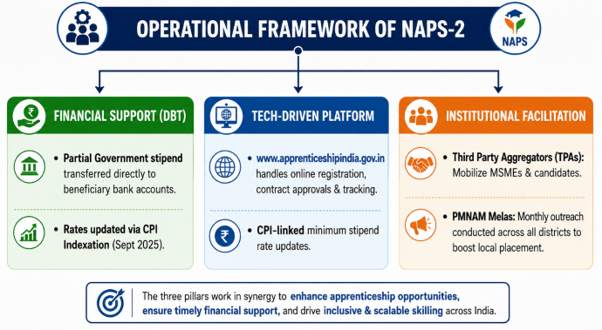
- Stipend Support: The Central Government directly disburses its share of the minimum stipend into the bank accounts of apprentices via DBT (operationalized since July 2023), eliminating delays and intermediaries.
- CPI Indexation: Minimum stipend rates were revised by the Central Apprenticeship Council (CAC) linked to the Consumer Price Index (CPI) and officially notified in September 2025.
2. NEP 2020 & Academic Integration
-
- Apprenticeship Embedded Degree Programme (AEDP): Developed jointly by MSDE, UGC, and AICTE under the National Education Policy (NEP) 2020, enabling students in higher education (degree/diploma) to integrate on-the-job apprenticeship into their academic curriculum.
3. Sunrise Sectors & Trade Diversity
-
- Training is imparted through both Designated Trades and Optional Trades.
- Active emphasis is placed on emerging, high-growth “sunrise” sectors—including IT, Semiconductors, Drones, Renewable Energy, Logistics, Electronics, and Biotechnology.
Key Performance & Employment Impact Indicators
-
- Total Engagement: Over 52.98 lakh apprentices engaged across India from FY 2018–19 to FY 2026–27 (up to June 2026).
- MSME Participation: Out of 57,945 registered establishments, 38,936 are MSMEs.
- DBT Disbursal: A cumulative total of ₹1,573.46 crore disbursed as Government stipend support via DBT from 2023–24 to June 2026.
- Pradhan Mantri National Apprenticeship Melas (PMNAM): 7,370 PMNAMs organized across districts nationwide, engaging over 40.24 lakh candidates.
- Employment Outcomes (AJNIFM Third-Party Study):
- Around 72% of trained apprentices secured full-time employment post-completion.
- Demonstrated higher income trajectories and improved job retention rates.
UPSC Quick Reference Table
| Metric / Parameter | Detailed Specification |
| Nodal Ministry | Ministry of Skill Development and Entrepreneurship (MSDE) |
| Governing Legislation | Apprentices Act, 1961 |
| Primary Disbursement | Direct Benefit Transfer (DBT) directly to apprentice bank accounts |
| Cumulative Engagement | 52.98+ Lakh Apprentices (FY 2018-19 to June 2026) |
| Empirical Impact | 72% transition rate into full-time employment (AJNIFM Study) |
| Academic Synergy | AEDP (Apprenticeship Embedded Degree Programme with UGC & AICTE) |
Conclusion:
NAPS-2 addresses skill gaps by connecting industry demands with practical workforce training. Utilizing Direct Benefit Transfer (DBT), technology portals, and embedding apprenticeships into academic degrees under NEP 2020 helps transition rural and urban youth into formal employment across key economic sectors.
TOPIC-5: Policy Reforms for Indian Coast Guard (ICG) Personnel
-
- GS Paper 2 (Government policies and interventions for development; Gender parity and social empowerment; Welfare measures for armed forces/paramilitary personnel)
- GS Paper 3 (Security challenges and their management in border/maritime areas; Role of armed forces and coast guard in maritime security).
Overview of the Reforms
The Ministry of Defence has announced two policy reforms for the Indian Coast Guard (ICG). Unveiled by Raksha Mantri Shri Rajnath Singh at Kartavya Bhavan-2, New Delhi, these forward-looking policies aim to promote gender parity in officer recruitment and career progression and streamline administrative procedures for ex-gratia compensation to families of personnel missing at sea.
Key Policy Directives
1. Gender-Neutral Induction and Career Progression
-
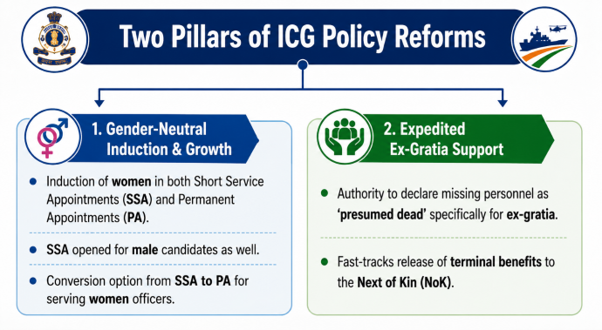
- Equal Entry Pathways: Establishes a comprehensive framework allowing women candidates to be inducted into both Short Service Appointments (SSA) and Permanent Appointments (PA) at par with male counterparts. SSA entry has also been made gender-neutral by opening it to male candidates.
- Parity in Career Progression: Guarantees equal opportunities starting from ab-initio training up to higher promotions, subject to standard eligibility criteria.
- Conversion Option for Serving Officers: Existing serving women officers under SSA are granted the option to convert their service to Permanent Appointments (PA), fulfilling key parameters of Nari Shakti (Women Empowerment) in maritime security.
2. Streamlined Ex-Gratia Procedures for Personnel Missing at Sea
-
- Administrative Presumption of Death: Authorizes competent authorities to declare ICG personnel reported missing at sea while on duty as ‘presumed dead’ specifically for the administrative purpose of granting ex-gratia compensation.
- Relief for Next of Kin (NoK): Eliminates prolonged administrative delays and legal wait times, enabling prompt release of ex-gratia compensation and terminal benefits to grieving families during times of mental trauma.
UPSC Quick Reference Table
| Component | Detailed Specification |
| Nodal Body | Indian Coast Guard (ICG), Ministry of Defence |
| Pillar 1: Gender Reforms | Gender-neutral SSA & PA entry; option to convert SSA to PA for women officers |
| Pillar 2: Family Relief | ‘Presumed dead’ status for missing-at-sea personnel to fast-track ex-gratia payouts |
| Operational Context | Prepares the ICG as it approaches its Swarnim Jayanti (Golden Jubilee) in 2027 |
| Key Principles | Gender Equality (Nari Shakti), Administrative Efficiency, Maritime Security |
Conclusion:
These twin reforms address long-standing administrative and operational needs within the Indian Coast Guard. Opening permanent commissioning pathways for women officers promotes gender parity in national defence, while simplifying ex-gratia procedures provides financial security and support to the families of personnel missing at sea.
Spread the Word