Topic-1: Pradhan Mantri Kaushal Vikas Yojana (PMKVY)
-
- GS Paper 2 (Government policies and interventions for development in various sectors and issues arising out of their design and implementation);
- GS Paper 3 (Indian Economy – Issues relating to planning, mobilization of resources, growth, development, and employment).
What is Pradhan Mantri Kaushal Vikas Yojana (PMKVY)?
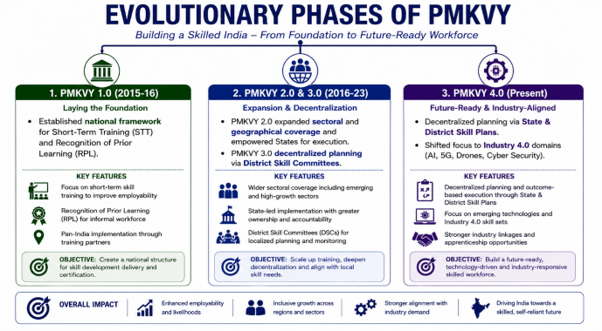
The Pradhan Mantri Kaushal Vikas Yojana (PMKVY) is the flagship short-term skill development scheme implemented by the Ministry of Skill Development and Entrepreneurship (MSDE) through the National Skill Development Corporation (NSDC). Launched in 2015, the scheme provides industry-relevant skill training, upskilling, and certification through Recognition of Prior Learning (RPL) to enhance candidate employability and workforce readiness across India.
Evolutionary Phases of PMKVY
Key Reforms and Financial Outcomes
1. Skills Outcomes Fund & Skill Impact Bond
-
- Skills Outcomes Fund: Formally created via an MoU exchanged on 15th July, 2026 between MSDE and NSDC, establishing a corpus of ~₹530 crore. It mobilizes government, CSR, and philanthropic capital to support over 2 lakh youth through skill vouchers, outcomes-focused financing, and entrepreneurship models.
- Skill Impact Bond: Outcome-based financing initiative targeting 50,000 youth (with a minimum 60% women representation). As of July 1, 2026, 51,869 candidates have been enrolled and 48,437 certified.
2. Third-Party Impact Assessment Findings
-
- AJNIFM Study (PMKVY 4.0): An independent evaluation by the Arun Jaitley National Institute of Financial Management showed an 18.8 percentage point increase in combined employment/self-employment among STT candidates (rising from 26.6% pre-training to 45.4% post-training). Income increases were reported by 41.4% of STT candidates and 48.9% of RPL candidates.
- NITI Aayog & IIPA Reports: NITI Aayog (2020) noted 94% of surveyed employers were willing to hire PMKVY-trained candidates. An IIPA study on PMKVY 2.0 showed 70.5% placement in preferred skill sectors.
3. Industry Collaboration & Governance
-
- Awarding Bodies (ABs): Over 15 corporate entities (e.g., HCL Technologies, IBM, Bajaj Finserv, Microsoft) act as NCVET-recognized Awarding Bodies to design market-aligned job roles.
- Technology Infrastructure: Uses Skill India Digital Hub (SIDH) as the primary platform for candidate lifecycle management, featuring biometric verification via Aadhaar/face-authentication for attendance tracking.
PMKVY Financial Expenditure Summary
| Financial Year | Budget Estimates (BE) | Revised Estimates (RE) | Actual Expenditure |
|---|---|---|---|
| 2023–24 | ₹1,558.00 Crore | ₹920.00 Crore | ₹510.52 Crore |
| 2024–25 | ₹1,938.30 Crore | ₹1,538.00 Crore | ₹1,538.00 Crore |
| 2025–26 | ₹1,915.00 Crore | ₹1,100.00 Crore | ₹265.57 Crore |
UPSC Quick Reference Table
| Feature | Detailed Specification |
| Scheme Name | Pradhan Mantri Kaushal Vikas Yojana (PMKVY) |
| Nodal Ministry | Ministry of Skill Development and Entrepreneurship (MSDE) |
| New Financial Engine | Skills Outcomes Fund (~₹530 Crore corpus established July 2026) |
| Regulatory Authority | National Council for Vocational Education and Training (NCVET) |
| Digital Ecosystem | Skill India Digital Hub (SIDH) |
| Impact Assessor (PMKVY 4.0) | Arun Jaitley National Institute of Financial Management (AJNIFM) |
Conclusion:
Through PMKVY 4.0 and initiatives like the Skills Outcomes Fund, MSDE is moving from a training-volume-based model toward outcome-driven skilling. Aligning training with Industry 4.0 needs and enforcing biometric tracking helps improve candidate employability and better match workforce skills with labor market demands.
Topic-2: Commercialisation and Transfer of Government-Developed Technologies
-
- GS Paper 3 (Science and Technology – Developments and their applications and effects in everyday life; Achievements of Indians in science & technology; Indigenization of technology and developing new technology; Intellectual Property Rights [IPR]).
What is Technology Commercialisation and Transfer?
Technology Commercialisation and Transfer refers to the legal and institutional process through which scientific research, inventions, and Intellectual Property (IP) developed in public-funded laboratories (such as CSIR, DST, and DBT) are licensed and transferred to private enterprises, startups, and industrial partners. This enables lab-developed technologies to be converted into market-ready products and commercial applications.
Core Institutional Vehicles and Policy Frameworks
1. National Research Development Corporation (NRDC)
-
- Meaning: An enterprise under the Department of Scientific & Industrial Research (DSIR) serving as the principal national vehicle for technology licensing, startup incubation, and IP management.
- Key Achievements: Licensed technologies to over 5,100 entrepreneurs, supported 2,100+ IP filings, and operationalized regional outreach centres at Pune, Guwahati, and Bhubaneswar.
2. Department-Specific Guidelines and Mechanisms
-
- CSIR: Utilizes guidelines on Technology Transfer and Utilisation of Knowledgebase supported by Business Development Groups (BDGs) and Technical Research Centres (TRCs).
- DBT: Operates under the IP Guidelines 2023, enabling institutions to own and license IP through exclusive or non-exclusive mechanisms guided by institutional IP committees.
- BIRAC (under DBT): Established 7 Technology Transfer Offices (TTOs) under the National Biopharma Mission and 94 biotech incubation centres across 25 States/UTs.
- DST: Deployed 22 Technology Enabling Centres (TECs) to connect researchers with industries and provides financial/equity support through the Technology Development Board (TDB).
Performance Metrics and Commercialization Data
1. Technology Licensing and Transfer Performance (2023–2025)
| Organization | Year | Technologies Licensed / Developed | Technologies Commercialized / Transferred |
|---|---|---|---|
| CSIR | 2025 | 233 | 249 |
| 2024 | 181 | 144 | |
| 2023 | 293 | 59 | |
| DBT | 2025 | 24 | 12 |
| 2024 | 71 | 6 | |
| 2023 | 25 | 0 | |
| DST | 2025 | 63 | 19 |
| 2024 | 62 | 12 | |
| 2023 | 60 | 5 |
2. NRDC Financial and Licensing Performance
| Parameter | 2023–24 | 2024–25 | 2025–26 |
|---|---|---|---|
| Licenses Issued / Commercialized | 42 | 36 | 28 |
| Upfront Charges (Premia) | ₹104.71 Lakh | ₹230.21 Lakh | ₹123.85 Lakh |
| Royalty Income | ₹324.11 Lakh | ₹81.60 Lakh | ₹93.20 Lakh |
3. Startup Creation Impact
-
- CSIR: Facilitated 148 startups, generating ₹142.67 lakh in royalty/premia income, attracting ₹246.60 lakh in private investments, and creating ~7,200 jobs.
- DBT: Created 34 startups across biomanufacturing, healthcare, agritech, and medical devices.
- NRDC: Supported 13 startups under the Technology Development, Validation & Commercialisation (TDVC) programme.
4. National Innovation Assessment
-
- The Office of the Principal Scientific Advisor (PSA) conducted two rounds of performance evaluations (in 2022 and 2025) of non-strategic public R&D institutions, establishing IP creation and technology transfer as core Innovation Excellence Indicators.
UPSC Quick Reference Table
| Feature | Detailed Specification |
| Nodal Institutional Vehicle | NRDC (Department of Scientific & Industrial Research) |
| Biotech Ecosystem Engine | BIRAC (7 TTOs + 94 Incubation Centres across 25 States/UTs) |
| Industry Network Hubs | 22 Technology Enabling Centres (TECs) under DST |
| Financial Assistance Agency | Technology Development Board (TDB) under DST |
| Regulatory Assessment Body | Office of the Principal Scientific Advisor (PSA) |
Conclusion:
By strengthening institutional frameworks through NRDC, BIRAC TTOs, and TECs, the government is bridging the gap between public R&D labs and private industry. Commercializing indigenous technologies through licensing and startup support accelerates self-reliance (Aatmanirbhar Bharat) across critical technology sectors.
Topic-3: Railway Electrification Drive
-
- GS Paper 3 (Infrastructure: Railways; Energy, Environment and Climate Change; Indigenization of Technology and Conservation).
What is the Railway Electrification Drive?
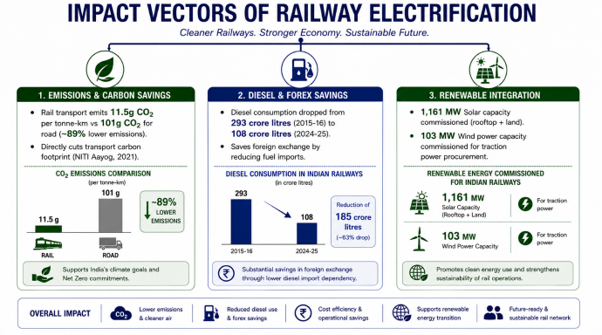
The Railway Electrification Drive is a mission-mode infrastructure transformation initiative by Indian Railways (IR) aimed at converting the country’s entire Broad Gauge (BG) network from diesel-based traction to electric traction. The program seeks to enhance haulage capacity, reduce reliance on imported fossil fuels, cut carbon emissions, and integrate renewable energy into the national rail network.
Global & National Benchmarks
1. Global Electrification Rankings (UIC Report, June 2025)
Indian Railways has emerged as the second most electrified railway network globally (and the first among major large-scale rail networks), second only to Switzerland:
-
- Switzerland: 100%
- India: 99.6%
- China: 82%
- Spain: 67%
- Japan: 64%
- United Kingdom: 39%
2. Pace of Electrification
-
- Pre-2014 (approx. 60 years): 21,801 Route Kilometers (RKM) electrified.
- 2014–2026 Period: 48,072 RKM electrified.
- Current Policy: All new lines and multi-tracking projects are sanctioned and built directly with 100% electric traction.
Key Benefits & Operational Metrics
Zone & State Progress Overview
-
- 15 Out of 19 Railway Zones Fully Electrified (100%): Central, East Coast, East Central, Eastern, Konkan, Kolkata Metro, North Central, North Eastern, Northern, South Central, South Coast, South East Central, South Eastern, West Central, and Western Railways.
- Near-Complete Zones: North Western (99.8%), Northeast Frontier (98.7%), Southern (98.7%), and South Western (96.1%).
- State Performance: 25 States/UTs (including Uttar Pradesh, Bihar, Madhya Pradesh, Andhra Pradesh, and Maharashtra) have achieved 100% electrification.
UPSC Quick Reference Table
| Metric / Parameter | Detailed Specification |
| Nodal Ministry | Ministry of Railways |
| Current BG Electrification Level | 99.6% (Second globally behind Switzerland’s 100%) |
| Electrification Added (2014–2026) | 48,072 Route Kilometers (RKM) |
| Diesel Consumption Reduction | From 293 crore litres (2015-16) down to 108 crore litres (2024-25) |
| CO₂ Emission Reduction vs Road | ~89% lower CO₂ emissions (11.5g/tonne-km vs 101g/tonne-km) |
| Commissioned Renewable Capacity | 1,264 MW (1,161 MW Solar + 103 MW Wind) |
Conclusion:
By electrifying 99.6% of its Broad Gauge network and integrating renewable energy, Indian Railways is establishing a lower-carbon transport framework. This shift cuts diesel imports and lowers logistics emissions, supporting India’s broader climate and infrastructure goals.
Topic-4: Nuclear Energy Mission for Viksit Bharat
-
- GS Paper 3 (Infrastructure: Energy; Science & Technology—developments and their applications; Indigenization of technology);
- GS Paper 2 (Government policies and interventions for development in various sectors and issues arising out of their design and implementation).
What are the Key Concepts & Frameworks?
1. Nuclear Energy Mission (NEM)
-
- Meaning: A national strategy announced in the Union Budget 2025–26 to scale India’s nuclear generation capacity to 100 GWe by 2047 in alignment with the Viksit Bharat vision and India’s net-zero carbon commitment by 2070. It features a dedicated ₹20,000 crore allocation to operationalize at least five indigenous Small Modular Reactors (SMRs) by 2033.
2. The SHANTI Act, 2025
-
- Meaning: Parliament enacted the Sustainable Harnessing and Advancement of Nuclear Energy for Transforming India (SHANTI) Act, 2025, modernizing the national nuclear legal framework.
- Key Interventions:
- Private Sector Entry: Permits private entities and joint ventures to participate in nuclear power generation, R&D, and technology co-development.
- Statutory Status for AERB: Grants independent statutory authority to the Atomic Energy Regulatory Board (AERB), empowering it to draft regulations, carry out oversight, and execute enforcement actions.
3. Small Modular Reactors (SMRs)
-
- Meaning: Nuclear reactors with smaller footprints and capacities () designed for modular manufacturing, enhanced passive safety, and lower upfront capital requirements.
- Indigenously Developed Models by BARC:
- BSMR-200: A 220 MWe Pressurized Water Reactor (PWR). Siting approved for Tarapur, Maharashtra.
- SMR-55: A 55 MWe Pressurized Water Reactor (PWR). Siting approved for Tarapur, Maharashtra.
- HTGCR: Up to 5 MWth High-Temperature Gas-Cooled Reactor designed as a high-heat source for thermochemical hydrogen production (e.g., copper-chlorine cycle). Siting approved for BARC, Visakhapatnam (Vizag).
Roadmap to 100 GW Capacity by 2047
The roadmap divides capacity addition into three structured phases across public and private sectors:
1. Plant Safety Framework
-
- Defense-in-Depth: Features redundant, diverse, and fail-safe safety mechanisms, creating multiple containment barriers between radioactive sources and the environment.
- Dual Oversight: Subjected to continuous internal monitoring by NPCIL and independent statutory oversight by the AERB.
2. Waste Disposal & Surveillance
-
- Statutory Rules: Governed by the Atomic Energy (Safe Disposal of Radioactive Wastes) Rules, 1987 and the AERB Safety Code.
- Treatment Process: Segregated by activity level, treated through chemical decontamination, ion-exchange, and volume reduction, then conditioned into stable matrices inside engineered structures with radiation shielding and leak detection.
- Environmental Monitoring: Monitored on-site by facility management and off-site through Environmental Survey Laboratories (ESLs) operated by BARC.
UPSC Quick Reference Table
| Feature | Detailed Specification |
| Nodal Body | Department of Atomic Energy (DAE) / BARC / NPCIL |
| 2047 Target | 100 GWe nuclear capacity (Current: 8.78 GW) |
| SMR Target | At least 5 indigenous SMRs operational by 2033 |
| Key Legislation | SHANTI Act, 2025 (Opens sector to private entities; statutory AERB) |
| SMR Models & Sites | BSMR-200 & SMR-55 (Tarapur, MH); HTGCR (Vizag, AP) |
| HTGCR Function | 5 MWth nuclear heat source for Green Hydrogen production |
Conclusion:
The Nuclear Energy Mission and the SHANTI Act, 2025 transform India’s nuclear landscape by opening the sector to private participation and accelerating indigenous Small Modular Reactors. This strategy establishes nuclear energy as a central base-load source to meet India’s 100 GWe target by 2047 and net-zero goals by 2070.
Topic-5: Scientific Achievements of Aditya-L1 and Chandrayaan-3 Missions
-
- GS Paper 3 (Science and Technology – Developments and their applications; Achievements of Indians in science & technology; Indigenization of technology; Space technology).
What are Aditya-L1 and Chandrayaan-3?
Aditya-L1 is India’s first dedicated space-based solar physics observatory, positioned in a halo orbit around the Sun-Earth Lagrangian Point 1 (L1). Chandrayaan-3 is India’s historic lunar exploration mission that accomplished the world’s first successful soft landing in the lunar south polar region at the Shiv Shakti Point.
Major Scientific Achievements of Aditya-L1
-
- Coronal Mass Ejection (CME) Onset: Captured the first-ever spectroscopic signatures of the onset phase of a CME (solar plasma ejections).
- Geomagnetic Storm Dynamics: Combined direct particle/field measurements at L1 with global ground observations to provide insights into intense geomagnetic storms.
- Photospheric Iron Fluorescence: Completed the first comprehensive analysis of iron fluorescence on the Sun across 47 massive X-class solar flares during Solar Cycle 25.
- Near-Ultraviolet (NUV) Eruption Imaging: Recorded high-resolution, detailed near-ultraviolet views of powerful solar flares and rare localized solar plasma ejections.
- Space Weather Capability: Though classified primarily as a solar physics mission, its continuous solar data establishes foundational capabilities for space weather forecasting.
Major Scientific Outcomes of Chandrayaan-3
-
- Thermal Profile (ChaSTE Payload): Penetrated 10 cm deep into lunar soil to record the first in-situ high-latitude temperature profile. Revealed a steep vertical thermal gradient and a two-layer “cake-like” regolith structure at a depth of ~6 cm. Found the top 2–6 cm to be hyper-porous yet highly cohesive, serving as an insulating thermal blanket.
- Elemental Composition (APXS Payload): Detected elevated abundances of magnesium-rich minerals, confirming the Lunar Magma Ocean (LMO) hypothesis and suggesting deep mantle ejections from the South Pole-Aitken (SPA) basin.
- Near-Surface Plasma (RAMBHA-LP Payload): Recorded electron densities between and non-thermal kinetic temperatures (), demonstrating strong modulation by solar winds.
- Seismic Profiling (ILSA Payload): Recorded over 250 distinct vibration events at the Shiv Shakti landing site, providing rare insights into local lunar seismic activity.
Technological Feedforward to Future Missions
UPSC Quick Reference Table
| Mission / Instrument | Core Scientific Discovery / Outcome |
| Aditya-L1 (SUIT / VELC / PAPA) | Spectroscopic CME onset; Iron fluorescence across 47 X-class flares. |
| ChaSTE (Chandrayaan-3) | Sub-surface temperature profile; hyper-porous “thermal blanket” regolith. |
| APXS (Chandrayaan-3) | Mg-rich mineral detection; supports Lunar Magma Ocean (LMO) model. |
| RAMBHA-LP (Chandrayaan-3) | In-situ polar plasma measurement (). |
| ILSA (Chandrayaan-3) | Recorded 250+ lunar seismic/vibrational events. |
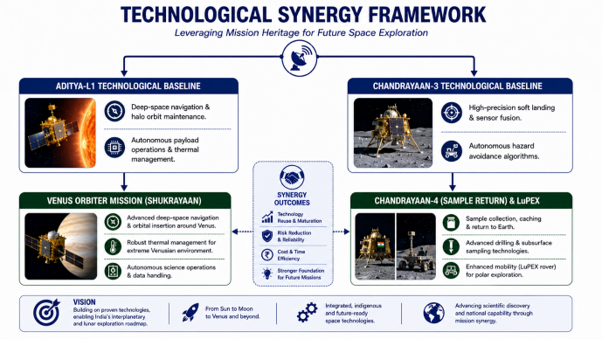
| Future Missions Supported | Venus Orbiter Mission, Chandrayaan-4 (Sample Return), LuPEX. |
Conclusion:
The scientific data from Aditya-L1 and Chandrayaan-3 transitions India into a major producer of primary deep-space data. The autonomous guidance, halo-orbit maintenance, and landing algorithms perfected through these missions establish the technical baseline for upcoming projects like Chandrayaan-4 and the Venus Orbiter Mission.
Topic-6: Implementation of BioE3 Policy
-
- GS Paper 3 (Science and Technology – Developments and their applications in everyday life; Biotechnology; Indigenization of technology; Environmental conservation and clean growth).
What is the BioE3 Policy?
The BioE3 (Biotechnology for Economy, Environment, and Employment) Policy is a flagship initiative approved by the Union Cabinet in August 2024 to foster high-performance biomanufacturing across India. It focuses on building an indigenous, resilient ecosystem to shift from chemical-based manufacturing to sustainable, bio-based alternatives, supporting economic growth (Economy), reducing carbon footprints (Environment), and creating skilled green jobs (Employment).
Key Execution Vectors and Policy Infrastructure
1. BioEnablers & Shared Physical Infrastructure
-
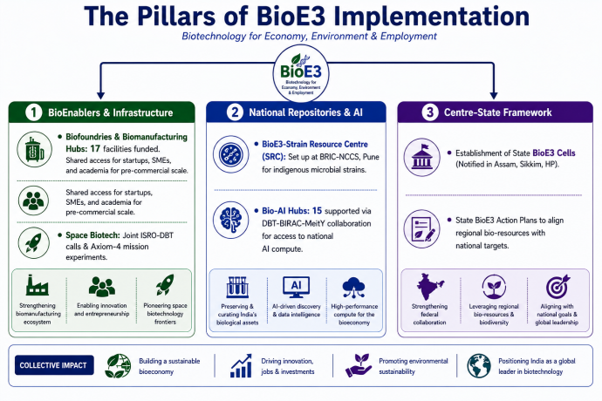
- Biofoundries and Biomanufacturing Hubs: Pilot and pre-commercial scale shared facilities provided to startups, SMEs, and academia to scale lab-proven bio-products to viable market scales. 17 facilities have been funded under the first call.
- Bio-AI Hubs: 15 Bio-AI Hubs recommended under a joint DBT-BIRAC initiative, supported by an MoU signed with MeitY to grant these hubs access to national AI computing infrastructure.
2. BioE3-Strain Resource Centre (SRC)
-
- Location: Established at BRIC-NCCS (National Centre for Cell Science), Pune.
- Function: Serves as a national repository providing access to high-performance indigenous microbial strains with full “Freedom-to-Operate” (FTO) for commercial utilization. This eliminates dependence on imported proprietary strains, ensures regulatory compliance, and retains commercial value within India.
3. Centre-State Partnerships & BioE3 Cells
-
- Regional Units: Dedicated BioE3 Cells notified by State Governments in Assam, Sikkim, and Himachal Pradesh to coordinate regional biomanufacturing strategies.
- Targeted Regional Projects: Supported joint partnerships, such as a Sikkim-BRIC project developing bio-based solutions for pests/pathogens in large cardamom crops.
The Six Identified Thematic Verticals
Over 270 research and scale-up projects are currently being funded across six identified sectors:
1. Bio-based Chemicals, Biopolymers, APIs & Enzymes: Developing import substitutes like itaconic acid, succinic acid, PLA, nanocellulose, and bio-enzymes for specialty chemicals and APIs.
2. Smart Proteins & Functional Foods: Funding fermentation-derived, plant-based, and cell-cultured smart protein alternatives.
3. Precision Biotherapeutics: 27 active projects advancing cell & gene therapies (CGTs), mRNA delivery platforms, and monoclonal antibodies (e.g., for cryptococcal meningitis and advanced cancers).
4. Climate-Resilient Agriculture: 15 projects focusing on bio-based agri-inputs, marine biostimulants, traditional cultivars, and gene editing for climate stress resilience.
5. Carbon Capture & Utilization (CCU): 37 projects focusing on integrated CCUS biomanufacturing solutions for heavy point-source emission industries (cement, steel, biorefineries).
6. Futuristic Marine & Space Research: 11 marine projects (seaweed sensors, sustainable shrimp farming) and 23 space biotechnology projects in collaboration with ISRO (including space experiments during the Axiom-4 mission).
UPSC Quick Reference Table
| Feature | Detailed Specification |
| Nodal Body | Department of Biotechnology (DBT) & BIRAC |
| Indigenous Strain Hub | BioE3-SRC at BRIC-NCCS, Pune (Offers “Freedom-to-Operate” strains) |
| Computational Node | 15 Bio-AI Hubs linked with MeitY National AI Infrastructure |
| State BioE3 Cells | Functional in Assam, Sikkim, and Himachal Pradesh |
| Underlying Business Model | Public-Private Co-creation (Grant-in-aid for academia; co-funding/royalty sharing for SMEs) |
| Grassroots Engagement | Design for BioE3 challenge (Category 1: Students; Category 2: Citizens) |
Conclusion:
Through shared infrastructure like Biofoundries, the BioE3-Strain Resource Centre, and public-private co-creation models, the BioE3 Policy accelerates India’s transition to a sustainable bioeconomy. This strategy helps reduce reliance on imported chemical inputs while positioning biomanufacturing as a driver of clean industrial growth.
Spread the Word