Indian Polity & Governance
Launch of FCRA 2.0 Portal & e-OCI Cards:
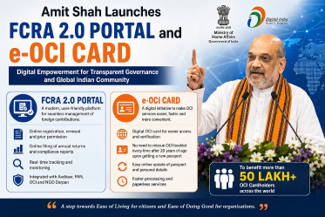
Context: The Union Home Ministry launched the updated FCRA 2.0 Portal alongside an automated electronic Overseas Citizen of India (e-OCI) card. The dual rollout aims to tighten financial monitoring of foreign inflows while modernizing digital services for the Indian diaspora.
-
- Evolution of FCRA: The Foreign Contribution (Regulation) Act (FCRA) was first enacted in 1976 during the Emergency to curb foreign interference in domestic politics. It was heavily amended in 2010 and 2020.
- Nodal regulatory authority: The administration, licensing, and enforcement of both FCRA compliance and OCI documentation fall exclusively under the jurisdiction of the Ministry of Home Affairs (MHA).
- The banking bottleneck: Under current statutory rules, any NGO registered to receive foreign funding must maintain its primary “FCRA Account” exclusively at the State Bank of India (SBI), Main Branch at Parliament Street, New Delhi.
- Banned Entities under FCRA: The Act prohibits specific categories of individuals from accepting foreign contributions, including election candidates, members of legislatures, political parties, judges, and government servants.
- e-OCI Legal Character: An Overseas Citizen of India does not possess dual citizenship. Article 9 of the Indian Constitution explicitly forbids dual nationality. OCI is a statutory immigration status granted under the Citizenship Act, 1955.
- OCI rights limitations: While OCI cardholders receive a lifelong, multi-purpose, visa-free entry status to India, they are constitutionally barred from voting, holding public office, or purchasing agricultural land.
- The FCRA 2.0 Tech Layer: The 2.0 upgrade introduces automated financial data-matching algorithms designed to flag “smurfing”, the practice of breaking down large foreign donations into small, untraceable sums across multiple accounts.
- Administrative Streamlining for Diaspora: The e-OCI framework eliminates the mandatory physical re-issuance of cards whenever a passport is renewed for individuals under 20 or over 50 years of age, transitioning to automated digital profiling.
- Public transparency controls: The new portal mandates real-time reporting of utilization certificates by NGOs, capping administrative expenses using foreign funds at 20% (down from 50% prior to the 2020 amendment).
- Biometric and Verification Integrity: The e-OCI card features cryptographically signed barcodes that link directly to the Bureau of Immigration database, easing friction points during border controls at international entry ports.
(IE)
The Hathnikund-Yamuna Accord:
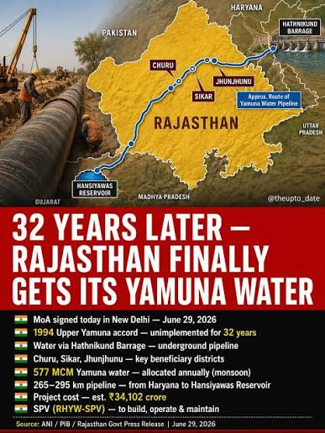
Context: Under the chairmanship of the Union Home Ministry and in coordination with the Ministry of Jal Shakti, a landmark inter-state agreement was reviewed. The ₹34,102 crore infrastructure project manages the distribution of water from the Hathnikund Barrage on the Yamuna River, channelling vital flows to drought-prone regions in Rajasthan through Haryana’s canal networks.
-
- The Infrastructure Project: The accord governs the transfer of roughly 580 Million Cubic Metres (MCM) of surplus Yamuna water during the monsoon window (July to October) utilizing three newly designed, high-capacity underground pipelines.
- Hathnikund: The Hathnikund Barrage is located on the Yamuna River in the Yamunanagar district of Haryana. It replaced the historic, defunct Tajewala Barrage downstream, managing water distribution between Haryana, Uttar Pradesh, and Delhi.
- Canal infrastructure linkage: The project relies on upgrading the Western Yamuna Canal network to carry water across Haryana’s territory before it drops into the delivery pipelines heading toward northern Rajasthan.
- Constitutional Framework for Water: Under the Seventh Schedule of the Indian Constitution, Water is primarily a State subject (Entry 17 of the State List). However, the regulation and development of inter-state rivers fall under federal purview via Entry 56 of the Union List.
- Article 262 and Inter-State Water Disputes: The Constitution provides a unique legal framework under Article 262 for resolving disputes over inter-state rivers. It bars the Supreme Court’s ordinary jurisdiction and allows Parliament to set up specialized tribunals.
- The Inter-State Council Link: Because the agreement required consensus between the governments of Rajasthan and Haryana, the negotiations were moderated by the Union Home Ministry, using principles of cooperative federalism aligned with the mandate of the Inter-State Council (Article 263).
- Mitigating Groundwater Depletion: The primary environmental goal for northern Rajasthan (specifically districts like Jhunjhunu and Churu) is to substitute over-exploited groundwater irrigation with surface monsoon flows, helping to stabilize falling water tables.
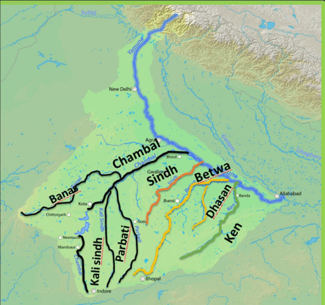
- Yamuna River Hydrology: The Yamuna is the longest tributary of the Ganga. It originates from the Yamunotri Glacier at the Bandarpoonch peaks in Uttarakhand, flowing past the Lower Himalayas before entering the Indo-Gangetic plains at Hathnikund.
-
- The monsoon surplus harvesting strategy: This framework models future climate adaptation projects by capturing high-volume monsoon floodwaters that would otherwise cause downstream flooding in Delhi and Agra, redirecting it to arid agricultural fields.
- Ecological flow constraints: A key challenge in implementing the accord is maintaining the mandatory minimum ecological flow of the Yamuna River downstream of the barrage to prevent total river drying and preserve aquatic ecosystems.
(PIB+TH)
Economy
Sovereign Credit Rating Methodology Dispute:
Context: Speaking at an international trade delegation, India’s Commerce Minister renewed a long-standing macroeconomic complaint, arguing that global sovereign credit rating methodologies are systematically biased against emerging economies. He contrasted their rigid frameworks with more objective domestic analytical models like CareEdge Ratings.
-
- The Global Oligopoly: Over 95% of the worldwide credit rating market is dominated by the “Big Three” credit rating agencies: Standard & Poor’s (S&P), Moody’s Investors Service, and Fitch Ratings.
- Sovereign Rating Definition: A sovereign credit rating provides a qualitative and quantitative assessment of a national government’s ability and willingness to service its debt obligations on time.
-
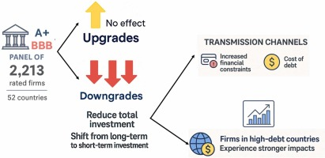
- The Core Analytical Dispute: India contends that these agencies over-index on subjective, qualitative parameters (such as institutional governance indices, perceived press freedom, and political stability metrics) while undervaluing strong, hard quantitative indicators.
- The Investment Grade Ceiling: Despite holding the position of the fastest-growing major global economy with stable fundamentals, India is consistently rated at the lowest rung of “Investment Grade” (BBB- by Fitch/S&P, Baa3 by Moody’s), just one step above speculative “junk” status.
- The External Debt Counter-Argument: India’s macroeconomic fundamentals show minimal vulnerability to external shocks; its total external sovereign debt is very low, and its foreign exchange reserves comfortably exceed its total external debt stock.
- Impact on Yields and Borrowing Costs: A depressed sovereign credit rating inflates the risk premium on Indian bonds, driving up borrowing costs for both the Union Government and Indian corporate entities seeking capital in international financial markets.
- The Economic Survey Framework: Previous Economic Surveys published by the Ministry of Finance have historically demonstrated a structural bias against emerging markets, noting that no developing nation has ever been awarded a AAA rating regardless of clear fiscal milestones.
- Institutional Indicator Flaws: Global agencies rely heavily on indicators like the World Bank’s Worldwide Governance Indicators (WGI). India critiques the WGI for using perception-based surveys from external thin-tank groups rather than verifiable administrative improvements.
- Ability vs. Willingness to Pay: India maintains that its clean history of never defaulting on any external sovereign debt obligation should yield a perfect score on the “willingness to pay” metric, which global models continue to discount based on subjective risk weights.
- Domestic Alternatives: In response, India has promoted the international expansion of domestic credit rating agencies (such as CRISIL, ICRA, and CareEdge) to foster more diverse and objective credit modelling in emerging markets.
(IE)
MPEDA Seafood Value-Addition Framework:
Context: On July 2, 2026, the Marine Products Export Development Authority (MPEDA) concluded its nationwide upskilling initiative at the Seafood Expo Bharat in Kochi. The program trained over 2,500 food processing professionals in advanced processing techniques, part of India’s broader push to increase value-added marine exports.

-
- Statutory Status of MPEDA: Established in 1972 under the Marine Products Export Development Authority Act, this statutory export promotion organization operates under the administrative control of the Ministry of Commerce and Industry.
- The Economics of Value-Addition: The project aims to shift India’s marine export mix away from low-margin bulk commodities (like raw frozen shrimp) toward high-margin, ready-to-cook, processed seafood items, boosting net foreign exchange earnings per unit.
- The blue economy framework: This export initiative supports India’s national Blue Economy strategy, which emphasizes sustainable economic utilization of oceanic and coastal resources to generate livelihoods while safeguarding marine ecosystems.
-
- Linkage to PMMSY: MPEDA’s industrial capacity-building programs supplement the Pradhan Mantri Matsya Sampada Yojana (PMMSY), a flagship scheme launched to address supply chain gaps from harvest points to international markets.
- Sanitary and Phytosanitary (SPS) Compliance: The training focuses on aligning Indian processing lines with international food safety standards, including HACCP (Hazard Analysis Critical Control Point) protocols required by major import markets like the US, EU, and Japan.
- Socio-economic impact on coastal women: The seafood processing sector is a major employer of rural women. Upskilling these workers helps raise wages and improve financial independence within coastal communities.
- The cold chain deficit: A primary obstacle to scaling up value-added exports is India’s fragmented cold chain infrastructure. Addressing this requires investment in refrigerated logistics, blast freezers, and modernized fishing harbours.
- Aquaculture dominated export profile: Over 70% of India’s marine export value is driven by aquaculture products, particularly Litopenaeus vannamei (Pacific White Shrimp), making diversification into processed marine finfish crucial for market resilience.

-
- End-to-End Traceability Mandates: International regulations increasingly demand clear product provenance. MPEDA’s digital initiatives aim to register aquaculture farms and link them to processing plants via blockchain or automated tagging systems.
(PIB)
Geography,
Monsoon Troughs & Extreme Coastal Precipitation Anomaly:
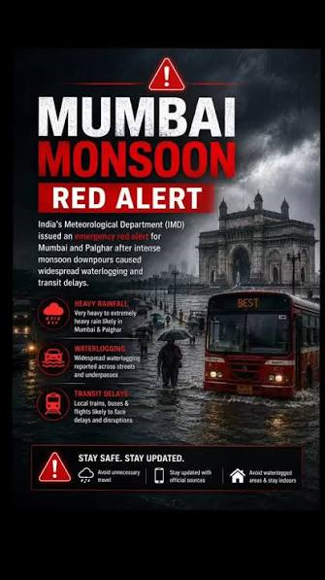
Context: India Meteorological Department (IMD) issued an emergency “Red Alert” for Mumbai and the Konkan coast due to extreme rainfall. Concurrently, the IMD released data showing that June 2026 concluded with a net national monsoon deficit of nearly 40%, highlighting intense spatial variance.
-
- The Monsoon Driving Mechanism: The Southwest Monsoon is driven by thermal differences between the heated landmass of Peninsular India (forming a deep low-pressure center over Tibet and Northwest India) and the cooler Indian Ocean.
- Long Period Average (LPA): The IMD assesses monsoon deficits using the LPA, the average recorded rainfall over a moving 50-year base period. The current July forecast projects overall rainfall to sit below 94% of the LPA, classifying it as “below normal.”
- IMD Alert Protocols: The IMD uses a four-stage color-coded warning matrix: Green (all clear), Yellow (watch out for changes), Orange (stay prepared for disruptions), and Red (take immediate emergency action against severe hazards).
- The orographic uplift anomaly: The extreme rain concentrated along the Konkan coast and Goa is caused by strong, moisture-laden winds from the Arabian Sea hitting the steep, vertical wall of the Western Ghats, causing rapid orographic cooling and downpours on the windward slope.
- The Rain-Shadow Effect: While the windward side of the Western Ghats suffers from flooding, the leeward side (Deccan Plateau, Marathwada, and Rayalaseema) experiences a severe rain shadow, resulting in dry conditions and growing rain deficits.
- The Dual-Branch Structure: The Southwest Monsoon advances in two distinct branches: the Arabian Sea Branch (which interacts with the West Coast and Central India) and the Bay of Bengal Branch (which sweeps through the Northeast and curves across the Indo-Gangetic plains).
- The Monsoon Trough Position: The spatial variation in rain is determined by the position of the Monsoon Trough, an elongated low-pressure line. When this trough shifts south of its normal position, it intensifies coastal downpours while leaving northern plains dry.
- Concurrent Disasters: The current monsoon pattern presents a climate anomaly where river systems like the Brahmaputra in Assam are experiencing severe flooding, while central agricultural belts face prolonged dry spells.
- Kharif Sowing Vulnerability: June and early July represent the critical window for sowing Kharif crops (such as paddy, pulses, cotton, and coarse cereals). A 40% initial deficit disrupts agricultural cycles, delaying sowing and threatening crop yields.
(IE)
Ecology & Environment and DM
The Great Nicobar Island Mega-Project Audit:
Context: Parliamentary Public Accounts Committee (PAC) called for an updated, stringent environmental review of the ₹72,000-crore holistic development project in Great Nicobar. The inquiry balances India’s strategic maritime positioning with its environmental and tribal protection laws.
-
- Strategic Components: The project features an International Container Transshipment Terminal (ICTT) at Galathea Bay, a greenfield international airport, a township, and a combined gas/solar power plant.
- Geographical Location: Great Nicobar is the southernmost island of the Andaman and Nicobar archipelago, located near the vital global shipping channel of the Malacca Strait. It contains Indira Point, India’s southernmost point.
- Biosphere Status: The entire island was designated a UNESCO Biosphere Reserve in 2013. It includes two major protected areas: Campbell Bay National Park and Galathea National Park.
- The Nicobar Megapode: The island is the primary habitat of the Nicobar Megapode (Megapodius nicobariensis), a unique, endangered ground-nesting bird that builds large mounds of decomposing organic matter to incubate its eggs.
- Giant Leatherback Nesting: Galathea Bay is an important global nesting site for the Giant Leatherback Sea Turtle (Dermochelys coriacea), the largest living sea turtle, protected under Schedule I of India’s Wildlife (Protection) Act, 1972.
- Particularly Vulnerable Tribal Groups (PVTGs): The dense interior forests of Great Nicobar are home to the Shompen tribe, a hunter-gatherer PVTG that remains largely isolated from modern civilization. The coastal areas are inhabited by the Mongoloid Nicobarese
- Tectonic and Seismic Risks: The island sits directly on the plate boundary between the Indo-Australian and Eurasian tectonic plates. Classified under Seismic Zone V, it suffered significant permanent land subsidence during the 2004 Indian Ocean Tsunami.
- Coral Reef Translocation: To limit damage from port dredging, scientists are carrying out a coral translocation project, moving fragile hard coral colonies from Galathea Bay to adjacent, safer marine shelves.
- Legal Frameworks Engaged: The project requires complex clearances under the Forest (Conservation) Act, the Environment (Protection) Act, 1986, and the Coastal Regulation Zone (CRZ) Directives.
(TH)
NTCA Low-Density Tiger Reserve Restructuring Plan:
Context: India’s total wild tiger population is expanding at a steady 6% annually, nearly 25 out of the country’s 58 designated Tiger Reserves are suffering from low tiger densities or a depleted prey base, prompting a shift in conservation management.
-
- Statutory Foundations of Project Tiger: Launched originally in 1973, Project Tiger is overseen by the National Tiger Conservation Authority (NTCA), a statutory body established under the Wild Life (Protection) Amendment Act, 2006.
- The Translocation recipient Strategy: To balance uneven distribution, the NTCA is converting underpopulated reserves into active “recipient sites,” translocating surplus tigers from saturated habitats to reserves with viable forest cover.
- Reserves Requiring Priority Intervention: The WII review highlighted three specific reserves facing low density or local extinction risks due to degraded habitat conditions: Satkosia (Odisha), Buxa (West Bengal), and Palamau (Jharkhand).
- The Source-Sink Model: Long-term tiger conservation relies on a source-sink dynamic. Saturated “source” habitats (like Corbett or Kanha) act as breeding grounds from which tigers disperse through ecological corridors to occupy lower-density “sink” habitats.
- Prey Biomass Depletion: The primary driver behind low-density reserves is not a lack of canopy cover, but a severe deficit in prey biomass (ungulates like Chital, Sambar, and Barking Deer) caused by historic poaching and competition from livestock.
- M-STrIPES Digital Tracking: Field monitoring is standardized across India using the M-STrIPES (Monitoring System for Tigers – Intensive Protection and Ecological Status) software application, which tracks patrol routes, snare detections, and ecological metrics.
- Legal Status of the Tiger: The Bengal Tiger (Panthera tigris tigris) is protected under Schedule I of the Wildlife (Protection) Act, 1972, and is listed as Endangered on the IUCN Red List.
- The St. Petersburg Declaration Tracker: India achieved its international Tx2 commitment, a pledge made at the 2010 global summit to double wild tiger populations, well ahead of the targeted global timeline.
- Zonation Architecture: Every Tiger Reserve must be legally split into two structural zones: an inviolate Core Area (managed exclusively for wildlife conservation with no human rights permitted) and an outer Buffer Area (where co-managed sustainable development and resource extraction are allowed).
- Genetic Bottleneck Risks: The isolation of low-density reserves due to infrastructure fragmentation prevents natural migration. This cuts off gene flow, increasing the risk of inbreeding depression and making populations vulnerable to disease outbreaks.
(IE)
Science & Technology
Generative AI, GANs, and National Security Disinformation:
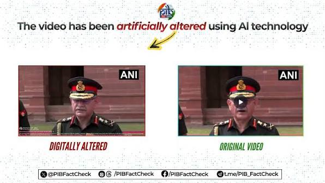
Context: recently in news a deepfake video of former Army Chief General Upendra Dwivedi. The video used generative AI to spread false claims about high-level military resignations, spotlighting how deepfakes can be weaponized against national security structures.
-
- Generative Adversarial Networks (GANs): Deepfakes are created using GAN architectures, where two neural networks, the Generator (which crafts the fake media) and the Discriminator (which detects flaws against a real dataset), train against each other to create highly realistic synthetic media.
- Hybrid Warfare Tactic: In modern defense doctrine, the strategic dissemination of AI-generated deepfakes targeting military commands is classified as a hybrid warfare tactic designed to disrupt institutional morale and spark public panic.
- Current Indian Legal Matrix: India lacks a standalone, dedicated piece of deepfake legislation. Law enforcement relies on a combination of Section 66D of the Information Technology (IT) Act, 2000 (cheating by personation using computer resources) and provisions within the Bharatiya Nyaya Sanhita (BNS) covering forgery and defamation.
- The Detection Challenge: Advanced deepfake detection models look for subtle physical inconsistencies, such as abnormal eye-blinking cycles, unnatural shadows around the mouth, and irregularities in blood-flow signatures on the skin surface (photoplethysmography).
- Digital Watermarking Solutions: Proactive technological defenses are moving toward Content Provenance frameworks, using unalterable, cryptographic metadata embedded at the point of camera capture to verify image and video authenticity.
- Biometric Identity Vulnerability: Beyond political disinformation, the evolution of high-fidelity voice and facial cloning poses security threats to financial systems that rely on remote “Video-KYC” and biometric voice verification.
(PIB unit)
Government Schemes & Initiatives
Ayushman Bharat Digital Mission (ABDM):
Context: Following the nationwide observation of National Doctors’ Day, the Ministry of Health and Family Welfare confirmed that the Ayushman Bharat Digital Mission (ABDM) has crossed the milestone of creating 90 crore ABHA accounts, anchoring India’s Digital Public Infrastructure (DPI) in healthcare.
-
- Historical Significance of Doctors’ Day: Celebrated on July 1, the day commemorates the birth and death anniversary of Bidhan Chandra Roy, an eminent physician, freedom fighter, the second Chief Minister of West Bengal, and a recipient of the Bharat Ratna.

-
- Nodal Implementing Agency: The countrywide execution of the ABDM is managed directly by the National Health Authority (NHA), which also administers the PM-JAY cashless health insurance scheme.
- The 14-Digit ABHA Architecture: The Ayushman Bharat Health Account (ABHA) serves as a unique identifier across India’s digital health sector. It securely links a patient’s medical history, lab reports, and prescriptions across different hospitals and clinics.
- Federated data architecture: The ABDM does not collect or store health records in a central government database. It utilizes a federated model where medical records remain stored locally at the hospital that generated them, shared securely across the network only when requested.
- Consent-based health data exchange: The platform uses a consent-manager architecture. Doctors or insurers cannot view an individual’s health files without explicit, time-bound digital permission granted by the patient.
- Healthcare Professionals Registry (HPR): A verified digital directory of all licensed medical practitioners (covering both modern medicine and AYUSH streams) across India, designed to prevent medical fraud and map professional density.
- Health Facility Registry (HFR): This public directory indexes both state-run and private healthcare facilities including clinics, diagnostic laboratories, and pharmacies improving transparency and resource allocation.
- National Health Policy (NHP 2017) Alignment: The scaling of ABDM fulfills a primary goal of India’s National Health Policy 2017, which advocates for the systemic digitalization of healthcare to move toward Universal Health Coverage (UHC).
- Telemedicine Integration Layer: The digital account system links directly with eSanjeevani, the government’s national outpatient telemedicine platform, enabling rural patients to share their medical histories digitally with urban specialists.
- Interoperability Standards: The system uses open source digital protocols and unified health interfaces, allowing private health-tech applications, hospital management software, and government systems to communicate across a single network.
(TH)
Spread the Word