
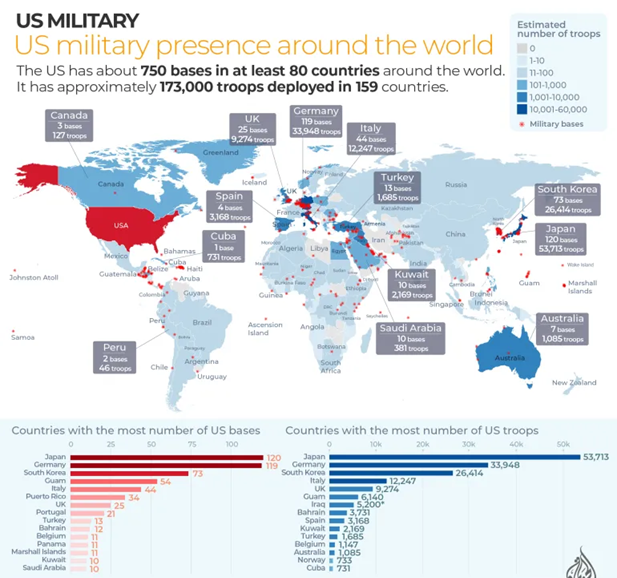
The US controls about 750 bases in at least 80 countries worldwide and spends more on its military than the next 10 countries combined.
With 120 active bases, Japan has the highest number of US bases in the world followed by Germany with 119 and South Korea with 73.
Large bases or “Bases”: Defined as military installations larger than 4 hectares (10 acres) or worth more than $10 million. These bases typically have in excess of 200 US military personnel. 439 or 60 percent of the US’s foreign bases fall under this category.
Small bases or “Lily Pads”: These bases are smaller than 4 hectares(10 acres) or have a value of less than $10 million. These include cooperative security locations and forward operating sites. The remaining 40 percent of US foreign bases fall under this category.
According to global US military deployment data published in the Conflict Management and Peace Science Journal, the US had around 173,000 troops deployed in 159 countries as of 2020.
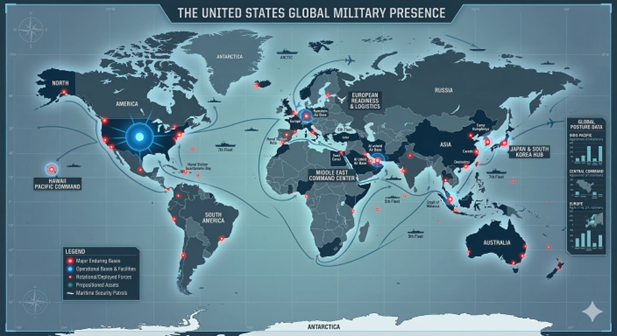
Major Overseas U.S. Military Bases
| Base Name | Country / Location | Branch | Key Strategic Role |
|---|---|---|---|
| Camp Humphreys | South Korea | Army | The largest U.S. base overseas; HQ for U.S. Forces Korea. |
| Ramstein Air Base | Germany | Air Force | Primary hub for U.S. Air Forces in Europe (USAFE) and NATO. |
| Kadena Air Base | Japan (Okinawa) | Air Force | Keystone of the Pacific"; largest U.S. air wing in East Asia. |
| Fleet Activities Yokosuka | Japan | Navy | HQ for the U.S. 7th Fleet; only carrier homeport outside the U.S. |
| Al Udeid Air Base | Qatar | Air Force | Forward HQ for U.S. Central Command (CENTCOM). |
| Naval Support Activity Bahrain | Bahrain | Navy | HQ for the U.S. 5th Fleet; secures Middle East oil routes. |
| Naval Station Rota | Spain | Navy | Strategic gateway for the Mediterranean and Atlantic fleets. |
| Camp Lemonnier | Djibouti | Navy/Joint | Only permanent U.S. base in Africa; focuses on counter-terrorism. |
| Andersen Air Force Base | Guam (U.S. Territory) | Air Force | Critical for long-range bomber operations in the Indo-Pacific. |
| Diego Garcia | BIOT (Indian Ocean) | Navy/Air Force | Remote outpost supporting bombers and naval logistics. |
The “Big Three” nations hosting U.S. forces have remained consistent for decades due to post-WWII and Korean War treaties:
1. Japan: ~120 bases and over 54,000 personnel.
2. Germany: ~119 bases and over 36,000 personnel.
3. South Korea: ~73 bases and over 23,000 personnel.
Note: Many of these names changed recently. In 2023, the U.S. Department of Defense officially renamed nine Army installations that originally honoured Confederate soldiers (e.g., Fort Bragg became Fort Liberty, Fort Hood became Fort Cavazos).
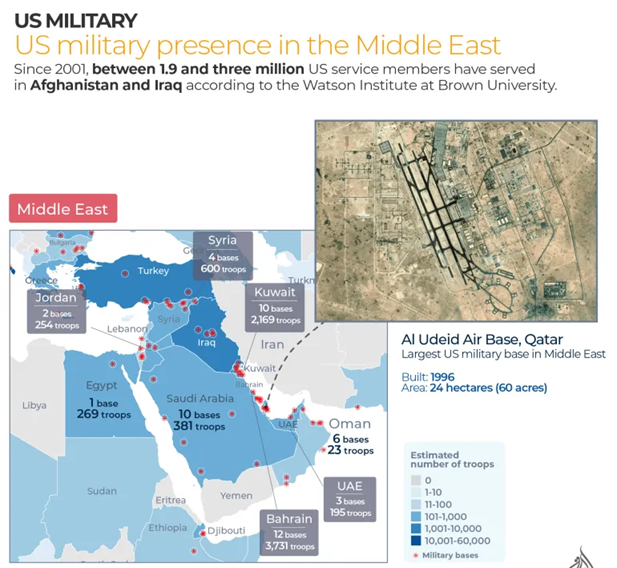
US MILITARY PRESENCE IN THE MIDDLE EAST
Between 1.9 and three million US service members have served in Afghanistan and Iraq since 2001, with over half of them deployed more than once.
The largest US military installation in the Middle East is the Al Udeid Air Base, located west of Doha, Qatar. Established in 1996, it hosts around 11,000 American and coalition service members. Covering an area of 24 hectares (60 acres), the base accommodates almost 100 aircraft as well as drones.
.An estimated 241,000 people have died as a direct result of the war since 2001, according to the Costs of War project at Brown University. In addition, hundreds of thousands more, mostly civilians, have died due to hunger, disease and injury caused by the devastating war.
In 2003, the US invaded Iraq after it accused long-time Iraqi leader Saddam Hussein of having weapons of mass destruction – none was found. At its peak in 2007, the US had an estimated 170,000 troops in the country. Today, there are around 2,500 US troops in the country as part of a security agreement with the Iraqi government.
US MILITARY PRESENCE IN JAPAN AND SOUTH KOREA
The US has been in Japan since the end of World War II (1939-1945) and in South Korea since the Korean War (1950-1953).
Nearly half of all US military deployed abroad, some 80,100 American personnel, are stationed in Japan with 53,700 and South Korea with 26,400.
South Korea hosts Camp Humphreys, the largest overseas US military base, located approximately 65km (40 miles) south of the capital Seoul.
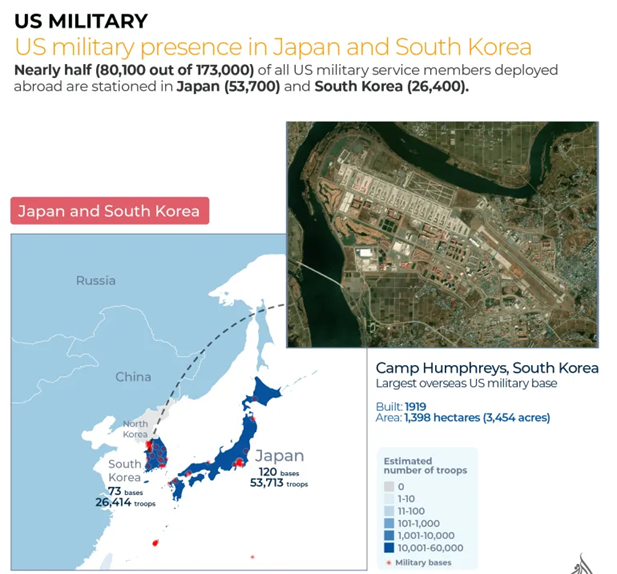
The 1,398 hectares (3,454 acres) base is one of 80 bases in the country and is less than 100km (60 miles) from the heavily fortified demilitarized zone that demarcates North Korea from South Korea.
US MILITARY PRESENCE IN EUROPE
Europe is home to at least 60,000 US troops. At 33,900, Germany has the highest number of US troops in Europe – and the second highest in the world – followed by Italy at 12,300 and the UK at 9,300. However, the number of US troops stationed in Germany has more than halved between 2006 and 2020, dropping from 72,400 to 33,900.
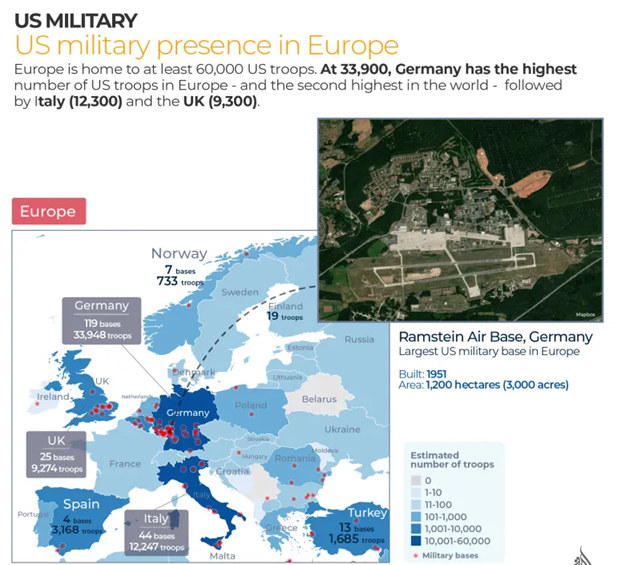
The Ramstein Air Base in Germany is the largest hub for US troops and military supplies in Europe. Just outside the 1,200 hectares (3,000 acres) base is the Landstuhl Regional Medical Center, the largest US military hospital outside the US. The facility was used extensively during the Afghanistan and Iraq wars and treated thousands of wounded soldiers.
Like nearly all US bases, Ramstein is equipped with hospitals, schools, power stations, apartment complexes and a host of amenities often referred to as “Burger Kings and bowling alleys”.
US MILITARY PRESENCE IN LATIN AMERICA
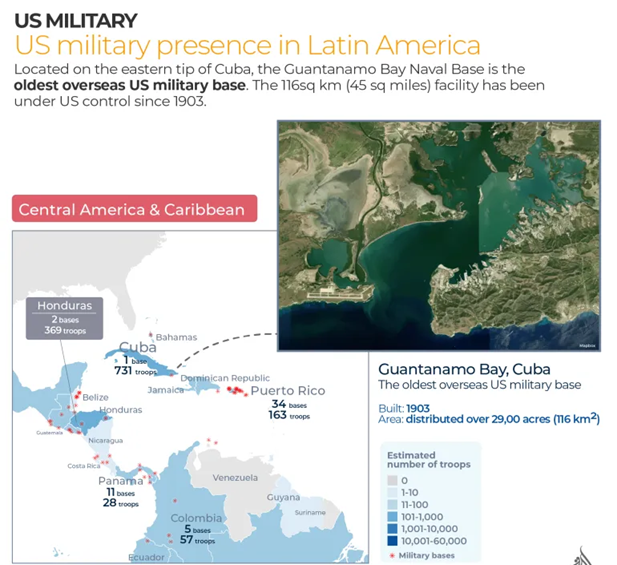
Located on the eastern tip of Cuba, the Guantanamo Bay naval base is the US’s oldest overseas military base. The 116sq km (45 sq miles) facility has been under American control since the end of the 19th century.
The base is a hotly debated issue between the US and Cuba. For decades, Cuba has insisted that the US hand back the territory it took by force in 1898 and subsequently leased permanently in 1903.
US TROOP DEPLOYMENT SINCE 1950
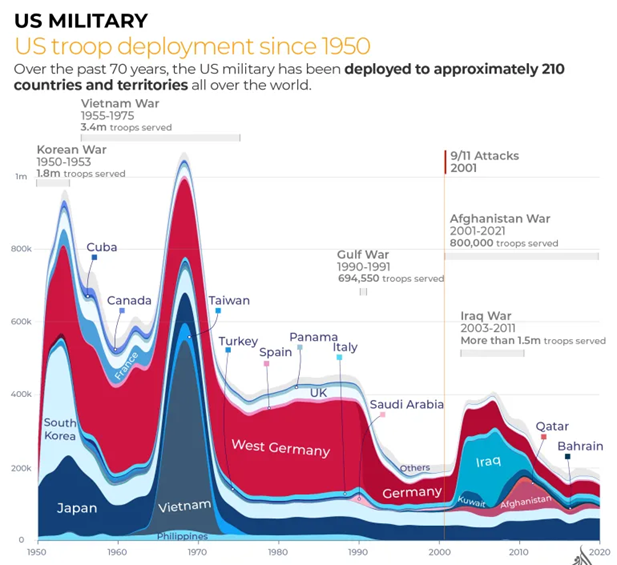
Over the past 70 years, the US military has been deployed to more than 200 countries and territories.
US MILITARY SPENDING SINCE 1950
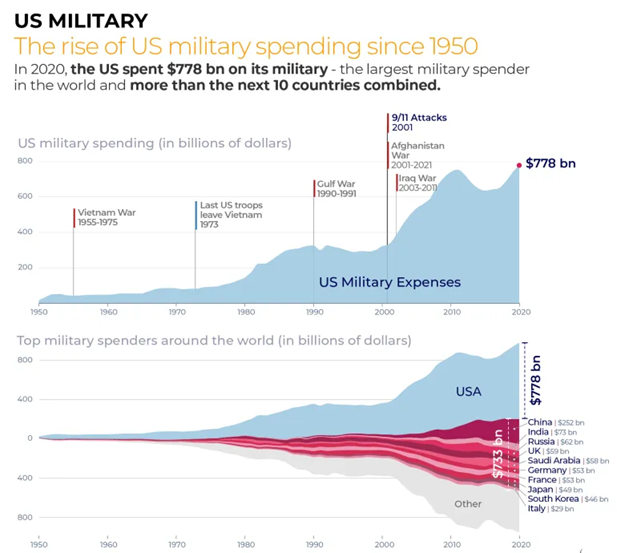
In 2020, the US spent $778bn on its military – the largest military spender in the world and more than the next 10 countries combined – according to the Stockholm International Peace Research Institute (SIPRI).
China ranked second at $252bn, followed by India at $73bn, Russia at $62bn and the UK at $59bn.
Top 5 Global Defense Spenders
The top five spenders alone account for roughly 60% of all global military expenditure.
| Country | 2025/26 Budget (USD) | % of GDP | Key Strategic Focus |
|---|---|---|---|
| United States | $921–$997 Billion | 3.4% | Hemispheric security, "Golden Dome" missile defense, and China deterrence. |
| China | $251–$277 Billion | 1.7% | Naval expansion, Taiwan "reunification" readiness, and AI-driven warfare. |
| Russia | $161–$186 Billion | 7.3% | Sustaining the Ukraine conflict and military-industrial efficiency. |
| Germany | $107 Billion | 2.1% | European leadership, NATO readiness, and the €100B Special Fund. |
| India | $82–$86 Billion | 1.9% | Twin-front deterrence (China/Pakistan) and "Atmanirbhar" (self-reliance). |
|
The Lagrange Point Shashi Tharoor argues that in a world where the U.S. is increasingly transactional and China is increasingly assertive, India must find its “Lagrange point.” In physics, this is a parking spot in space where gravitational forces balance out.
|
