
Introduction
Insurance is a critical risk-protection system that enables households and enterprises to recover from unforeseen events without exhausting savings. Recognizing its structural importance, the IRDAI has committed to the vision of “Insurance for All by 2047,” ensuring adequate life, health, and property protection for every citizen and enterprise.
Key Points
-
- Global Ranking: India is the 10th largest insurance market globally by premium volume.
- Financial Awareness: Share of insurance and pension funds in household financial assets reached 29.6% in FY25.
- Legislative Overhaul: FDI limit in insurance raised to 100% under the Sabka Bima, Sabki Raksha Act, 2025.
- Affordability Boost: GST exemption granted on individual life and health insurance policies from September 2025.
- Social Safety Net: PMJJBY recorded 26.88 crore enrolments, while PMSBY reached 57.11 crore enrolments as of Feb 2026.
Sector Performance
India’s insurance sector is vital for promoting savings and supporting economic transformation.
-
- Market Scale: In FY 2024-25, the sector issued 41.84 crore policies and collected premiums of ₹11.93 lakh crore.
- Segment Dominance: Life insurance anchors the sector, representing 74% of total premium income and 91% of Assets Under Management (AUM).
- Health Surge: Within non-life segments, health insurance has surpassed motor insurance, contributing 41% of gross domestic premium.
- Expanding Reach: The distribution network grew to nearly 83 lakh agents and partners, with over 22,000 offices operational by March 2025.
Regulatory Reforms
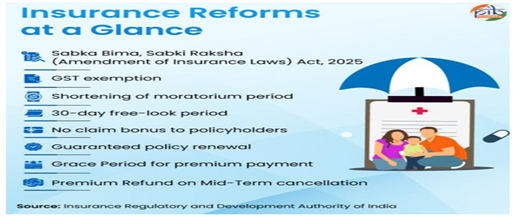
The Sabka Bima, Sabki Raksha (Amendment of Insurance Laws) Act, 2025 and IRDAI initiatives aim to deepen penetration and improve the ease of doing business.
-
- FDI Liberalization: Raising the FDI limit from 74% to 100% to attract long-term investment and technology transfer.
- Foreign Reinsurers: Net Owned Fund requirement for foreign reinsurers reduced from ₹5,000 crore to ₹1,000 crore.
- Consumer Safeguards: Maximum penalty for non-compliance enhanced to ₹10 crore; introduction of a 30-day “free-look” period for policies.
- Health Reforms: Reduction of the moratorium period from 8 years to 5 years; guaranteed policy renewals regardless of previous claims.
Major Social Insurance Protection Schemes
The Government leverages a comprehensive set of schemes to provide a safety net for vulnerable populations.
| Scheme | Type | Benefits/Coverage | Enrolment (Feb 2026) |
|---|---|---|---|
| PMJJBY | Life Insurance | ₹2 lakh cover for ₹436/year (age 18-50). | 26.88 Crore |
| PMSBY | Accidental | ₹2 lakh cover for ₹20/year (age 18-70). | 57.11 Crore |
| AB-PMJAY | Health | ₹5 lakh per family/year; expanded to all seniors 70+. | 43.52 Crore cards |
| PMFBY | Crop | Covers non-preventable natural risks; ₹1.94 lakh crore claims paid. | 93.98 Crore apps |
| ESI | Social Security | Medical and sickness benefits for 3.24 crore employees. | 14.91 Crore total beneficiaries |
Challenges
-
- Low Non-Life Penetration: The Hindu reports that while life insurance is anchored, non-life penetration remains low at 1%, highlighting a significant gap in property and liability coverage.
- Linguistic and Digital Barriers: ORF notes that despite the Digital Personal Data Protection Act integration, rural populations struggle with complex policy wording and digital-only claim processes.
- Insurance Density Disparity: PRS Legislative highlights that insurance density (USD 97.0) is still low compared to developed markets, suggesting that many policyholders remain under-insured relative to their actual risk exposure.
Way Forward
-
- Incentivizing Micro-Insurance: Developing hyper-local products tailored for informal workers and rural communities to meet the 2047 vision.
- Leveraging Digital Public Infrastructure: Fully integrating the Digital Personal Data Protection Act to streamline underwriting and claim settlements.
- Product Innovation: Encouraging insurers to offer Allopathy/AYUSH blended health products and regional-specific crop insurance models.
- Awareness Campaigns: Utilizing the Policyholders’ Education and Protection Fund to bridge the financial literacy gap.
Conclusion
India’s insurance sector by combining legislative reforms like 100% FDI with community-centric schemes like PMJJBY, the nation is building a resilient ecosystem that protects income and assets.
Spread the Word