Introduction
As the world’s second-largest producer of fruits and vegetables, India is leveraging the Production-Linked Incentive Scheme (PLISFPI) to move beyond raw commodity exports toward high-value integrated global value chains.
Key Points
-
- Fiscal Commitment: PLISFPI operates with an outlay of ₹10,900 crore (2021-22 to 2026-27).
- Capacity Expansion: Processing and preservation capacity grew by 34 lakh MT per annum as of Feb 2026.
- Employment Generation: Approximately 3.39 lakh jobs created, significantly outperforming the target of 2.5 lakh.
- Export Growth: Processed food exports grew at a CAGR of 13.23% (2019-20 to 2024-25).
- Investment Mobilized: Beneficiaries reported investments amounting to ₹9,207 crore under the scheme.
Policy Framework
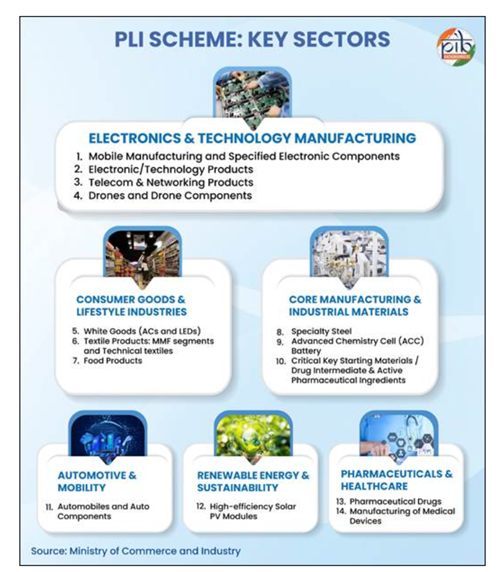
The PLISFPI is a sector-specific manifestation of the broader Production Linked Incentive (PLI) Scheme launched in April 2020.
-
- Objective: To boost domestic manufacturing by offering financial incentives based on incremental sales.
- Alignment: Supports the visions of Atmanirbhar Bharat and Make in India.
- Scope: Expanded to 14 strategic sectors with a total outlay of ₹1.97 lakh crore, with food processing as a key focus area.
The Integrated Framework
The scheme is structured to address the entire ecosystem from production to global branding:
-
- Category I (Major Segments): Focuses on Ready-to-Cook/Ready-to-Eat (RTC/RTE) foods, millet-based products, processed fruits/vegetables, marine products, and mozzarella cheese.
- Category II (SME Innovation): Incentivizes innovative and organic products, including free-range eggs and poultry products.
- Category III (Global Branding): Reimburses 50% of branding/marketing expenses abroad (capped at 3% of sales or ₹50 crore/year) to establish strong Indian food brands globally.
- Millet Push (PLISMBP): A sub-component carved out in FY 2022-23 (₹800 crore outlay) specifically to promote millet-based RTC/RTE products.
Institutional and Incentive Structure
-
- Incentive Basis: Based on incremental sales. Applicants must meet minimum sales thresholds in the base year (2019-20).
- Management Agency: Implemented through IFCI Limited (Project Management Agency).
- Monitoring: Continuous progress tracking via a web-based MIS and online portal for transparency.
Transformational Impact (As of Feb 2026)
-
- Industrial Participation: 165 applications approved across 274 project locations.
- Incentives Disbursed: ₹2,162.55 crore distributed to beneficiaries.
- MSME Integration: 69 MSMEs are direct applicants, with another 40 acting as contract manufacturing units.
- Export Performance: Cumulative export sales of beneficiaries reached ₹89,053.44 crore (April 2021 – September 2025).
Challenges
-
- Supply Chain Perishability: While processing capacity has grown by 34 lakh MT, The Hindu reports that cold-chain gaps in “last-mile” connectivity from farm gates to project locations remain a hurdle for smaller MSMEs.
- Standardization Hurdles: ORF notes that meeting stringent international food safety and phytosanitary standards for Category III (Global Branding) requires significant technical upskilling for indigenous organic producers.
- Raw Material Price Volatility: PRS Legislative highlights that fluctuations in the prices of key inputs (like marine products or mozzarella milk) can impact the “incremental sales” targets required to trigger incentives.
Way Forward
-
- Strengthening Post-Harvest Logistics: Accelerating the integration of PM Kisan SAMPADA Yojana with PLI project locations to reduce wastage.
- Expanding Global Footprint: Utilizing Category III incentives to position Millet-based products as a premium “superfood” in European and North American markets.
- Technological Upgradation: Encouraging the adoption of Industry 4.0 (IoT in preservation and traceability) to enhance global competitiveness.
Conclusion
The PLISFPI has successfully converted India’s massive agricultural surplus into a competitive manufacturing advantage by linking incentives directly to growth. The scheme has mobilized nearly ₹9,207 crore in private investment and surpassed employment targets.
Spread the Word