Daily Prelims Test (Day-1)
Quiz-summary
0 of 10 questions completed
Questions:
- 1
- 2
- 3
- 4
- 5
- 6
- 7
- 8
- 9
- 10
Information
Daily Prelims Test (Day-1)
You have already completed the quiz before. Hence you can not start it again.
Quiz is loading...
You must sign in or sign up to start the quiz.
You have to finish following quiz, to start this quiz:
Results
0 of 10 questions answered correctly
Your time:
Time has elapsed
You have reached 0 of 0 points, (0)
Categories
- Not categorized 0%
- 1
- 2
- 3
- 4
- 5
- 6
- 7
- 8
- 9
- 10
- Answered
- Review
-
Question 1 of 10
1. Question
With reference to the Regulating Act 1773, consider the following statements:
1. It designated the Governor of Bengal as the Governor-General of Bengal and created an Executive Council to assist him.
2. It established a Supreme Court at Calcutta with jurisdiction over British subjects residing in Bengal.
3. It subordinated the Presidencies of Madras and Bombay to the Governor-General in Council at Bengal in matters of war and diplomacy.
How many of the above statements are correct?
Correct
Answer: C
Explanation:
Statement 1 is correct: The Regulating Act of 1773 designated the Governor of Bengal as the Governor-General of Bengal. It also created an Executive Council consisting of four members to assist him in his duties.
Statement 2 is correct: The Act provided for the establishment of a Supreme Court at Calcutta (constituted in 1774). This court had jurisdiction over all British subjects (including company servants) residing in Bengal.
Statement 3 is correct: It initiated the process of centralisation by subordinating the Governors of the Madras and Bombay presidencies to the Governor-General of Bengal. Specifically, they were required to seek the Governor-General’s approval in matters of war and diplomacy (foreign policy).
Incorrect
Answer: C
Explanation:
Statement 1 is correct: The Regulating Act of 1773 designated the Governor of Bengal as the Governor-General of Bengal. It also created an Executive Council consisting of four members to assist him in his duties.
Statement 2 is correct: The Act provided for the establishment of a Supreme Court at Calcutta (constituted in 1774). This court had jurisdiction over all British subjects (including company servants) residing in Bengal.
Statement 3 is correct: It initiated the process of centralisation by subordinating the Governors of the Madras and Bombay presidencies to the Governor-General of Bengal. Specifically, they were required to seek the Governor-General’s approval in matters of war and diplomacy (foreign policy).
-
Question 2 of 10
2. Question
With reference to the Constituent Assembly of India, consider the following statements:
1. It was partly elected by the members of the Provincial Legislative Assemblies and partly nominated by the rulers of the princely states.
2. The representatives of the provinces were elected indirectly through proportional representation by means of the single transferable vote.
3. The Chief Commissioners’ Provinces had no representation in the Constituent Assembly.
How many of the above statements are correct?
Correct
Answer: B
Explanation:
Statement 1 is correct: The Constituent Assembly was a partly elected and partly nominated body. Members from British Indian provinces were elected by the members of the Provincial Legislative Assemblies, while the representatives of the princely states were nominated by the heads of those states.
Statement 2 is correct: The representatives of the provinces were chosen through an indirect election process. This election used the system of proportional representation by means of the single transferable vote (STV).
Statement 3 is incorrect: The Chief Commissioners’ Provinces did have representation in the Constituent Assembly. Of the 296 seats allotted to British India, 292 were from Governors’ provinces and 4 were drawn from the Chief Commissioners’ provinces (one from each: Delhi, Ajmer-Merwara, Coorg, and British Baluchistan).
Incorrect
Answer: B
Explanation:
Statement 1 is correct: The Constituent Assembly was a partly elected and partly nominated body. Members from British Indian provinces were elected by the members of the Provincial Legislative Assemblies, while the representatives of the princely states were nominated by the heads of those states.
Statement 2 is correct: The representatives of the provinces were chosen through an indirect election process. This election used the system of proportional representation by means of the single transferable vote (STV).
Statement 3 is incorrect: The Chief Commissioners’ Provinces did have representation in the Constituent Assembly. Of the 296 seats allotted to British India, 292 were from Governors’ provinces and 4 were drawn from the Chief Commissioners’ provinces (one from each: Delhi, Ajmer-Merwara, Coorg, and British Baluchistan).
-
Question 3 of 10
3. Question
With reference to the making of the Indian Constitution, consider the following statements:
Statement–I: The Constitution of India was adopted on 26 November 1949 but came into full effect on 26 January 1950.
Statement–II: The date of 26 January was chosen to commemorate the declaration of Purna Swaraj made by the Indian National Congress in 1930.
Which one of the following is correct in respect of the above statements?
Correct
Answer: A
Explanation:
Statement–I is correct: The Constitution of India was formally adopted and signed by the members of the Constituent Assembly on 26 November 1949 (celebrated today as Constitution Day). While some provisions (like citizenship, elections, and provisional parliament) came into force immediately, the entire Constitution came into full effect on 26 January 1950.
Statement–II is correct: The specific date of 26 January was selected as the Date of Commencement because of its historical significance. On 26 January 1930, the Indian National Congress had celebrated Purna Swaraj (Complete Independence) Day, following the resolution passed at the Lahore Session in December 1929.
Statement–II directly explains why the delay between adoption (November) and commencement (January) occurred. The framers deliberately chose 26 January 1950 as the date of commencement to honour the historic Purna Swaraj declaration of 1930.
Incorrect
Answer: A
Explanation:
Statement–I is correct: The Constitution of India was formally adopted and signed by the members of the Constituent Assembly on 26 November 1949 (celebrated today as Constitution Day). While some provisions (like citizenship, elections, and provisional parliament) came into force immediately, the entire Constitution came into full effect on 26 January 1950.
Statement–II is correct: The specific date of 26 January was selected as the Date of Commencement because of its historical significance. On 26 January 1930, the Indian National Congress had celebrated Purna Swaraj (Complete Independence) Day, following the resolution passed at the Lahore Session in December 1929.
Statement–II directly explains why the delay between adoption (November) and commencement (January) occurred. The framers deliberately chose 26 January 1950 as the date of commencement to honour the historic Purna Swaraj declaration of 1930.
-
Question 4 of 10
4. Question
With reference to the functions of a Constitution, consider the following statements:
1. It lays down the fundamental framework of governance and regulates the relationship among different organs of the State.
2. It defines the distribution of powers and the authority responsible for decision-making within the political system.
3. It guarantees absolute freedom by eliminating all forms of State-imposed restrictions on individual liberty.
Which of the statements given above are correct?
Correct
Answer: A
Explanation:
Statement 1 is correct: One of the primary functions of a Constitution is to provide a fundamental framework for governance. It creates the various organs of the State (Legislature, Executive, and Judiciary) and defines their roles, while also regulating the relationship between them to ensure a system of checks and balances.
Statement 2 is correct: A Constitution specifies who has the power to make decisions in a society. For example, in a Parliamentary system like India, it defines the distribution of powers between the Union and the States (Federalism) and clarifies the authority of the Parliament and the Cabinet.
Statement 3 is incorrect: A Constitution does not eliminate all forms of State-imposed restrictions. While it protects individual liberty through Fundamental Rights, these rights are almost never absolute. A Constitution typically empowers the State to impose reasonable restrictions on liberty in the interest of public order, national security, morality, or the sovereignty of the nation. In fact, a major function of a Constitution is to limit the power of the government, not to abolish it entirely.
Incorrect
Answer: A
Explanation:
Statement 1 is correct: One of the primary functions of a Constitution is to provide a fundamental framework for governance. It creates the various organs of the State (Legislature, Executive, and Judiciary) and defines their roles, while also regulating the relationship between them to ensure a system of checks and balances.
Statement 2 is correct: A Constitution specifies who has the power to make decisions in a society. For example, in a Parliamentary system like India, it defines the distribution of powers between the Union and the States (Federalism) and clarifies the authority of the Parliament and the Cabinet.
Statement 3 is incorrect: A Constitution does not eliminate all forms of State-imposed restrictions. While it protects individual liberty through Fundamental Rights, these rights are almost never absolute. A Constitution typically empowers the State to impose reasonable restrictions on liberty in the interest of public order, national security, morality, or the sovereignty of the nation. In fact, a major function of a Constitution is to limit the power of the government, not to abolish it entirely.
-
Question 5 of 10
5. Question
With reference to the provisions relating to Equality in the Constitution of India, consider the following Articles:
1. Article 14
2. Article 15
3. Article 18
4. Article 21
How many of the above Articles primarily reflect the principle of civic equality (i.e., equality before law and absence of legal discrimination)?
Correct
Answer: C
Explanation:
Civic equality refers to the equal rights and opportunities enjoyed by all citizens within a society, particularly in their relationship with the state and its institutions. This entails:
-
- Equal access to legal and political processes: Including voting, holding office, and seeking justice.
- Equal protection under the law: No discrimination based on arbitrary factors like caste, religion, gender, or social status.
- Equal access to public services and resources: Education, healthcare, employment, and other essential provisions.
- Equal participation in public life: Freedom of expression, assembly, and association to shape society.
Articles 14, 15, and 18 of the Constitution of India ensure ‘Civic Equality’:
Article 14: Equality before the law and equal protection of laws:
-
- Guarantees that everyone is subject to the same laws and legal procedures, regardless of background.
- Prohibits discrimination in the application of laws by the state.
Article 15: Prohibition of discrimination on grounds of religion, race, caste, sex, or place of birth:
-
- Specifically prohibits discrimination in public spaces, educational institutions, and employment based on these factors.
- Allows for affirmative action measures to uplift disadvantaged groups.
Article 18: Abolition of untouchability:
-
- Prohibits the practice of untouchability, a historical form of social discrimination against specific castes.
- Ensures equal access to public spaces, services, and opportunities for all individuals.
Incorrect
Answer: C
Explanation:
Civic equality refers to the equal rights and opportunities enjoyed by all citizens within a society, particularly in their relationship with the state and its institutions. This entails:
-
- Equal access to legal and political processes: Including voting, holding office, and seeking justice.
- Equal protection under the law: No discrimination based on arbitrary factors like caste, religion, gender, or social status.
- Equal access to public services and resources: Education, healthcare, employment, and other essential provisions.
- Equal participation in public life: Freedom of expression, assembly, and association to shape society.
Articles 14, 15, and 18 of the Constitution of India ensure ‘Civic Equality’:
Article 14: Equality before the law and equal protection of laws:
-
- Guarantees that everyone is subject to the same laws and legal procedures, regardless of background.
- Prohibits discrimination in the application of laws by the state.
Article 15: Prohibition of discrimination on grounds of religion, race, caste, sex, or place of birth:
-
- Specifically prohibits discrimination in public spaces, educational institutions, and employment based on these factors.
- Allows for affirmative action measures to uplift disadvantaged groups.
Article 18: Abolition of untouchability:
-
- Prohibits the practice of untouchability, a historical form of social discrimination against specific castes.
- Ensures equal access to public spaces, services, and opportunities for all individuals.
-
Question 6 of 10
6. Question
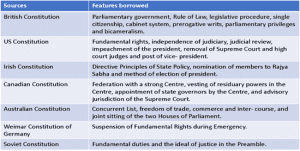
Consider the following pairs of provisions adopted from the Constitutions of different countries:
Provisions Sources
1. Joint Sitting of the two House of the Parliament – British Constitution
2. Advisory jurisdiction of the Supreme Court – Canadian Constitution
3. Parliamentary government – Australian Constitution
How many pairs given above are incorrectly matched?
Correct
Answer: B
Explanation:
Refer to the table of correct pairs given below:
 Incorrect
Answer: B
Explanation:
Refer to the table of correct pairs given below:
-
Question 7 of 10
7. Question
With reference to the Panel of Chairpersons in the Lok Sabha, consider the following statements:
1. A member of the Panel of Chairpersons may preside over the sitting of the House in the absence of both the Speaker and the Deputy Speaker.
2. A member of the Panel cannot preside over the House when the offices of both the Speaker and the Deputy Speaker are vacant.
Which of the statements given above is/are correct?
Correct
Answer: C
Explanation:
Statement 1 is correct: Under the Rules of Lok Sabha, the Speaker nominates from among the members a Panel of Chairpersons (not more than 10). Any of them can preside over the House when the Speaker or the Deputy Speaker is absent. While presiding, the member has the same powers as the Speaker.
Statement 2 is correct: There is a critical legal distinction between absence and vacancy. The Panel of Chairpersons is meant only for cases of absence. If the offices of both the Speaker and the Deputy Speaker are vacant (due to resignation, death, or removal), a member of the Panel cannot preside. In such a scenario, the President of India must appoint a member of the House to perform the duties of the Speaker (often referred to as a Speaker pro tem).
Key Differences: Absence vs. Vacancy
Feature In case of Absence In case of Vacancy Who presides? A member of the Panel of Chairpersons nominated by the Speaker. A member of the House appointed by the President. Duration Temporary (until the Speaker/Deputy Speaker returns). Until a new Speaker/Deputy Speaker is elected. Authority Rules of Procedure of the Lok Sabha. Constitutional Provision (Article 95). Incorrect
Answer: C
Explanation:
Statement 1 is correct: Under the Rules of Lok Sabha, the Speaker nominates from among the members a Panel of Chairpersons (not more than 10). Any of them can preside over the House when the Speaker or the Deputy Speaker is absent. While presiding, the member has the same powers as the Speaker.
Statement 2 is correct: There is a critical legal distinction between absence and vacancy. The Panel of Chairpersons is meant only for cases of absence. If the offices of both the Speaker and the Deputy Speaker are vacant (due to resignation, death, or removal), a member of the Panel cannot preside. In such a scenario, the President of India must appoint a member of the House to perform the duties of the Speaker (often referred to as a Speaker pro tem).
Key Differences: Absence vs. Vacancy
Feature In case of Absence In case of Vacancy Who presides? A member of the Panel of Chairpersons nominated by the Speaker. A member of the House appointed by the President. Duration Temporary (until the Speaker/Deputy Speaker returns). Until a new Speaker/Deputy Speaker is elected. Authority Rules of Procedure of the Lok Sabha. Constitutional Provision (Article 95). -
Question 8 of 10
8. Question
With reference to the provisions relating to simultaneous or double membership under the Constitution of India, consider the following statements:
1. A person cannot simultaneously be a member of both Houses of Parliament.
2. If a person is elected to more than one seat in the same House of Parliament, he or she must vacate all but one seat within the prescribed time.
3. A person cannot simultaneously be a member of Parliament and of a State Legislature.
Which of the statements given above are correct?
Correct
Answer: D
Explanation: Under the Constitution of India (Article 101) and the Representation of the People Act, 1951, specific rules are laid down to prevent “double membership.”
Statement 1 is correct: According to Article 101(1), a person cannot be a member of both Houses of Parliament (Lok Sabha and Rajya Sabha). If elected to both, the Representation of the People Act (1951) stipulates that the person must choose one house; otherwise, their seat in the Rajya Sabha becomes vacant (if they are already a member of the Rajya Sabha and get elected to the Lok Sabha).
Statement 2 is correct: If a person is elected to more than one seat in the same House (for example, contesting and winning from two Lok Sabha constituencies), they must exercise an option for one of the seats within the prescribed time (14 days). If they fail to do so, all seats held by that person in that House become vacant.
Statement 3 is correct: Under Article 101(2), a person cannot simultaneously be a member of Parliament and of a State Legislature. If a person is elected to both, they must resign their seat in the State Legislature within 14 days (as per the Prohibition of Simultaneous Membership Rules, 1950). If they do not, their seat in Parliament becomes vacant.
Incorrect
Answer: D
Explanation: Under the Constitution of India (Article 101) and the Representation of the People Act, 1951, specific rules are laid down to prevent “double membership.”
Statement 1 is correct: According to Article 101(1), a person cannot be a member of both Houses of Parliament (Lok Sabha and Rajya Sabha). If elected to both, the Representation of the People Act (1951) stipulates that the person must choose one house; otherwise, their seat in the Rajya Sabha becomes vacant (if they are already a member of the Rajya Sabha and get elected to the Lok Sabha).
Statement 2 is correct: If a person is elected to more than one seat in the same House (for example, contesting and winning from two Lok Sabha constituencies), they must exercise an option for one of the seats within the prescribed time (14 days). If they fail to do so, all seats held by that person in that House become vacant.
Statement 3 is correct: Under Article 101(2), a person cannot simultaneously be a member of Parliament and of a State Legislature. If a person is elected to both, they must resign their seat in the State Legislature within 14 days (as per the Prohibition of Simultaneous Membership Rules, 1950). If they do not, their seat in Parliament becomes vacant.
-
Question 9 of 10
9. Question
With reference to the procedure for impeachment of the President under the Constitution of India, consider the following statements:
1. The President of India can be impeached only on the ground of violation of the Constitution.
2. The notice for initiating impeachment must be signed by at least one-fourth of the total membership of the House and passed by a majority of the total membership of that House.
3. Nominated members of either House of Parliament are entitled to participate in the impeachment proceedings.
Which of the statements given above are correct?
Correct
Answer: B
Explanation:
Statement 1 is correct: Under Article 61 of the Constitution, the President can be removed from office only by the process of impeachment on the ground of “violation of the Constitution.” Interestingly, the Constitution does not define what exactly constitutes a “violation of the Constitution.”
Statement 2 is incorrect: While the notice for initiating impeachment must indeed be signed by at least one-fourth of the total membership of the House, the voting requirement to pass the resolution is more stringent than stated. The resolution must be passed by a majority of not less than two-thirds of the total membership of the House (Special Majority), not just a simple majority of the total membership.
Statement 3 is correct: There is a unique distinction between the election and impeachment of the President. While nominated members of Parliament cannot vote in the Presidential election, they are entitled to participate and vote in the impeachment proceedings of the President.
Comparison: Election vs. Impeachment of the President
Feature Presidential Election Presidential Impeachment Nominated Members of MP Cannot participate Can participate Members of State Assemblies (MLAs) Participate Cannot participate Members of Delhi & Puducherry Assemblies Participate Cannot participate Voting Requirement Proportional Representation (STV) 2/3rd of Total Membership Incorrect
Answer: B
Explanation:
Statement 1 is correct: Under Article 61 of the Constitution, the President can be removed from office only by the process of impeachment on the ground of “violation of the Constitution.” Interestingly, the Constitution does not define what exactly constitutes a “violation of the Constitution.”
Statement 2 is incorrect: While the notice for initiating impeachment must indeed be signed by at least one-fourth of the total membership of the House, the voting requirement to pass the resolution is more stringent than stated. The resolution must be passed by a majority of not less than two-thirds of the total membership of the House (Special Majority), not just a simple majority of the total membership.
Statement 3 is correct: There is a unique distinction between the election and impeachment of the President. While nominated members of Parliament cannot vote in the Presidential election, they are entitled to participate and vote in the impeachment proceedings of the President.
Comparison: Election vs. Impeachment of the President
Feature Presidential Election Presidential Impeachment Nominated Members of MP Cannot participate Can participate Members of State Assemblies (MLAs) Participate Cannot participate Members of Delhi & Puducherry Assemblies Participate Cannot participate Voting Requirement Proportional Representation (STV) 2/3rd of Total Membership -
Question 10 of 10
10. Question
Certain provisions of the Constitution of India came into force on 26 November 1949 itself, while the remaining provisions became effective on 26 January 1950 (the date of commencement). With reference to this, consider the following provisions:
1. Provisions relating to the proclamation of National Emergency
2. Provisions relating to Citizenship
3. Provisions relating to the Council of Ministers with the Prime Minister at the head to aid and advise the President
4. Provisions relating to the Election Commission of India
Which of the above provisions came into force only on 26 January 1950?
Correct
Answer: A
Explanation: While the majority of the Constitution of India came into force on 26 January 1950, certain specific provisions necessary for the transition to a new republic became effective immediately upon adoption on 26 November 1949.
-
- Proclamation of National Emergency (Article 352):This provision was not among those that came into force on 26 November 1949. Article 352, along with the rest of the Emergency Provisions (Part XVIII), became effective on the date of commencement, 26 January 1950.
- Citizenship (Articles 5, 6, 7, 8, 9):These provisions came into force on 26 November 1949. They were essential to immediately define who qualified as a citizen of India at the time of the Constitution’s adoption, particularly due to the migrations caused by partition.
- Council of Ministers (Article 74):This provision did not come into force on 26 November 1949. Article 74, which specifies that there shall be a Council of Ministers with the Prime Minister to aid and advise the President, became effective on 26 January 1950.
- Election Commission of India (Article 324):This provision came into force on 26 November 1949. It was necessary to allow for the immediate superintendence, direction, and control of the first elections to be held under the new Constitution.
Incorrect
Answer: A
Explanation: While the majority of the Constitution of India came into force on 26 January 1950, certain specific provisions necessary for the transition to a new republic became effective immediately upon adoption on 26 November 1949.
-
- Proclamation of National Emergency (Article 352):This provision was not among those that came into force on 26 November 1949. Article 352, along with the rest of the Emergency Provisions (Part XVIII), became effective on the date of commencement, 26 January 1950.
- Citizenship (Articles 5, 6, 7, 8, 9):These provisions came into force on 26 November 1949. They were essential to immediately define who qualified as a citizen of India at the time of the Constitution’s adoption, particularly due to the migrations caused by partition.
- Council of Ministers (Article 74):This provision did not come into force on 26 November 1949. Article 74, which specifies that there shall be a Council of Ministers with the Prime Minister to aid and advise the President, became effective on 26 January 1950.
- Election Commission of India (Article 324):This provision came into force on 26 November 1949. It was necessary to allow for the immediate superintendence, direction, and control of the first elections to be held under the new Constitution.