Topic 1: Commissioning of Stealth Frigate ‘INS Taragiri’
GS Paper 3: Science and Technology- developments and their applications and effects in everyday life; Indigenization of technology and developing new technology; Security forces and agencies and their mandate.
Context: The Indian Navy commissioned INS Taragiri, the fourth stealth frigate of the Project 17A (Nilgiri Class), at Visakhapatnam on April 3, 2026, in the presence of Raksha Mantri Shri Rajnath Singh.
Project 17A: Technological Mastery
INS Taragiri represents a “generational leap” in indigenous warship design, moving India from a buyer to a premier builder of complex naval platforms.
-
- Design & Build: Designed by the Warship Design Bureau (WDB) and built by Mazagon Dock Shipbuilders Limited (MDL).
- Integrated Construction: Built using modern modular construction techniques, which allowed for significantly reduced timelines compared to previous classes.
- Stealth Features: Features a sleeker hull form and a significantly reduced Radar Cross-Section (RCS), allowing it to operate with lethal stealth in contested waters.
- Legacy: It is named after the erstwhile Leander-class frigate INS Taragiri (1980), which was a pioneer in India’s anti-submarine warfare (ASW) capabilities.
Technical Specifications & Combat Power
The frigate is a multi-role platform capable of high-speed transit and long-endurance deployments.
-
- Displacement: Approximately 6,670 tonnes.
- Propulsion: Driven by a Combined Diesel or Gas (CODOG) engine and managed by an Integrated Platform Management System (IPMS).
- Weapon Suite:
- Surface-to-Surface: BrahMos supersonic cruise missiles.
- Air Defence: Medium Range Surface-to-Air Missiles (MRSAM).
- Anti-Submarine: Advanced indigenous ASW suite including torpedoes and rockets.
Strategic & Economic Significance
The commissioning of INS Taragiri sends a strong geopolitical signal regarding India’s role as a “Preferred Security Partner” in the Indo-Pacific.
1. Aatmanirbharta (Self-Reliance):
-
- Boasts over 75% indigenous content.
- Supported by an ecosystem of over 200 MSMEs.
2. Expanding the Security Umbrella:
-
- Beyond coastlines, the Navy is now securing critical sea lanes, choke points, and undersea digital infrastructure (internet cables).
3. Defence Exports:
-
- The Raksha Mantri highlighted that India’s defence exports reached an all-time high of ₹38,424 crore in FY 2025-26, compared to just ₹1,200 crore a decade ago.
4. Regional Stability:
-
- Operates under the vision of MAHASAGAR (Maritime Aid for Health, Areas and Security for All in the Global South and Adriatic Region).
UPSC Prelims Fodder: Fact-Check
| Feature | Details |
| Project 17A | Nilgiri-class Stealth Frigates (Total 7 ships being built). |
| INS Taragiri | 4th ship of the class; commissioned at Visakhapatnam. |
| MDL | Mazagon Dock Shipbuilders Limited (The builder of Taragiri). |
| CODOG | Combined Diesel or Gas propulsion. |
| Eastern Fleet | INS Taragiri will join the Eastern Fleet based in Visakhapatnam. |
Conclusion:
INS Taragiri is not merely a warship but a floating embodiment of Viksit Bharat by mastering stealth technology and integrated construction.
Topic 2: India’s Seafood Exports – Growth and Global Competitiveness
GS Paper 3: Indian Economy and issues relating to planning, mobilization of resources, growth, development and employment; Major crops-cropping patterns in various parts of the country; Economics of animal-rearing.
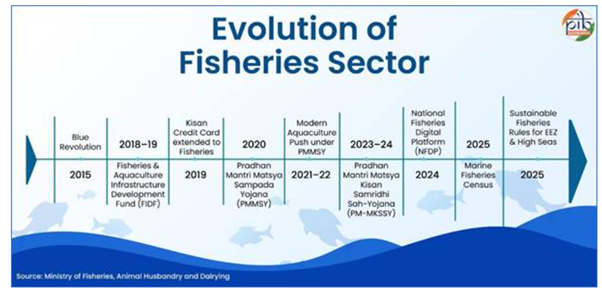
Context: The Ministry of Fisheries, Animal Husbandry & Dairying has highlighted the transformative growth of India’s fisheries sector, which has evolved into a commercially significant global powerhouse over the past decade.
Sectoral Overview and Growth Trends
India has solidified its position as the second-largest aquaculture producer globally, contributing approximately 8% of global fish production.
-
- Production Milestone: Fish production rose from 141.64 lakh tonnes in 2019-20 to 197.75 lakh tonnes in 2024-25, achieving an average annual growth of 7%.
- Export Surge: Marine product exports more than doubled in 11 years, rising from ₹30,213 crore (2013-14) to ₹62,408 crore in 2024-25.
- The Shrimp Factor: Frozen shrimp remains the flagship export, valued at ₹43,334 crore, accounting for nearly 70% of the total export value.
- Value Addition: The share of value-added products (processed/ready-to-eat) in the export basket increased from 2.5% to 11%, worth USD 742 million.
Strategic Diversification and Infrastructure
To reduce over-dependence on shrimp and a few markets, the government is implementing the Pradhan Mantri Matsya Sampada Yojana (PMMSY).
-
- Species Diversification: Promoting high-value species like Tuna, Seabass, Mud Crab, GIFT Tilapia, and Seaweed.
- Infrastructure Support: Investment in modern fishing harbors, fish landing centers, and seamless cold-chain networks to maintain quality.
- Market Reach: While the USA is the largest destination (36.42%), focus is shifting toward the EU, SE Asia, Japan, and the Middle East.
Global Compliance and Sustainability
India is aligning its sector with stringent international standards to ensure uninterrupted market access.
-
- US Marine Mammal Protection Act (MMPA): India secured a “comparability finding” in 2025 after demonstrating scientific measures to reduce marine mammal by-catch.
- Turtle Excluder Devices (TEDs): Mandatory installation of TEDs on shrimp trawlers to protect sea turtles and ensure compliance for wild-caught shrimp exports.
- Traceability: Launch of a national digital framework for end-to-end tracking from farm to fork, ensuring food safety and global compliance.
Ease of Doing Business (EoDB) Reforms
The Department of Fisheries has streamlined regulatory hurdles to attract investment:
-
- Sanitary Import Permit (SIP): Fully digitized and integrated with the National Single Window System; approval time reduced from 30 days to 72 hours.
- SIP Waivers: Requirements waived for SPF (Specific Pathogen Free) shrimp broodstock and R&D samples to facilitate faster cycles in aquaculture.
UPSC Prelims Fodder: Fact-Check
| Feature | Details |
| Global Rank | 2nd largest aquaculture producer; 8% of global production. |
| Flagship Export | Frozen Shrimp (₹43,334 crore). |
| Major Market | USA (36.42% of value). |
| PMMSY | Pradhan Mantri Matsya Sampada Yojana (Nodal scheme for fisheries). |
| MMPA | Marine Mammal Protection Act (US regulation for by-catch compliance). |
Conclusion:
India’s fisheries sector is transitioning from a traditional livelihood activity to a commercially sophisticated, globally compliant industry
Spread the Word