Introduction
India is the world’s second-largest fish-producing nation, contributing approximately 8% of global output. The sector is a cornerstone of national food security and coastal economies, accounting for 7.43% of Agricultural Gross Value Added (GVA). Total fish production has more than doubled over the last decade, rising from 95.79 lakh tonnes in FY 2013–14 to 197.75 lakh tonnes in FY 2024–25, a significant 106% increase.
Key Point
-
- Historic Budget: The Union Budget 2026-27 proposed the highest-ever annual support of ₹2,761.80 crore.
- Production Surge: Fish production reached 197.75 lakh tonnes in FY 2024-25.
- Financial Inclusion: Kisan Credit Card (KCC) benefits have been extended to 4.39 lakh fishers, with lending limits raised to ₹5 lakh.
- Blue Economy Growth: Seafood exports reached ₹62,408 crore in FY 2024–25, dominated by frozen shrimp.
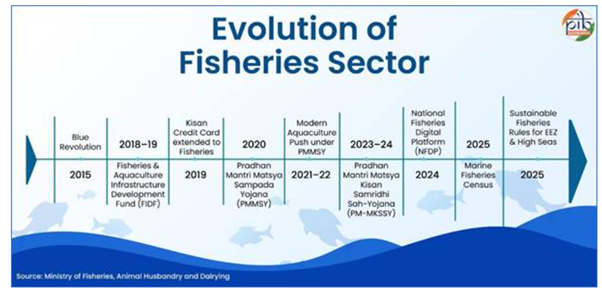
Evolution of Fisheries Sector
Institutionalizing Growth
Since the launch of the Blue Revolution in 2015, the sector has transitioned toward an organized, technology-driven framework.
Central Pillars of Development
-
- Pradhan Mantri Matsya Sampada Yojana (PMMSY): Launched in 2020, it remains the primary anchor for development with an allocation of ₹2,500 crore for 2026–27.
- Fisheries and Aquaculture Infrastructure Development Fund (FIDF): Addressing gaps in harbors and cold chains, this fund has approved 225 projects worth ₹6,685.78 crore as of January 2026.
- FFPOs: The formation of 2,195 Fisheries Farmer Producer Organizations has improved market access and financial inclusion.
Enhancing Productivity through Technology
The government prioritizes high-density, water-efficient farming models.
-
- Recirculatory Aquaculture Systems (RAS): A modern method where water is filtered and reused, ideal for high-output farming with minimal land and water. As of March 2026, 12,081 RAS units have been approved.
- Bio-floc Technology: Uses beneficial microbes to convert waste into feed, improving water quality. 4,205 Bio-floc units have been approved under PMMSY.
Risk Mitigation
Targeted schemes aim to bring fishers into the formal financial system.
-
- Kisan Credit Card (KCC): Provides affordable working capital. The lending limit was recently increased from ₹2 lakh to ₹5 lakh.
- PM-MKSSY: This sub-scheme under PMMSY focuses on formalization and insurance coverage, with a total outlay of ₹6,000 crore spanning 2023–24 to 2026–27.
- Social Protection: Livelihood support during fishing bans has benefited approximately 4.33 lakh fisher families.
Digital Governance and Data-Driven Decisions
India is institutionalizing a unified digital framework to improve transparency.
-
- National Fisheries Digital Platform (NFDP): Launched in 2024, it provides work-based digital identities for stakeholders and has registered over 30.60 lakh people.
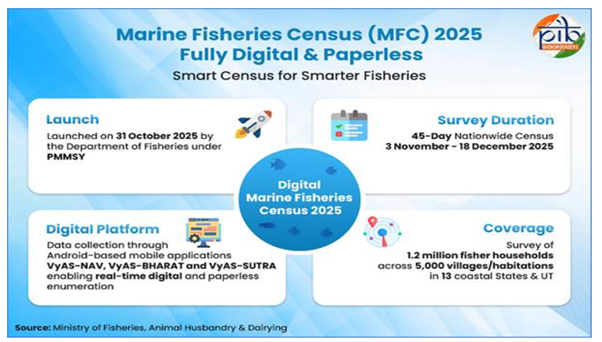
- Marine Fisheries Census (MFC) 2025: Utilized advanced mobile apps like VyAS–NAV for real-time, georeferenced data collection, generating detailed socio-economic profiles for the first time.
Sustainable Governance and Coastal Expansion
With a coastline exceeding 11,099 km, sustainable management is critical.
-
- Inland Reservoirs: Mission Amrit Sarovar has integrated fisheries into 1,222 water bodies.
- EEZ Regulation: The 2025 Rules for Sustainable Harnessing of Fisheries established a regulatory framework for India’s 24 lakh sq. km Exclusive Economic Zone (EEZ) and the high seas.
Challenges
Based on analysis from The Hindu, ORF, and PRS Legislative (2025-26):
-
- Climate Vulnerability: The Hindu reports that extreme weather events and rising sea temperatures are disrupting breeding cycles, particularly impacting the small-scale marine fishers who lack deep-sea equipment.
- Traceability Hurdles: ORF highlights that while the NFDP is a leap forward, many MSME exporters struggle to meet stringent EU and US traceability and ESG standards, threatening the ₹62,408 crore seafood export momentum.
- Credit Gap: PRS Legislative notes that despite the KCC lending limit increase to ₹5 lakh, many inland fishers still lack formal land/pond titles required to access institutional credit.
Way Forward
-
- High-Seas Diversification: Utilizing the 2026-27 budgetary support to upgrade traditional vessels for deep-sea fishing to reduce over-exploitation of near-shore resources.
- Value-Chain Integration: Connecting the 2,195 FFPOs directly to e-commerce and export hubs through the National Fisheries Digital Platform to eliminate intermediaries.
- Climate Resilience: Scaling the Bio-floc and RAS models in inland states to stabilize production against erratic monsoons.
Conclusion
Through massive capital investment, digital formalization, and sustainable resource management, India is positioning itself to achieve SDG 14: Life Below Water while unlocking the vast export potential of its aquatic resources.
Spread the Word