Indian Polity & Governance
Demand for sixth schedule in Ladakh:
Context
The Union government recently revoked the detention of activist Sonam Wangchuk under the National Security Act (NSA), nearly six months after his arrest. His detention was linked to ongoing protests in Ladakh demanding Statehood and inclusion under the Sixth Schedule of the Constitution.
1. Constitutional Basis of Sixth Schedule
-
- Provided under Articles 244(2) and 275(1) of the Constitution.
- Designed for tribal areas in Northeast India.
2. Objective
-
- Protect tribal identity, land rights, and cultural practices.
- Promote self-governance through decentralised institutions.
3. Areas of Applicability: Applicable only in:
-
-
- Assam
- Meghalaya
- Tripura
- Mizoram
-
4. Autonomous District Councils (ADCs): Each ADC has 30 members:
-
-
- 26 elected
- 4 nominated by Governor
-
5. Legislative Powers of ADCs
-
- Can make laws on:
- Land
- Forests (excluding reserved forests)
- Marriage, inheritance, customs
- Laws require Governor’s assent.
- Can make laws on:
6. Judicial Powers
-
- ADCs can establish village courts.
- Handle disputes based on customary laws.
7. Financial Powers: Authority to:
-
-
- Levy and collect taxes
- Collect land revenue
-
8. Limited Applicability of Central/State Laws: Laws of Parliament or State Legislature apply:
-
-
- Only with modifications
- Or with Governor’s approval
-
9. Sixth Schedule Demand in Ladakh
-
- Demographic Argument: ~97% population is Scheduled Tribes
- Post-2019 Concerns:
- After abrogation of Article 370
- Fear of:
- Land alienation
- Job competition
- Cultural dilution
10. Present Governance & Government Response
-
- Ladakh is a Union Territory without legislature.
- Existing bodies:
- Leh & Kargil Autonomous Hill Development Councils (statutory, not constitutional)
Government alternatives:
-
- 85% reservation + 15-year domicile rule
- Article 371-type safeguards (like Article 371A and Article 371G)
- Strengthening Hill Councils
- Cultural recognition (Bhoti, Purgi languages)
(IE)
Geography, Mapping, Ecology & Environment and DM
India Submits 1st National Report on Implementation of Nagoya Protocol on Access and Benefit Sharing to Convention on Biological Diversity:
Context
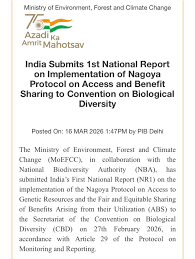
India has submitted its first National Report on the Nagoya Protocol, highlighting its role as a global leader in Access and Benefit Sharing (ABS) with over 60% of the world’s Internationally Recognised Certificates of Compliance.
-
- The report demonstrates a strong, three-tier institutional framework under the Biological Diversity Act 2002 that has mobilized ₹216.31 crore and supported local communities through 395 approvals involving non-monetary benefits like technology transfer.
-
- Global Leadership: India issued 12,830 ABS approvals and published 3,556 certificates, dominating global compliance.
- Financial Impact: ₹139.69 crore of the ₹216.31 crore mobilized has been distributed directly to local communities and Biodiversity Management Committees (BMCs).
- Institutional Framework: A robust, three-tier system includes the National Biodiversity Authority, State Boards, and over 2.76 lakh local BMCs.
- Capacity Building: Over 2.56 lakh individuals were trained, with 395 approvals including non-monetary benefits such as technology transfer and collaborative research.
(PIB)
India’s Renewable Energy Capacity Expansion:
Context
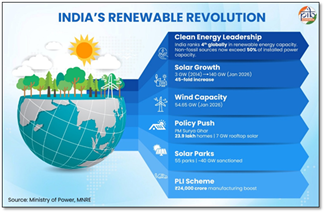
Government released updates on progress in renewable energy capacity addition, particularly solar and wind sectors.
-
- India aims to achieve 500 GW non-fossil fuel capacity by 2030.
- Renewable sources include:
- Solar
- Wind
- Hydro
- Biomass.
- Solar energy is the fastest growing sector in India.
- India is a founding member of the
International Solar Alliance. - Renewable energy reduces:
- Carbon emissions
- Fossil fuel dependence.
- Grid integration remains a major challenge.
- Renewable sources are intermittent in nature.
- Energy storage solutions (like batteries) are crucial.
(PIB)
Urban Heat Island Effect:
Context
Rising temperatures in urban areas were linked to the urban heat island effect, especially in major Indian cities.
-
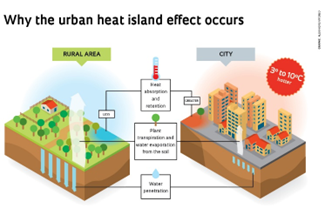
- Urban Heat Island (UHI) refers to higher temperatures in urban areas compared to rural surroundings.
- Causes include:
- Concrete surfaces
- Reduced vegetation
- Heat absorption.
- Urban areas have low albedo, leading to higher heat retention.
- Waste heat from vehicles and industries contributes.
- UHI leads to:
- Increased energy demand
- Heat stress.
- Mitigation measures:
- Urban greening
- Cool roofs
- Reflective materials.
- UHI exacerbates climate change impacts locally.
(WORLD RESOURCE INSTITUTE)
Science & Technology
Electrifying Indian Kitchens:
Context
India is at a critical juncture in its energy policy, spending approximately $26.4 billion annually to import 60% of its LPG and 50% of its natural gas.
-
- Economic Advantage: Electric cooking is currently 37% cheaper than non-subsidized LPG and 14% cheaper than piped natural gas for an average family of four in Delhi.
- Higher Energy Efficiency: Induction cooktops offer 85% energy transfer efficiency, significantly outperforming the roughly 40% efficiency of standard LPG burners.
- Import Dependency: India’s LPG import bill surged by 50% in just six years, reaching a record high in FY24–25 and highlighting the need for domestic energy alternatives.
- Grid Management Challenges: A mass shift to electric cooking could overwhelm the power grid during “peak” hours (3 p.m. and 9–11 p.m.), risking outages and driving up electricity spot-market prices.
- Smart Technology Solutions: The adoption of OpenADR (Automated Demand Response) can automatically adjust the consumption of smart appliances to flatten demand peaks without user intervention.
- The “Prosumer” Model: Integrating rooftop solar with battery storage through the PM-Surya Ghar Yojana allows households to generate and store their own power for evening cooking, reducing grid stress.
- Peer-to-Peer (P2P) Trading: Successful pilots in Uttar Pradesh demonstrate that blockchain-based P2P trading can reduce energy costs by 43% by allowing neighbours to sell surplus solar power to each other.
- Targeted Urban Strategy: Experts recommend an “Urban First” transition to electric cooking, which would free up imported LPG supplies specifically for rural areas with less reliable electricity.
- R&D for Indian Needs: Mass adoption requires new induction technology designed for traditional multi-pot Indian cooking and high-heat “flame-replicating” models.
- Policy Roadmap: Key recommendations include redirecting the ₹40,000 crore annual LPG subsidy toward induction stove capital support and mandating all-electric construction for new residential buildings.

(TH+ET)
Spread the Word