Indian Polity & Governance
Supreme Court on Governor’s Role in State Bills:
Context
The Supreme Court of India recently examined delays by Governors in granting assent to State Bills.
-
- The powers of Governors regarding State Bills are provided under Article 200.
- A Governor may give assent, withhold assent, return the Bill, or reserve it for the President.
- Money Bills cannot be returned for reconsideration.
- Bills reserved for the President are governed by Article 201.
- Governors act as constitutional heads of states.
- The Governor may return a Bill only once for reconsideration.
- If the legislature passes it again, the Governor must give assent (except in cases reserved for the President).
- The Constitution does not specify a time limit for assent.
- The issue relates to federal relations between Union and States.
(TH)
Digital Personal Data Protection Implementation:
Context
The government discussed steps for implementing the Digital Personal Data Protection framework aimed at regulating how personal data is collected, processed and stored in India.
-
- The law aims to protect personal digital data of individuals.
- It establishes obligations on data fiduciaries, which are entities processing personal data.
- Individuals whose data is processed are called data principals.
- The law emphasises consent-based data processing.
- Data fiduciaries must ensure data security safeguards.
- The law provides individuals the right to correction and erasure of personal data.
- A Data Protection Board is envisaged to address grievances.
- Significant data fiduciaries may face additional compliance obligations.
- The law seeks to balance data protection with innovation and digital economy growth.
(ET)
International Relations
India–France Cooperation in the Indo-Pacific:
Context
India and France held discussions to deepen strategic cooperation in the Indo-Pacific region, focusing on maritime security, defence cooperation and economic engagement. France has emerged as one of India’s key European partners in maintaining a rules-based order in the Indo-Pacific.
-
- India and France share a Strategic Partnership established in 1998, covering defence, nuclear energy and space cooperation.
- France is a resident power in the Indo-Pacific because it has overseas territories such as Reunion Island, Mayotte and French Polynesia.
- These territories provide France with one of the largest Exclusive Economic Zones (EEZs) in the world.
- India and France conduct the Varuna Naval Exercise, a bilateral naval exercise to enhance maritime cooperation.
- Both countries cooperate in defence manufacturing, including aircraft and submarine technologies.
- France supports India’s membership in the Nuclear Suppliers Group (NSG).
- Cooperation also exists in civil nuclear energy, especially after the India–France civil nuclear agreement.
- The Indo-Pacific region has become geopolitically important due to major trade routes and strategic sea lanes.
- Both countries emphasise freedom of navigation and international maritime law, especially under UNCLOS.
(IE)
Economy
RBI Liquidity Operations and Monetary Policy Management:
Context
The Reserve Bank of India monitored liquidity conditions in the banking system and conducted operations to ensure adequate availability of funds in financial markets. Such liquidity management is an important part of monetary policy transmission.
-
- The RBI manages liquidity through the Liquidity Adjustment Facility (LAF), which allows banks to borrow or lend money overnight.
- The repo rate is the rate at which commercial banks borrow funds from the RBI against government securities.
- The reverse repo rate is the rate at which the RBI borrows money from commercial banks.
- Open Market Operations (OMOs) involve the purchase and sale of government securities by the RBI in the open market.
- When the RBI purchases securities, liquidity increases in the banking system.
- When the RBI sells securities, liquidity is absorbed from the system.
- The Cash Reserve Ratio (CRR) requires banks to maintain a certain percentage of their deposits with the RBI as reserves.
- Liquidity conditions affect short-term interest rates, credit availability, and overall economic activity.
- Monetary policy in India is conducted by the Monetary Policy Committee (MPC) established under the RBI Act, 1934 (amended in 2016).
- The primary objective of monetary policy in India is inflation targeting, currently at 4% ± 2%.
(ET)
Geography, Mapping, Ecology & Environment and DM
Progress of the Deep Ocean Mission:
Context
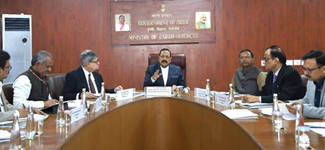
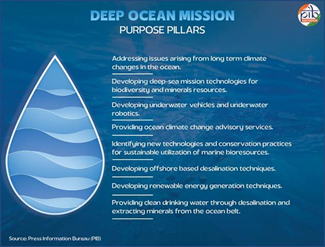
The government reviewed progress under the Deep Ocean Mission, which aims to explore deep-sea resources and develop ocean technologies.
-
- The mission seeks to explore deep-sea mineral resources such as polymetallic nodules.
- It includes development of a manned submersible capable of reaching ~6,000 m depth.
- Polymetallic nodules contain nickel, cobalt, copper and manganese.
- Deep ocean ecosystems include hydrothermal vents and cold seeps.
- Hydrothermal vent ecosystems rely on chemosynthesis rather than photosynthesis.
- India has an exploration contract with the International Seabed Authority.
- The exploration area lies in the Central Indian Ocean Basin.
- Deep ocean technology requires pressure-resistant materials and advanced robotics.
- Environmental concerns exist regarding benthic habitat disruption.
- The mission also aims to develop ocean climate observation systems.
(PIB)
Role of Seagrass Ecosystems:
Context
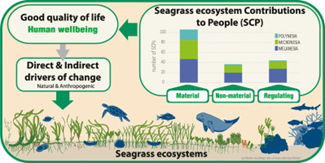
Scientists emphasised conservation of seagrass meadows due to their ecological and climate benefits.
-
- Seagrasses are flowering plants adapted to marine environments.
- They grow in shallow coastal waters.
- Seagrasses are important blue carbon ecosystems.
- They provide nursery habitats for fish and marine organisms.
- Seagrass meadows help stabilise sediments.
- They improve coastal water clarity.
- Dugongs rely heavily on seagrass for food.
- Seagrass ecosystems are threatened by coastal development and pollution.
- Seagrass loss can release stored carbon into the atmosphere.
- Seagrass conservation contributes to climate mitigation and biodiversity protection.
(TH)
Global Decline in Insect Populations:
Context
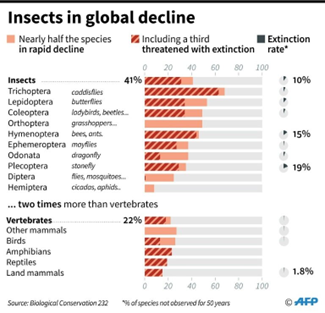
Scientists warned about the decline of insect populations worldwide, which could have serious implications for biodiversity, food security and ecosystem stability.
-
- Insects play a crucial role in pollination of crops and wild plants.
- Approximately 75% of global food crops depend partly on pollinators.
- Insects are important in nutrient recycling and decomposition processes.
- They serve as a primary food source for many birds, reptiles and amphibians.
- Major drivers of insect decline include:
- Habitat loss
- Pesticide use
- Climate change
- Pollution.
- Intensive agriculture and monoculture farming reduce insect diversity.
- Pollinator decline threatens crops like fruits, vegetables, nuts and oilseeds.
- Conserving natural habitats and reducing pesticide use are key strategies for insect conservation.
- Insects are considered indicator species reflecting ecosystem health.
(TH+ET)
Science & Technology
Expansion of Private Participation in India’s Space Sector:
Context
The government highlighted the growing participation of private companies in India’s space sector following reforms aimed at opening the industry to non-governmental entities.
-
- India’s space programme is led by the Indian Space Research Organisation.
- Space sector reforms introduced a regulatory body called IN-SPACe.
- IN-SPACe acts as an independent nodal agency to authorise and promote private space activities.
- The commercial arm of ISRO is NewSpace India Limited, which handles commercial launches and satellite services.
- Private companies can now develop satellites, launch vehicles, and space-based applications.
- Space sector reforms aim to increase India’s share in the global space economy.
- Satellite applications include communication, navigation, weather forecasting, and disaster management.
- India’s first satellite Aryabhata was launched in 1975.
- India has developed several launch vehicles including PSLV, GSLV, and LVM3.
- Expansion of the space ecosystem is expected to boost innovation and start-ups in space technology.
(PIB)
Spread the Word