
Introduction:
Ministry of Health and Family Welfare released the Strategy for AI in Healthcare for India (SAHI) during the India AI Impact Summit 2026. The strategy recognizes AI as a strategic enabler for reaching the goal of Viksit Bharat 2047, while emphasizing that its adoption must be anchored in patient-centered care, transparency, and public trust.
Strategy for AI in Healthcare for India (SAHI)
SAHI serves as the national framework for the responsible integration of AI into India’s health system.
-
- Inclusive Development: Aims to make healthcare high-quality, timely, and affordable for all, aligning with the #AIforAll vision.
- Democratization of Care: Focuses on enabling universal health coverage in rural areas with limited specialist availability through AI-driven diagnostics.
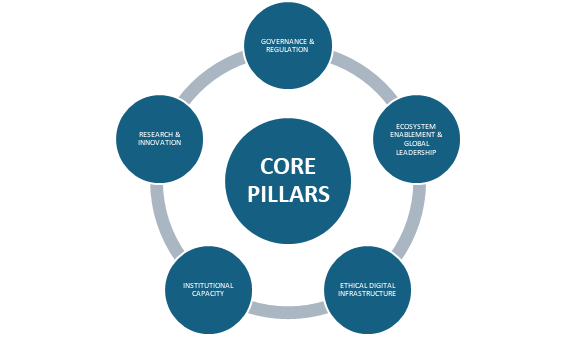
- Core Pillars: Addresses five critical areas:
-
- Governance Philosophy: Seeks to establish trusted, risk-proportionate oversight to ensure the accountable use of AI at scale.
Policy Framework & Digital Infrastructure
India’s journey toward AI-integrated healthcare is built upon a robust digital public infrastructure (DPI) foundation.
| Policy Initiative | Launch Year | Focus & Contribution |
|---|---|---|
| National Strategy for AI | 2018 | Emphasized #AIforAll and scalable solutions for emerging economies. |
| National Health Stack | 2018 | Established registries, health IDs, and coverage platforms for seamless data flow. |
| Ayushman Bharat Digital Mission (ABDM) | Ongoing | Realized the health vision with over 860 million health IDs created. |
| BODH Platform | 2026 | Benchmarking platform developed by IIT Kanpur for testing AI tools before deployment. |
Case Studies
The India AI Impact Summit 2026 compendiums highlight how AI is moving from “promise to practice”.
| Application Area | Specific AI Tool / Initiative | Real-World Impact |
|---|---|---|
| Neuroradiology | Scaida BrainCT | Assisting general radiologists in 30+ Tier-2/3 facilities; processed 15,000+ studies to speed up интерпретация of critical head trauma scans. |
| Accessibility | SMARTON | A voice-first platform available in 50 languages (10 Indian) empowering 15,000 visually impaired users to independently read documents and participate in society. |
| Early Screening | Nayanamritham 2.0 | AI-driven screening for diabetic retinopathy, enabling early detection of eye diseases at the community level. |
| TB Detection | Cough Against TB (CATB) | Systems that detect tuberculosis by analyzing cough sound patterns, accelerating the diagnostic timeline. |
| Surgical Aid | Virtual Cardiac Twin | Models patient-specific heart structures to assist surgeons in complex heart procedures. |
Ethical Stewardship
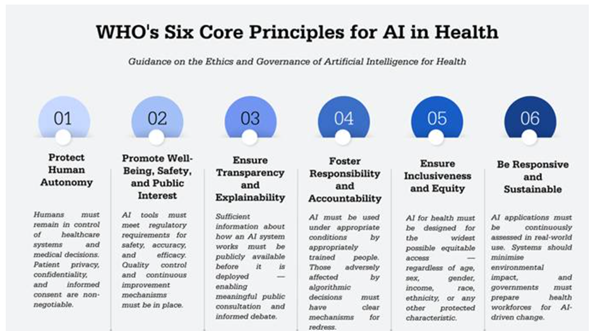
During the AI Summit, the Government of India, in collaboration with the World Health Organisation (WHO), emphasised that AI’s transformative potential must be accompanied by strong ethical stewardship, grounding in WHO’s six core principles for AI in health.
Challenges
-
- The Hindu reports that many AI tools lack representative data from diverse Indian populations, which can reinforce algorithmic biases and reduce diagnostic accuracy for marginalized groups.
- ORF notes that despite the proliferation of innovative tools, clinical adoption remains low due to a lack of trust among healthcare professionals and clear liability frameworks.
- Indian Express highlights that neuroradiology expertise is concentrated in Tier-1 cities; while AI like BrainCT helps, the 500% increase in imaging workload requires more trained “human-in-the-loop” validators.
- Expert discussions emphasize that lack of diverse genomics data hinders daily medicine transformation; the field requires data from at least 100 million people.
Way Forward
-
- Strategic national investment to build institutional capacity for overseeing safety, bias mitigation, and cybersecurity in health AI.
- Establishing clear commitments for developers and governments to safeguard human dignity and ensure AI systems minimize medical errors.
- Aligning with WHO’s six core principles for AI in health, specifically protecting human autonomy and advancing equity.
- Scaling the integration of medical professionals into the AI workforce pipeline to generate real-world evidence.
Conclusion
The SAHI framework and the launch of the BODH benchmarking platform signal India’s readiness to lead the global charge in health AI by building indigenous solutions tailored to its vast and diverse population.
Spread the Word