Indian Polity & Governance
India Strengthens Digital Public Infrastructure:
Context
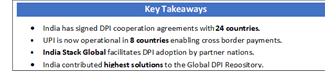
India highlighted the global recognition of its Digital Public Infrastructure (DPI) model.
-
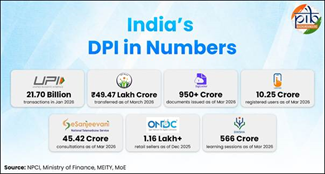
- DPI includes platforms like Aadhaar, UPI and DigiLocker.
- Aadhaar provides biometric digital identity to residents.
- UPI enables instant bank-to-bank digital payments.
- DigiLocker allows citizens to store official digital documents.
- DPI supports Direct Benefit Transfer (DBT) schemes.
- It reduces leakages in welfare distribution.
- The National Payments Corporation of India manages UPI.
- India’s digital model is discussed in G20 digital economy meetings.
- DPI supports financial inclusion and governance reforms.
- Many developing countries are studying India’s India Stack architecture.

(PIB+ET)
International Relations
India-Japan Strategic Cooperation Discussions:
Context
India and Japan discussed strengthening cooperation in the Indo-Pacific region and expanding economic ties.
-
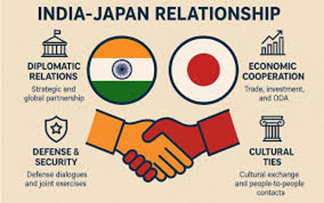
- India-Japan relations were elevated to Special Strategic and Global Partnership in 2014.
- Japan is one of the largest investors in India.
- Both countries cooperate in infrastructure and technology projects.
- Japan is involved in developing the Mumbai–Ahmedabad High Speed Rail (bullet train) project.
- Both countries are members of the Quadrilateral Security Dialogue (Quad).
- The Quad includes India, Japan, Australia and the United States.
- Cooperation includes maritime security and disaster relief.
- India and Japan conduct joint military exercises.
- Both support a free and open Indo-Pacific region.
- Japan is a major provider of Official Development Assistance (ODA) to India.
(TH)
Economy
RBI Emphasises Financial Stability in Digital Payments Expansion:
Context
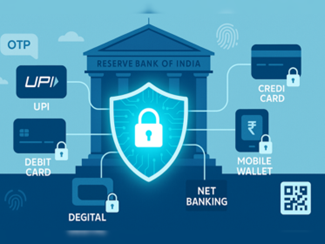
The Reserve Bank of India highlighted the need for financial stability and security as India’s digital payments ecosystem continues expanding.
-
- RBI is India’s central banking institution, established in 1935.
- RBI regulates the banking and financial system in India.
- India has one of the largest digital payment ecosystems in the world.
- Digital payments are facilitated through platforms like UPI and mobile banking.
- RBI also regulates payment banks and small finance banks.
- Digital transactions help improve financial inclusion.
- Cybersecurity and data protection are key concerns.
- RBI periodically releases Financial Stability Reports.
- Payment systems in India are supervised under the Payment and Settlement Systems Act, 2007.
- The National Payments Corporation of India operates many digital payment platforms.
(ET)
Geography, Mapping, Ecology & Environment and DM
Expansion of Renewable Energy Projects in India:
Context
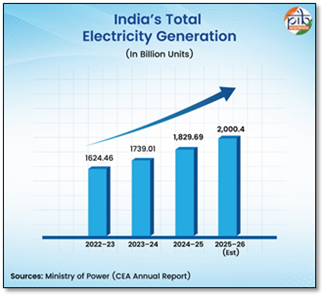
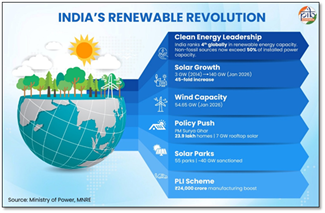
India continues expanding renewable energy capacity to achieve its 2030 climate targets.
-
- India aims to achieve 500 GW non-fossil fuel energy capacity by 2030.
- Major renewable sources include solar, wind, hydro and biomass.
- The National Solar Mission was launched in 2010.
- India is a founding member of the International Solar Alliance.
- Renewable energy helps reduce greenhouse gas emissions.
- India has one of the largest solar power capacities in the world.
- Wind energy potential is highest along the western and southern coasts.
- Renewable expansion reduces dependence on fossil fuel imports.
- Energy transition is key to India’s net-zero target for 2070.
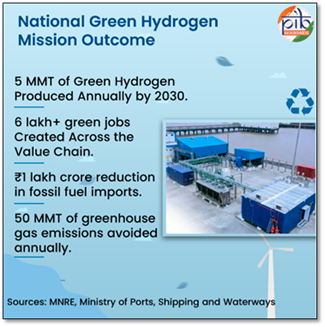
- Green hydrogen is emerging as a future clean energy source.
(ET)
Government Schemes & Initiatives
India’s Semiconductor Mission Review:
Context
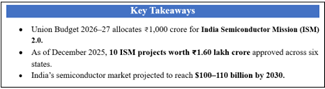
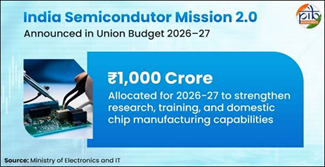
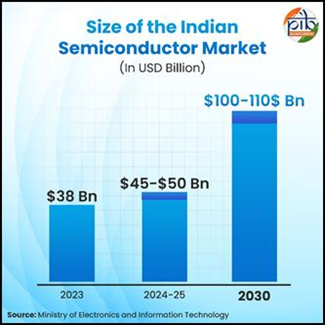
The government reviewed progress under the India Semiconductor Mission, aimed at strengthening India’s chip manufacturing ecosystem.
-
- The mission was launched in 2021 to develop semiconductor manufacturing in India.
- It operates under the Ministry of Electronics and Information Technology (MeitY).
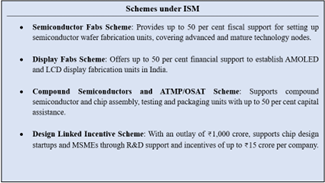
- The government approved a ₹76,000-crore incentive scheme for semiconductor manufacturing.
- The mission supports semiconductor fabrication plants (fabs) and display manufacturing.
- Semiconductor chips are critical for electronics, automobiles, telecommunications, and defence systems.
- Global chip production is dominated by countries such as Taiwan and South Korea.
- Semiconductor manufacturing requires ultra-clean fabrication facilities called fabs.
- Supply chain disruptions during COVID-19 highlighted global chip shortages.
- Domestic chip production aims to reduce import dependence.
- The mission aligns with India’s Atmanirbhar Bharat industrial strategy.
(ET+PIB)
Miscellaneous
International Women’s Day 2026 Preparations Highlight Women-Led Development:
Context
Ahead of International Women’s Day (8 March), the Government of India highlighted initiatives promoting women-led development and gender equality.
-
- International Women’s Day is celebrated annually on 8 March.
- It was first officially recognized by the United Nations in 1975.
- The day promotes gender equality and women’s empowerment.
- India has multiple schemes supporting women entrepreneurs.
- Women participation in Self-Help Groups (SHGs) has expanded under government programs.
- Women’s empowerment is linked to inclusive economic growth.
- India’s labour force participation rate for women remains a key development indicator.
- Gender equality is also one of the United Nations Sustainable Development Goals (Goal 5).
- Women-led development is a priority under India’s policy framework.
- Government initiatives focus on financial inclusion, skill development and entrepreneurship.

(PIB+TH)
Spread the Word