
Indian Polity & Governance
Nitish Kumar Moves to Rajya Sabha – Political Shift in Bihar:
Context
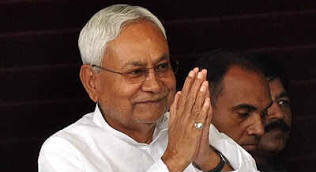
Long-time Bihar Chief Minister Nitish Kumar filed nomination for the Rajya Sabha, signalling the end of his long tenure as CM and opening the way for a leadership change in the state.
1. Rajya Sabha is the Upper House of Parliament.
2. Maximum strength of Rajya Sabha: 250 members.
3. Present effective strength: 245 members.
4. 12 members are nominated by the President for expertise in arts, literature, science, and social service.
5. Remaining members are elected by elected members of State Legislative Assemblies.
6. Election uses proportional representation by single transferable vote (STV).
7. Rajya Sabha is a permanent house and is not subject to dissolution.
8. One-third members retire every two years.
9. The Vice-President of India is the ex-officio Chairman of Rajya Sabha.
10. Money Bills can only be introduced in the Lok Sabha, limiting Rajya Sabha’s role.
(IE)
International Relations
India-Africa Defence Cooperation Initiative:
Context
Trade between India and the United Arab Emirates continued to grow following the Comprehensive Economic Partnership Agreement (CEPA).
-
- CEPA between India and UAE came into force in May 2022.
- It aims to increase bilateral trade to USD 100 billion.
- CEPA reduces tariffs on a large share of goods.
- UAE is among India’s largest trading partners.
- India exports gems, jewellery, petroleum products and textiles.
- UAE exports crude oil and petrochemicals to India.
- Dubai is a major re-export hub for Indian goods.
- CEPA also facilitates services trade and investments.
- The UAE hosts a large Indian diaspora population.
- The agreement strengthens India’s West Asia economic engagement.

(TH+ET)
Economy
India’s Services Sector Expansion:
Context
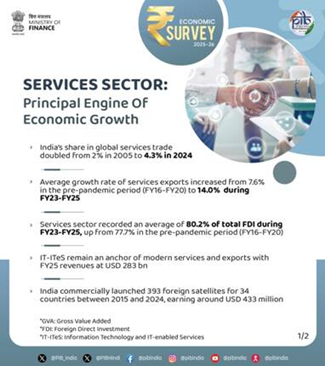
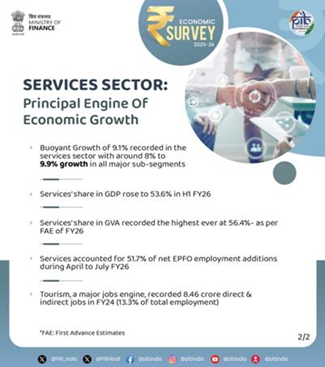
India’s services sector activity remains strong according to the Services Purchasing Managers’ Index (PMI).
-
- PMI measures economic health of manufacturing and services sectors.
- Compiled by S&P Global for India.
- PMI above 50 indicates expansion; below 50 indicates contraction.
- Services sector contributes about 55% of India’s GDP.
- Major service segments: IT services, financial services, tourism, transport.
- India is one of the largest exporters of IT services globally.
- Services exports are a major contributor to current account inflows.
- Digital economy expansion is boosting service-sector growth.
- Global demand affects services exports significantly.
-
- Services sector employment has been rising in urban areas.
(ET+PIB)
India’s Digital Public Infrastructure (DPI) Model:
Context
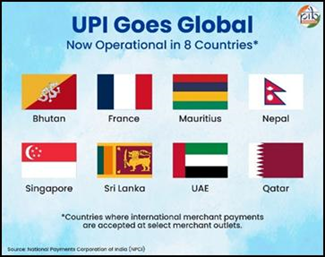
India continues promoting its Digital Public Infrastructure (DPI) globally as a model for digital governance.
-
- DPI includes Aadhaar, UPI, and DigiLocker platforms.
- National Payments Corporation of India (NPCI) manages UPI.
- UPI enables instant bank-to-bank transfers.
- Aadhaar provides biometric-based digital identity.
- DigiLocker stores official digital documents.
- DPI supports Direct Benefit Transfer (DBT).
- Helps reduce leakages in welfare delivery.
- India’s DPI model is promoted in G20 digital economy discussions.
- Open API architecture allows private innovation.
-
- Many countries are studying the India Stack framework.


(PIB)
RBI Expands CBDC Pilot:
Context
The Reserve Bank of India expanded its pilot project of the Central Bank Digital Currency (CBDC) or Digital Rupee.
-
- CBDC is a digital form of sovereign currency issued by a central bank.
- India’s CBDC is called e₹ (Digital Rupee).
- Pilot projects include retail and wholesale CBDC segments.
- Retail CBDC is used for everyday transactions by the public.
- Wholesale CBDC is used for interbank settlements.
- CBDC differs from cryptocurrencies as it is state-backed legal tender.
- It can improve payment efficiency and financial inclusion.
- Blockchain or distributed ledger technology may be used.
- CBDC may reduce costs of physical currency management.
-
- Many central banks globally are exploring CBDC.

(ET)
Geography, Mapping, Ecology & Environment and DM
World Wildlife Day 2026 Observed:
Context
India observed World Wildlife Day on 3 March, highlighting biodiversity conservation and illegal wildlife trade.
-
- World Wildlife Day was proclaimed by the United Nations General Assembly in 2013.
- The date commemorates the adoption of Convention on International Trade in Endangered Species of Wild Fauna and Flora in 1973.
- CITES regulates international trade in endangered species.
- Species under CITES are listed in Appendix I, II, and III based on protection level.
- India is a party to CITES since 1976.
- The nodal authority in India for CITES implementation is the Directorate of Wildlife Preservation.
- Illegal wildlife trade is estimated to be worth billions of dollars annually.
- Biodiversity conservation contributes to ecosystem stability and climate resilience.
- India hosts nearly 8% of global biodiversity.
- Wildlife protection in India is governed by the Wildlife Protection Act 1972.



(TH+PIB)
India’s Renewable Energy Capacity Expansion:
Context
India continues expanding renewable energy capacity toward its 2030 climate targets.
-
- India aims for 500 GW non-fossil fuel capacity by 2030.
- Major renewable sources include solar, wind, hydro, and biomass.
- India is among the top global solar energy producers.
- The National Solar Mission was launched in 2010.
- India is a founding member of the International Solar Alliance.
- Renewable energy reduces greenhouse gas emissions.
- Solar parks are developed under central and state policies.
- Wind energy potential is high along India’s western and southern coasts.
- Energy transition supports India’s net-zero target for 2070.
- Renewable expansion reduces dependence on fossil fuel imports.

(ET+TH)
Internal Security
CISF Raising Day Ceremony:
Context
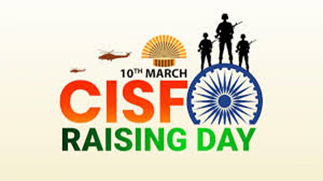
The Central Industrial Security Force (CISF) celebrated its Raising Day, attended by the Union Home Minister.
-
- CISF was established in 1969 under the CISF Act, 1968.
- It functions under the Ministry of Home Affairs.
- Originally created to protect public sector undertakings (PSUs).
- Now provides security to airports, metro networks, nuclear installations and heritage monuments.
- It is one of the Central Armed Police Forces (CAPFs).
- CISF also provides private sector security services under a government scheme.
- It operates Fire Wing units for industrial safety.
- Headquarters: New Delhi.
- It is among the few paramilitary forces with aviation security responsibility.
- CISF personnel also participate in UN peacekeeping missions.
(IE)
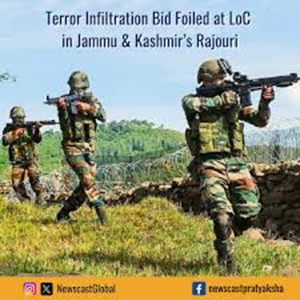
Terror Infiltration Attempt Foiled Along Line of Control:
Context
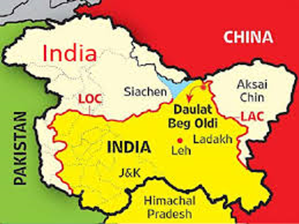
The Indian Army foiled a militant infiltration attempt along the Line of Control (LoC) in the Rajouri sector of Jammu & Kashmir.
-
- The Line of Control (LoC) is the de facto border between India and Pakistan in Jammu & Kashmir.
- It emerged after the Simla Agreement (1972) following the 1971 Indo-Pak war.
- LoC replaced the earlier Ceasefire Line established in 1949.
- It separates Pakistan-occupied Kashmir (PoK) from Indian territory.
- The LoC runs about 740 km.
- It is not an internationally recognized boundary but a military control line.
- The LoC is heavily militarized and monitored by the Indian Army.
- Infiltration attempts typically involve militants crossing from across the border.
(IE)
Miscellaneous
CBSE Postpones Board Exams in Middle East:
Context
The Central Board of Secondary Education postponed Class 10 and 12 board exams scheduled for 5–6 March 2026 in several Middle Eastern countries due to the regional situation.
-
- CBSE is a national school education board under the Ministry of Education.
- It was established in 1962.
- CBSE operates over 28,000 schools worldwide.
- Indian schools abroad affiliated with CBSE exist in Gulf countries and Southeast Asia.
- Countries affected included Bahrain, Kuwait, Oman, Qatar, Saudi Arabia and UAE.
- CBSE conducts national exams for Class 10 and Class 12.
- The board introduced multiple exam attempts system from 2026.
- CBSE is part of India’s national education administration framework.

(IE)
National Safety Day Observed in India:
Context
India observed National Safety Day to promote workplace safety and accident prevention.
-
- National Safety Day is observed on 4 March each year.
- It commemorates the founding of the National Safety Council in 1966.
- The National Safety Council is an autonomous body under the Ministry of Labour and Employment.
- It promotes safety awareness across industries.
- The observance launches National Safety Week
- Focus sectors include manufacturing, mining, and construction.
- Workplace safety is governed by the Occupational Safety, Health and Working Conditions Code, 2020.
- Safety campaigns encourage risk prevention and safe working practices.
- Industries conduct training and safety drills.
- The initiative aims to reduce industrial accidents and occupational hazards.
(PIB)
Spread the Word