Nuclear energy is the use of controlled atomic reactions to produce power. At its core, it relies on splitting atoms in a process called fission, which releases large amounts of heat. This heat is then used to generate electricity without producing greenhouse gases. Globally, nuclear energy is valued as a clean, dependable source that complements renewable options like solar and wind.
EVOLUTION OF INDIA’S NUCLEAR LAWS
1. The Atomic Energy Act, 1962, replaced the earlier 1948 law and laid down the foundation for India’s nuclear programme. It empowered the government to regulate atomic energy for peaceful purposes, ensuring strict control over research, development, and use of nuclear materials.
2. Amendments in 1986, 1987, and 2015 in the Atomic Energy Act of 1962 gradually opened the sector beyond the Central Government, allowing government companies and joint ventures to participate in nuclear power generation.
3. The Civil Liability for Nuclear Damage Act, 2010, introduced a no-fault liability regime, ensuring compensation in case of nuclear incidents. This law provided clarity on responsibility and built public trust by prioritizing safety and accountability in nuclear operations.
PRESENT OUTLOOK
-
- Stable Contribution: Nuclear power has consistently accounted for around 3% of total electricity generation, with a share of 3.1% in 2024–25.
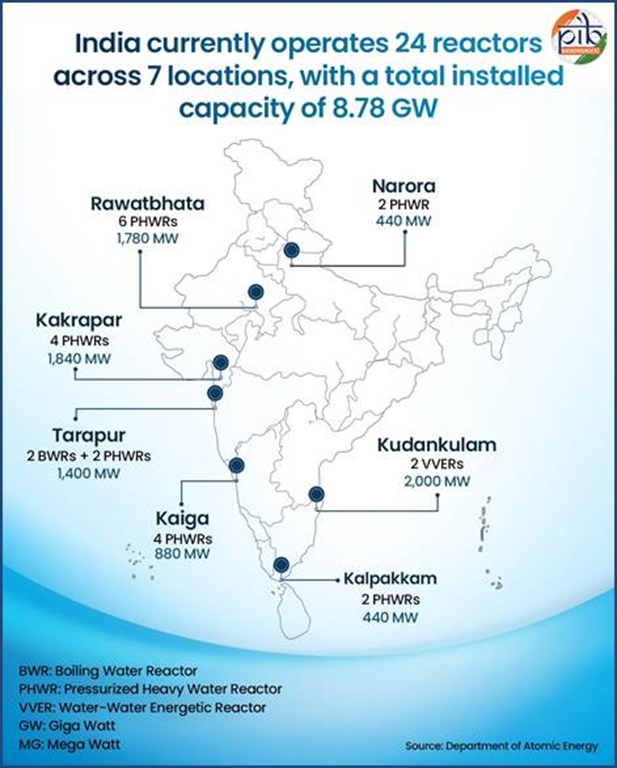
- Installed Capacity: The present nuclear capacity stands at 8.78 GW.
- Planned Expansion: With the indigenous 700 MW and 1000 MW reactors being developed through international cooperation, the capacity is projected to rise to 22.38 GW by 2031–32.
- The country’s first reactor was commissioned in Tarapur on October 28, 1969. Then, reactors were installed at many places, including Rawatbhata, Kalpakkam, Narora, Tarapur, Kakrapar, and Kudankulam. It takes eight years to commission one reactor in the country.
THE 2008 INDO-US NUCLEAR DEAL
The 2008 Indo-US Nuclear Deal, also known as the 123 Agreement, was a landmark pact ending India’s nuclear isolation by allowing it to purchase civilian nuclear technology and fuel from the U.S., in exchange for India separating its military and civilian nuclear programs and placing civilian facilities under IAEA safeguards, boosting India’s energy security and strategic standing. This agreement, rooted in a 2005 joint statement, legitimized India’s nuclear status, opened doors for global cooperation, and marked a strategic shift in U.S.-India relations, overcoming decades of technology denial regimes.