Economy
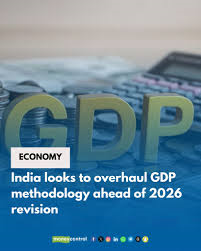
India Overhauls Real GDP Methodology for Better Accuracy:
Context: India is revamping the way Real GDP is calculated, adopting more detailed price indices and modern deflation techniques to provide accurate economic performance data.
-
- India’s GDP calculation methodology is undergoing a major overhaul to reflect real economy conditions.
- The revision involves expanding the price index basket from ~180 items to 500–600 items for inflation adjustment.
- Consumer Price Index (CPI) data will be more deeply embedded in GDP adjustments.
- A new GDP series with 2022/23 base year will be released on 27 Feb 2026.
- Methodology now includes double deflation, adjusting input and output prices separately ,improving accuracy especially for manufacturing.
- Shift intended to fix perceived distortions caused by outdated Wholesale Price Index (WPI) deflation.
- Part of wider statistical reforms including retail inflation and industrial output indices.
- IMF had earlier recommended statistical improvements for India’s GDP calculations.
- Better measurement helps policy-making, investment decisions and economic forecasting.
(TET)
RBI’s Liquidity Management Measures:
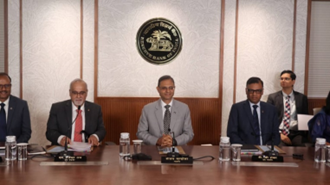
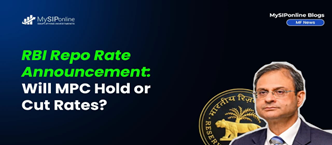
Context: Reserve Bank of India (RBI) continued active liquidity management amid evolving inflation trends.

-
- Reserve Bank of India conducts monetary policy through the Monetary Policy Committee (MPC).
- Repo rate is the rate at which RBI lends to commercial banks.
- Reverse repo is the rate at which RBI borrows from banks.
- Liquidity Adjustment Facility (LAF) manages short-term liquidity.
- Cash Reserve Ratio (CRR) is mandatory reserve with RBI (no interest).
- Statutory Liquidity Ratio (SLR) is maintained in liquid assets.
- Inflation targeting framework aims at 4% ± 2% CPI inflation.
- MPC has six members (3 RBI + 3 Government nominees).
- Open Market Operations (OMOs) involve purchase/sale of government securities.
- Liquidity tightening can impact credit growth and bond yields.
(TET)
Geography, Mapping, Ecology & Environment and DM
Understanding “Total Applied Toxicity (TAT)” in Environment:
Context: “Total Applied Toxicity” is emerging as a metric for ecosystem-level pollution assessment in water bodies.
-
- TAT measures cumulative toxicity of effluents, moving beyond single chemical limits.
- Helps monitor real-world ecosystem impacts of multiple pollutants.
- Relevant to pollution compliance under Water (Prevention and Control of Pollution) Act, 1974.
- Used by pollution regulators to enforce eco-based standards.

(TH)
Science & Technology
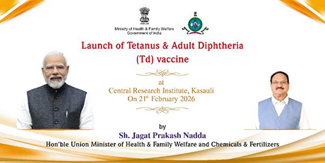
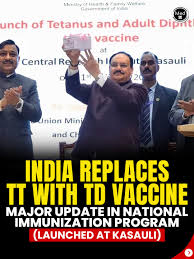
Td Vaccine Launch for Immunisation Programme:
Context: Union Health Minister launched an indigenously manufactured Tetanus & Diphtheria (Td) vaccine to support Immunisation efforts.
-
- The Td vaccine protects against tetanus and diphtheria, both serious bacterial diseases.
- It supports India’s Universal Immunisation Programme (UIP) goals.
- Indigenous manufacturing reduces import dependence in vaccine supply.
- Vaccine launch consistent with India’s focus on public health infrastructure.
(PIB)
India’s Green Hydrogen Mission Progress:
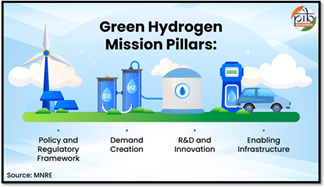
Context: Developments under the National Green Hydrogen Mission, focusing on electrolyser capacity expansion.
-
- Mission launched in January 2023.
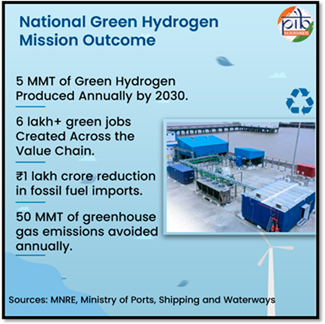
- Target: 5 MMT of green hydrogen production annually by 2030.
-
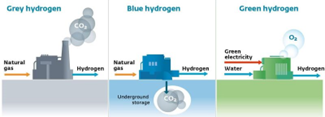
- Green hydrogen is produced using renewable electricity via electrolysis.
- Electrolysis splits water into hydrogen and oxygen.
- India aims to become a global export hub.
- Supports decarbonisation of steel, fertiliser, refinery sectors.
- Linked to India’s net-zero target by 2070.
- Offers SIGHT (Strategic Interventions for Green Hydrogen Transition).
- Hydrogen is energy-dense but storage intensive.
- Grey hydrogen is produced from natural gas (carbon intensive).
(TH)
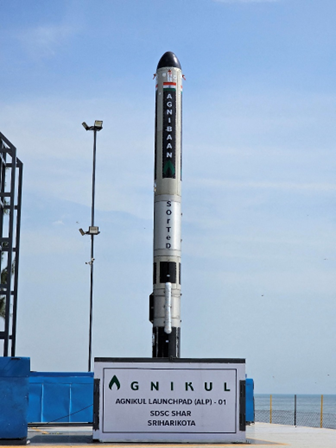
India’s Space Sector Reforms and IN-SPACe:
Context: Continued private sector participation growth in the space sector.
-
- Indian Space Research Organisation is India’s national space agency.
- IN-SPACe acts as a single-window regulator for private space players.
- IN-SPACe was created in 2020.
- Headquarters located in Ahmedabad.
- NewSpace India Limited (NSIL) is ISRO’s commercial arm.
- Space sector opened to private players in 2020 reforms.
- PSLV is a four-stage launch vehicle.
- GSLV uses cryogenic upper stage.
- India’s space economy share is ~2% globally.
- Reforms aim to increase share to 8–10%.
(TH+PIB)
Internal Security
India Unveils First Comprehensive National Counter-Terrorism Policy “PRAHAAR”:
Context: India launched its first ever national counter-terrorism policy titled PRAHAAR, aiming to provide a unified, intelligence-led framework to prevent and respond to terrorism.
-
- PRAHAAR stands for the national counter-terror strategy released on 23 Feb 2026 by the Ministry of Home Affairs.
- It is the first structured national counter-terror policy in India’s history.
- Aims to deny terrorists, financiers and supporters access to funds, weapons and safe havens.
- Based on zero tolerance toward terrorism and espouses intelligence-led prevention.
- The doctrine adopts a “whole-of-government” and “whole-of-society” approach.
- Emphasises rapid, proportionate and coordinated responses across agencies.
- Integrates cybersecurity threat responses, radicalisation mitigation and global cooperation.
- Focuses on respect for human rights and rule of law even while countering terrorism.
- Supports stronger intelligence sharing mechanisms domestically and internationally.
- The doctrine is significant amid evolving terror threats including cross-border and hybrid warfare.

(TH)
Government Schemes
India Expands Semiconductor Manufacturing Incentives:
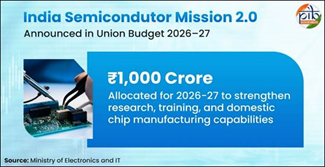
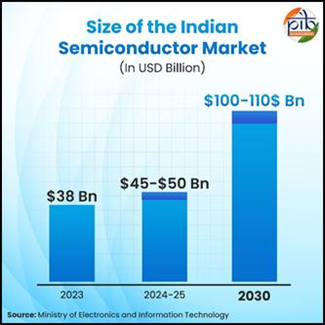
Context: Progress under India’s semiconductor push, with fresh approvals under the Semicon India Programme to strengthen domestic chip fabrication and assembly.
-
- The Semicon India Programme was launched in 2021 with an outlay of ₹76,000 crore.
- It operates under the Ministry of Electronics and Information Technology (MeitY).
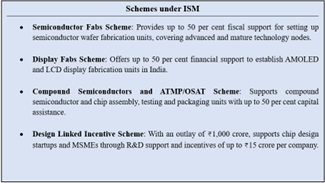
- Provides fiscal support of up to 50% of project cost for semiconductor fabs.
- Covers ATMP units (Assembly, Testing, Marking and Packaging).
- Encourages Compound Semiconductors, Silicon Photonics, Sensors fabs.
- Linked to Production Linked Incentive (PLI) scheme architecture.
- Semiconductor manufacturing is highly capital intensive and water intensive.
- India aims to reduce dependence on East Asian supply chains.
- Chip fabrication requires ultra-pure silicon wafers.
- Strategic relevance for electronics, EVs, defence and telecom sectors.
(TET)
Spread the Word