Indian Polity & Governance
NHRC Takes Suo Motu Cognizance of Assault on Journalist at DU Protest:
Context: National Human Rights Commission (NHRC) took suo motu cognisance of an alleged physical and sexual assault on a journalist covering a student protest at Delhi University after she was reportedly attacked by a mob who identified her caste.
-
- Suo motu cognisance means taking notice of a matter without a formal complaint, on the basis of credible media reports.
- The NHRC issued a notice to the Delhi Police Commissioner seeking a detailed report within two weeks.
- The journalist was allegedly assaulted while covering a protest against UGC regulations.
- The mob’s alleged targeting of the journalist because of her caste raises serious civil liberties and discrimination concerns.
- NHRC’s intervention reflects its constitutional role in protecting human rights and press freedom.
- This case intersects with freedom of the press and right to equal treatment under Articles 19(1)(a) and 14 of the Indian Constitution.
- Suo motu action underscores the relevance of independent statutory bodies in oversight.
(PIB+NHRC)
India AI Impact Summit 2026: Equity, Inclusion, Skill Gap & Public-Interest AI:
Context: India AI Impact Summit 2026, sessions were held on public-interest AI, equity and inclusion, and addressing Asia’s AI skill gap, emphasising directing AI resources to public-interest objectives.
-
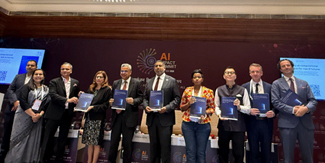
- The session “Building Public Interest AI” focused on equitable access to compute resources and inclusive AI systems.
- Dr Saurabh Garg (MoSPI) launched a report titled “Opening Up Computational Resources for New AI Futures”.
- It stressed that AI scaling must address consumer and creator access, not just elite tech players.
- Stakeholders emphasised equity and inclusion as central to future AI frameworks.
- Asia’s skill gap in AI was identified as a key policy challenge.
- This reflects India’s priority on AI for societal upliftment beyond commercial interests.
- The summit debates policy tools to ensure public benefits from AI growth.
- Discussions include ethical governance, accountability and data trustworthiness.
- Aligns with India’s “MANAV Vision” for human-centric AI.
(PIB)
Indian Society & Social Justice
World Day of Social Justice:
-
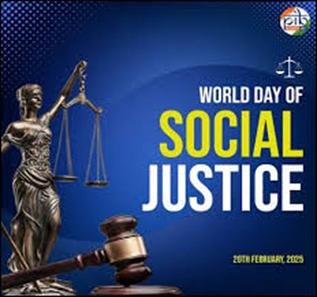
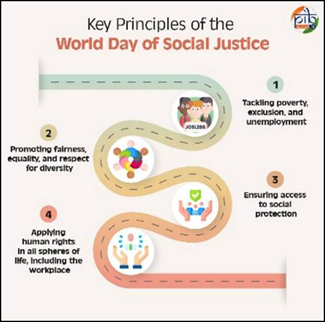
- Observed on 20 Feb to promote fairness, equitable opportunities, access to rights and dignity for all.
- World Day of Social Justiceis observed annually on 20 February. Today, Friday, 20 February 2026, marks the 18th year of this global observance, which was established by the United Nations (UN) in 2007 and first celebrated in 2009.
- The theme for 2026 is “Renewed Commitment to Social Development and Social Justice”. Some international organisations are also highlighting specific pillars under the banner of “Social Protection and Decent Work for All”.
- Key priorities for this year’s observance include:
- Renewed Multilateralism: Following the Second World Summit for Social Development held in Doha, 2026 focuses on translating political commitments into concrete outcomes.
- Just Transition: Ensuring that the shift to low-carbon and digital economies does not leave vulnerable communities behind.
- Bridging Gaps: Reducing systemic inequalities in employment, healthcare (such as universal health insurance in Asia), and social protection.
- Ministry of Social Justice and Empowerment (MoSJE)is leading national celebrations through events like the “Reading of the Preamble”to the Constitution.
(PIB)
International Relations
Visit of Hereditary Prince of Liechtenstein to India:
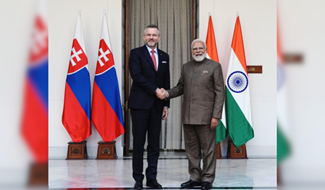
Context: HSH Prince Alois, Hereditary Prince of the Principality of Liechtenstein, paid an official visit to India, meeting Prime Minister Narendra Modi on the summit sidelines.
-
- The visit underscores bilateral diplomatic ties between India and Liechtenstein.
- Discussions reaffirmed friendly relations and potential cooperation.
- Liechtenstein is a microstate in Europe known for financial services and high per-capita income.
- Engagement with small states enhances India’s multilateral diplomacy.
- Diplomatic interactions at tech summits reflect intersection of foreign policy and economic diplomacy.
- Liechtenstein’s European Free Trade Association (EFTA) ties complement India-EFTA broader cooperation.
(PIB)
Economy
RBI Monetary Policy Outlook & Credit Growth Data:
Context: RBI’s updated credit growth numbers and monetary policy outlook, signaling emerging macroeconomic trends.
-
- Bank Credit Data: RBI’s latest monthly data indicated robust credit growth, reflecting increased borrowing by industry and services sectors.
- Deposit Growth: Deposit growth remained somewhat moderate, raising concerns about liquidity buffers.
- Monetary Policy Stance: RBI continues to signal a calibrated stance, balancing inflation containment with growth support.
- Inflation Dynamics: Retail inflation trends remain moderate, but food and energy price volatility persists.
- Credit to MSMEs: Incremental uptick in credit flow to MSMEs implies positive transmission of policy rates.
- Global Spillovers: External conditions like tightening by major central banks affect India’s policy calculus.
- Yield Curve Signals: Shorter-term yield stability contrasts with longer-term yield volatility.
- Transmission Lag: Banks’ interest rate transmission is incomplete, influencing credit demand elasticity.
- RBI Tools: RBI continues to evaluate liquidity operations, CRR/SLR adjustments, and open market operations.
- Policy Implications: Macroprudential measures may be reviewed if credit growth outpaces risk buffers.
(ET+TH)
Science & Technology
India Joins the Pax Silica Initiative at AI Impact Summit 2026:
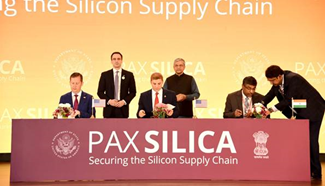
Context: During the India AI Impact Summit 2026 in New Delhi, India formally joined the Pax Silica initiative, deepening strategic cooperation with the United States on AI and critical technology supply chains.
-
- Pax Silica is a strategic coalition of trusted nations focused on securing the entire “silicon stack”, from minerals to semiconductors and AI tech.
- The initiative aims to reduce over-concentration in global supply chains, preventing economic coercion and ensuring innovation flow in open democratic societies.
- India’s participation was marked by a formal signing ceremony involving senior Indian and U.S. officials.
- The pact aligns with the India–U.S. Comprehensive Global Strategic Partnership in emerging technologies.
- Cooperation under Pax Silica covers supply chain resilience, secure compute access and building advanced tech infrastructure.
- It signals India’s transition from consumer to co-creator in high-tech ecosystems.
- India’s silicon and semiconductor manufacturing goals (via Semicon India Mission) complement this initiative.
(ET+PIB)
Important data/facts
Economy
National Logistics Policy Implementation Review:
Context: Progress and challenges in the national logistics policy, with emphasis on cost reduction and multimodal integration.
-
- National Logistics Policy (NLP) aims to reduce logistics costs to ~9–10% of GDP.
- Focus is on seamless multimodal transport
- Policy emphasises digitisation, use of Port Community Systems, and paperless clearances.
- Warehousing challenges and intermodal connectivity remain key bottlenecks.
- Linkages with inland waterways and coastal shipping are part of strategy.
- NLP also aims to enhance export competitiveness.
- Private sector participation is incentivised via PPP frameworks.
- Drone and robotic logistics trials are discussed for last-mile delivery.
- Policy outcomes will influence manufacturing and trade growth.
(ET)
Spread the Word