Indian Polity
Supreme Court: Menstrual Health Part of Right to Life (Article 21):
-
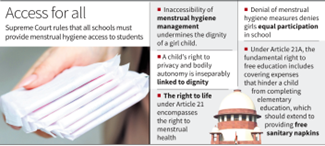
- Context On 31 January 2026, the Supreme Court of India ruled that menstrual health, including access to hygiene products and facilities, is integral to the fundamental right to life (Article 21), in a significant gender-rights judgment.
- The Supreme Court (SC) held that menstrual health is part of the fundamental right to life under Article 21 of the Constitution.
- The judgment emphasises dignity, health and well-being of menstruating persons as core to personal liberty and life.
- SC directed States and UTs to ensure free sanitary napkins in government and private schools.
- Schools must provide gender-segregated and usable toilets supportive of menstrual hygiene.
- The ruling strengthens gender rights jurisprudence under the Constitution.
- Implicitly directs government duty toward public health infrastructure and awareness.
- Enhances accountability on menstrual health policies within right-based frameworks.
- The judgment aligns health, equality and dignity within constitutional obligations of state.
(TH)
Economy
India Energy Week (IEW) 2026:
-
- Context: The flagship global energy conclave India Energy Week 2026 concluded on 30 January 2026 in Goa, highlighting India’s expanding leadership role in global energy security, energy transition, innovation and investment.
- IEW 2026, held from 27–30 Jan 2026, is India’s premier international energy exhibition and conference hosted under the Ministry of Petroleum & Natural Gas.
- It brought together global energy ministers, policymakers, industry leaders, investors and technology providers to discuss energy security, decarbonisation and investment opportunities.
- The event highlighted India’s preparedness to manage geopolitical volatility in energy markets.
- The conclave showcased India’s energy diversification strategy, balancing fossil fuels with sustainable fuels and technologies.
- IEW reinforces India’s role at the centre of global energy dialogue, reflecting its growing strategic influence in shaping global energy narratives.
- Global participation was significant, involving delegates, exhibitors and international organisations across continents.
- Focus areas included clean energy pathways, investment mobilisation, technology innovation and international partnerships.
- India Energy Week is an initiative aimed at bridging energy security with climate commitments and economic growth.
- IEW discussions also emphasised affordable energy access and transition strategies that ensure equitable development.
- India’s energy policies highlighted the importance of domestic capacity, resilience and global engagement.
(PIB)
Science & Technology
Western Railway Commissions Kavach 4.0 on Virar–Vadodara Section:
-
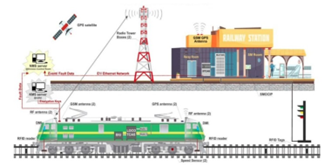
- Context: the Western Railway commissioned its Kavach 4.0 automatic train protection system on the Virar–Vadodara section, a major initiative to enhance rail safety and operational efficiency.
- Kavach is an automatic train protection (ATP) system developed indigenously by Indian Railways.
- The newly commissioned section enhances safety over one of the busiest corridors.
- The system reduces human error by automatically applying brakes if needed to prevent collisions.
- Financial outlay for expansion on the Western Railway route is approximately ₹1435 crore.
- Kavach’s rollout covers thousands of kilometres of route, with further extensions proposed.
- The system is part of Indian Railways’ broader safety modernisation strategy.
- It operates through onboard and track-side equipment for real-time train monitoring.
- The project aligns with the goal to reduce train accidents.
- Kavach is compatible with both passenger and freight operations, aiding logistics efficiency.
- The expansion reflects India’s push for advanced rail safety technologies domestically.
(PIB)
UIDAI Launches New Aadhaar App:
-
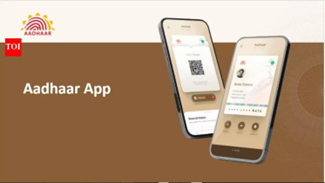
- Context: The Unique Identification Authority of India (UIDAI) has launched a fully redesigned Aadhaar mobile application on 28 January 2026, marking a significant upgrade from the previous “mAadhaar” app.
- The new app focuses on secure digital identity management, privacy, offline verification and citizen convenience as part of India’s broader Digital Public Infrastructure (DPI) frameworks.
- The new Aadhaar app is launched by UIDAI to offer a secure, user-centric digital identity experience on smartphones, replacing older versions like mAadhaar.
- It supports selective sharing of verifiable credentials, allowing citizens to disclose only what’s minimally required for a use-case (e.g., age verification, identity check).
(TH)
History, Art & Culture
10th Mising Youth Festival:
-
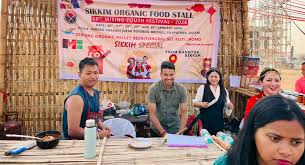
- Context: Union Home Minister Amit Shah’s address at the 10th Mising Youth Festival in Dhemaji, Assam promoting tribal culture, rights and heritage.
- The Mising Youth Festival celebrates the cultural traditions of the Mising tribal community in Assam.
- The festival emphasises preservation of language, literature, music and tribal heritage.
- It reflects India’s cultural diversity and tribal identities.
- The ‘Donyi-Polo’ tradition (nature worship) of the Mising community was highlighted.
- Tribal festivals strengthen community participation and empowerment.
- Assam’s socio-cultural landscape is influenced by numerous tribal groups.
- The festival also showcases traditional music, arts and community values.
(PIB)
Miscellaneous
Martyrs’ Day:
-
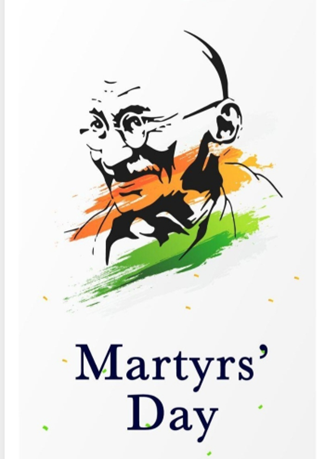
- Context: On 30 January 2026, the Supreme Court of India observed two minutes of silence at 11 am in honour of Indian freedom fighters on Martyrs’ Day, commemorating the assassination of Mahatma Gandhi.
- Martyrs’ Day is observed annually on 30 January, the death anniversary of Mahatma Gandhi.
- The ritual is a symbolic tribute to freedom fighters.
- Martyrs’ Day reflects remembrance of sacrifices for India’s independence.
- The practice unifies public institutions in memorial observance.
- Such national commemorations have constitutional and cultural value in Indian polity.
- It reinforces historical memory within India’s democratic framework.
(IE)
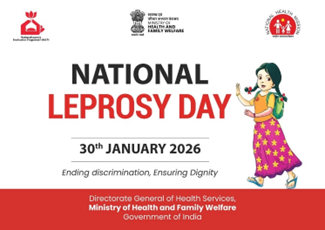
National Leprosy Day 2026:
-
- Context January 30 is observed as National Leprosy Day in India to raise awareness of leprosy (Hansen’s disease) and combat stigma attached to the disease.
- National Leprosy Day observed with outreach at Dilli Haat, New Delhi.
- Focus on Information, Education and Communication (IEC) outreach to educate public and reduce stigma.
- Leprosy remains curable but social exclusion persists in many communities.
- Government provides free treatment through National Leprosy Eradication Programme (NLEP).
- Early detection and MDT (Multidrug Therapy) are critical to prevent disability.
- Integration with general health services has improved access.
- International Day of Leprosy is observed on January 30 globally.
- India accounts for a significant proportion of global leprosy cases historically.
(PIB)
Spread the Word