Indian Society & Social Justice
EU’s Revised AMR Regulations Secured:
-
- Context: India secured continued market access for exports of animal-origin products under the European Union’s revised Antimicrobial Resistance (AMR) regulations.
- EU’s revised AMR regulations affect exports of meat, dairy, and other animal-origin products.
- India successfully negotiated continued market access for its exporters.
- AMR regulations aim to reduce antimicrobial use in livestock to curb resistance.
- Compliance includes surveillance systems, residue monitoring and stewardship plans.
- Market access is crucial for Indian dairy and poultry exports.
- Demonstrates India’s ability to shape technical trade standards globally.
- Agreement benefits exporters through greater predictability.
- Supports India’s GVC integration in animal-origin products.
- Links public health policy with trade policy.
- Shows importance of sanitary and phytosanitary (SPS) compliance in exports.
(PIB)
International Developments
India Joins BRICS Centre for Industrial Competencies:
-
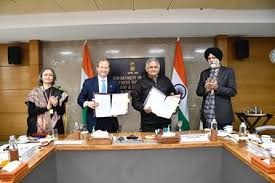
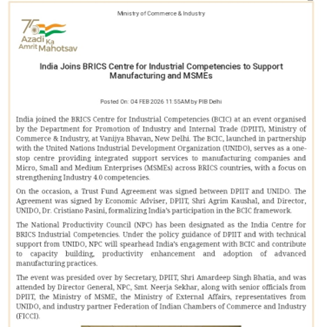
- Context: India officially joined the BRICS Centre for Industrial Competencies, aiming to enhance manufacturing and MSME capabilities within the BRICS framework.
- The BRICS Centre focuses on industrial competency development for member states.
- Objective: support manufacturing and MSMEs across BRICS economies.
- India’s membership underscores its Manufacturing and Economic Diplomacy push.
- Effort aligns with ‘Make in India’ and export competitiveness.
- Collaborative platform for skills, technology, market access.
- Encourages exchange on industry best practices.
- Strengthens South–South economic cooperation.
- MSMEs critical for employment and economic resilience.
- BRICS includes Brazil, Russia, India, China, and South Africa.
- Initiative complements India’s domestic industrial strategies.
(PIB)
Economy
Union Budget 2026–27: Chemical Parks Initiative:
-
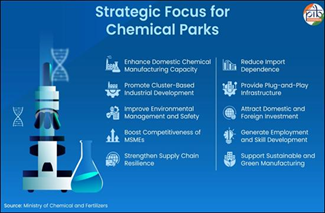
- Context: The Union Budget 2026–27 announced a new industrial initiative to establish dedicated Chemical Parks across India, aimed at strengthening domestic chemical manufacturing and enhancing global competitiveness.
- The Budget proposes support for three dedicated Chemical Parks through a challenge-based route.
- These parks will follow a cluster-based, plug-and-play model with shared utilities and standard environmental facilities.
- A budgetary allocation of ₹600 crore in Budget Estimate (BE) FY 2026-27 has been made for initial implementation.
- The initiative seeks to reduce import dependency in the chemicals sector.
- India ranks as the sixth-largest chemical producer globally and third in Asia.
- Chemical parks are expected to reduce project gestation timelines and costs through shared infrastructure.
- Parks will improve backward and forward integration across the chemical value chain.
- The initiative supports environmental management and industrial safety via common waste treatment and emissions controls.
- It complements existing cluster models such as Plastic Parks and Bulk Drug Parks.
- The initiative aligns with India’s broader manufacturing and export competitiveness goals.
(PIB)
Union Budget 2026–27: Strengthening India’s Textile Value Chain:
-
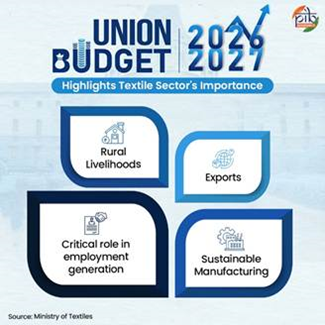
- Context: Budget 2026–27 places the textile sector at the centre of economic growth through structural support, employment focus, and global competitiveness emphasis.
-
- Budget prioritises textiles for employment, exports, and rural livelihoods.
- Focus on mega textile parks to modernise and scale infrastructure.
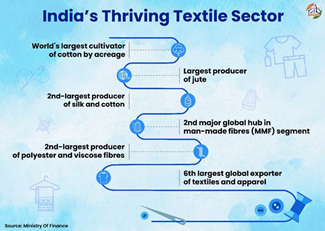
- Support for Man-Made Fibres (MMF) and technical textiles.
- MSMEs and artisans to get liquidity support, cluster modernisation, and skilling initiatives.
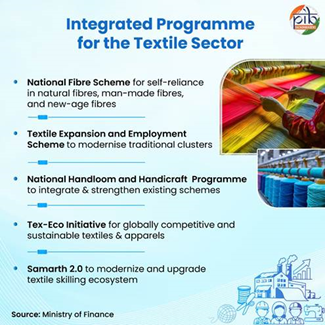
- National Fibre Scheme proposed to build self-reliance across natural and advanced fibres.
-
- National Handloom and Handicraft Programme strengthened to support artisans and market linkages.
- Technical textile production to be scaled for industrial and defence applications.
- Parks to encourage value addition and policy integration across states and sectors.
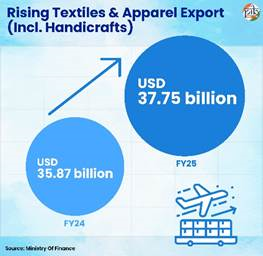
- Textiles identified as a key driver of export growth.
- Budget underscores sustainability and global competitiveness for the textile ecosystem.
(PIB)
Science & Technology
DRDO Successfully Demonstrates Solid Fuel Ducted Ramjet (SFDR) Technology:
-
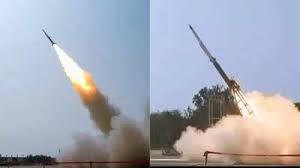
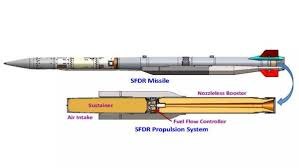
- Context: the Defence Research & Development Organisation (DRDO) successfully carried out a flight demonstration of Solid Fuel Ducted Ramjet (SFDR) Technology, a major milestone for India’s indigenous Missile programme.
-
- SFDR technology is a dual-mode air-breathing propulsion system for missiles.
-
- It enables sustained supersonic cruise phase by using atmospheric oxygen.
- Reduces dependence on onboard oxidiser compared with traditional solid-rocket motors.
- Critical for long-range and hypersonic missile systems.
- The technology is a stepping-stone towards Future Long-Range Missile Systems.
- Enhances fuel efficiency and range potential.
- Demonstration involved a successful test flight showing propulsion performance.
- Strengthens India’s Make in India defence credentials.
- Has strategic implications for air defence and strike capabilities.
- Complements ongoing indigenous programs like Pralay and Nirbhay families of missiles.
(TH)
Important data/facts
Economy
Agriculture & Farmers’ Welfare:
-
- Agri GVA grew 10.4% in 2024-25.
- Agriculture Infrastructure Fund supports post-harvest infrastructure through interest-subvented loans.
- Oilseed production expanded to 429.89 lakh tonnes.
- Timely availability of seeds and fertilisers guaranteed.
- MSPs fixed for 22 crops as per CACP recommendations.
- FPOs, SHGs supported to boost rural entrepreneurship.
- PMFBY allowed add-on cover for wild animal damage.
- Agri exports supported to boost global share.
- Budget increased agri sector outlays and rural support.
- Seeds/fertilizer measures address supply chain resilience.
(PIB)
Spread the Word