
Geography, Mapping, Ecology & Environment
Baikonur cosmodrome in Kazakhstan:
-
- World’s oldest and largest operational space launch facility.
- Located in Kazakhstan but leased and operated by Russia till 2050.
- Site of iconic launches: Sputnik-1 (1957) and Yuri Gagarin (1961).
- Located near the Baikonur city in southern Kazakhstan, on the steppes.
- Major hub for Soyuz crewed missions to the ISS.
- Symbol of Russia–Kazakhstan space cooperation.

(TH)
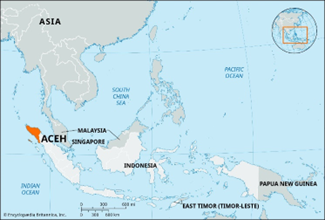
Aceh province:
-
- Located on Sumatra Island, Indonesia’s westernmost province.
- Sits along Sunda Arc, highly prone to mega-earthquakes and tsunamis (2004 Indian Ocean tsunami epicentre).
- Culturally distinct: Only Indonesian province allowed to implement Sharia law.
- Part of Strait of Malacca strategic zone → important for maritime security, piracy, and trade.
- Significant for India’s Act East and Indo-Pacific outreach due to proximity to Andaman–Nicobar.
(TH)
Great Nicobar Crake:
-
- Scientific Name: Rallina sp. (recently described, endemic to Great Nicobar Island).
- Status: Newly discovered/recorded species → significance for biodiversity mapping in Andaman & Nicobar.
- Habitat: Tropical rainforests, wetlands and understorey vegetation of Great Nicobar Island.
- Endemism: Strictly endemic to Great Nicobar (part of a global biodiversity hotspot).
- Conservation Concern:
- Located in an ecologically sensitive region prone to tsunamis, earthquakes, cyclones.
- The island is under pressure from infrastructure and developmental projects.
- Ecological Role: Indicator of healthy wetland & forest ecosystems.

(TH)
World Summit on Disaster Management, at Dehradun:
-
- The government is significantly strengthening disaster-forecasting and resilience infrastructure in Uttarakhand.
- Already three weather radars (at Surkanda Devi, Mukteshwar and Lansdowne) have been installed; three more radars at Haridwar, Pantnagar and Auli will soon be commissioned.
- Overall network expansion includes 33 meteorological observatories, 142 automatic weather stations (AWS), rain-gauges and district/block level rainfall monitoring aimed at improving early-warning and real-time forecasting.
- A specialised Himalayan climate-study programme has been launched to understand triggers of sudden events like cloudbursts / flash floods; the “Nowcast” 3-hour forecasting system is being expanded to this Himalayan region.
- It emphasised the increasing risks in the region — due to retreating glaciers, glacier-lake outburst risks, fragile Himalayan ecology, deforestation, and man-made encroachments — leading to frequent cloudbursts and flash floods.
- There is also a push to convert Himalayan vulnerabilities into opportunities: promoting agri-startups and science-led value-addition models via CSIR to boost livelihoods in mountain regions.
- The government frames disaster preparedness and climate adaptation not only as humanitarian necessity, but as critical for sustainable economic growth and resilience — aligning with broader climate commitments.
(PIB)
Science & Technology
Butterfly Nebula (NGC 6302):
-
- It is a bipolar planetary nebula located in the constellation Scorpius, ~3,800 light-years from Earth.
- Formed from the ejected outer layers of a dying Sun-like star; shows a distinct two-lobed “butterfly-wing” structure.
- Contains one of the hottest central stars known, with surface temperatures estimated around 220,000–250,000°C.
- The bipolar shape is caused by fast stellar winds interacting with a dense equatorial dust torus, restricting outflow to the poles.
- Observed in detail by Hubble Space Telescope and James Webb Space Telescope (JWST), giving insights into late stellar evolution.

(TH)
Spread the Word